Hello. This is Daily Stock, delivering swift and clear insights on global macro trends and core valuations of big tech companies.
The first major public appearance of the new leader of U.S. monetary policy is just around the corner.
Market participants are meticulously calibrating the new relationship between technological innovation and interest rates.
[Image: /stdaily/uploads/202608/gen_6a8a386248e9a8.48765330.png]
Core Summary
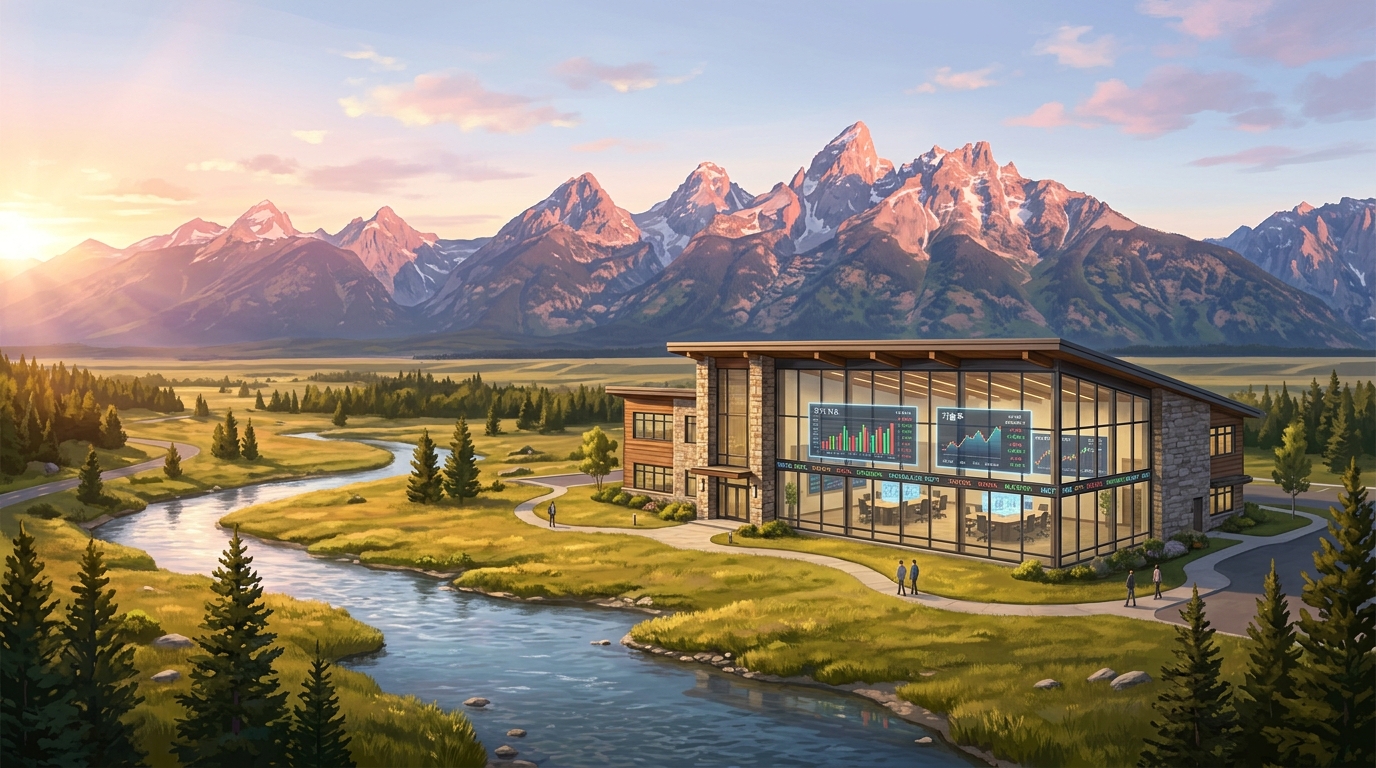
From August 27 to 29, 2026, the 2026 Jackson Hole Economic Policy Symposium will be held in Wyoming under the theme "Financial Innovation: Implications for Payments and Policy."
This meeting is expected to be a milestone for global monetary policy, featuring the first Jackson Hole keynote speech by Kevin Warsh, the new Federal Reserve Chair who succeeded Jerome Powell.
Meanwhile, Amazon (AMZN), a representative big tech high-CapEx company, is leading the market on the back of accelerated growth in its massive cloud service, AWS.
However, as Amazon revised its 2026 capital expenditure target upward from $200 billion to $220 billion, the valuation sensitivity of Nasdaq growth stocks to long-term interest rate volatility has once again come under scrutiny.
Current Status Summary
As of today (2026-08-23), the Nasdaq Index closed at 26,180.46, showing a strong wait-and-see stance ahead of U.S. macroeconomic indicators and the upcoming Fed Chair's policy direction.
In the domestic market, the KOSPI closed at 6,912.95, the KOSDAQ at 801.94, and the USD/KRW exchange rate reached 1,388.00 KRW, as investors monitor macroeconomic variables.
According to Daily Stock's proprietary Fear & Greed Index, the Nasdaq Fear & Greed Index is currently in the Neutral (55.2) stage. The heat from a week ago (Greed at 64) has cooled down due to caution ahead of Jackson Hole.
For reference, the domestic KOSPI Fear & Greed Index is currently Neutral (55.4), compared to Neutral (50.9) a week ago, Extreme Fear (12.8) a month ago, and Neutral (57.1) three months ago, representing a typical wait-and-see buying stance.
The market is entirely focused on how Chair Kevin Warsh will transition away from the previous strict "forward guidance" policy and whether he can ease upward pressure on Treasury yields.
Financial Analysis
According to Amazon's Q2 2026 earnings release, total quarterly revenue grew 20% year-over-year to $200.06 billion, successfully exceeding the $200 billion quarterly mark for the first time in the company's history.
The main driver for the quarter was AWS, its cloud infrastructure division, which surpassed $42.2 billion in revenue and achieved an explosive growth of 36.7%—proving its highest acceleration rate in 18 quarters.
| Metrics | Amazon (AMZN) | Microsoft (MSFT) | Alphabet (GOOGL) |
|---|---|---|---|
| **Stock Price (2026-08-21 Close)** | $258.63 | Price not confirmed on the day | Price not confirmed on the day |
| **Forward P/E** | Approx. 23x | Maintains higher multiple than Amazon | Mid-to-low 20s range |
| **Quarterly Cloud Growth** | 36.7% (AWS) | Mid-30% range (Azure) | Late-20% range (Google Cloud) |
| **2026 Annual CapEx Guidance** | Approx. $220 billion | Value not confirmed on the day | Approx. $195B to $205B |
Nevertheless, as the company revised its annual capital expenditure guidance to $220 billion to aggressively build AI infrastructure, its trailing twelve months (TTM) free cash flow (FCF) temporarily dipped into negative territory (-$7.6 billion) due to cumulative CapEx growth.
Unlike past instances where stock prices fell when capital expenditures increased, this time CEO Andy Jassy demonstrated structural health by sharing detailed metrics, stating that "the payback period for server investment is under three years, and the useful life of the overall infrastructure spans decades."
[Image: /stdaily/uploads/202608/gen_6a8a386e260947.80485330.png]
Valuation
Amazon's stock price currently sits at $258.63, pulling back slightly from its previous peak (near $290) achieved during the earnings surprise.
Despite short-term profit-taking, its Forward P/E remains anchored at approximately 23x, maintaining a relatively high valuation discount compared to its growth speed.
However, the 10-year U.S. Treasury yield (US10Y) and the possibility of prolonged Fed tightening still pose a significant headwind to valuing the future cash flows of capital-intensive companies like Amazon.
If the Fed signals a long-term hawkish stance at the Jackson Hole meeting, rising debt burdens and financing costs to support high interest rates could pressure Amazon's multiple.
Expert & Institutional Analysis
MUFG, a global financial research institution, assessed that even if the Fed observes a short-term slowdown in economic indicators, it is unlikely to take an immediate, clear monetary easing stance.
With persistent inflationary sparks such as Middle East conflict risks and rebounding oil prices, Kevin Warsh is highly likely to maintain a "Hawkish Hold" and freeze interest rates for the remainder of the year.
Major global asset managers are expressing deep confidence in Amazon's demonstrated "balance between investment execution and monetization."
However, they advise closely tracking supply chain bottlenecks, as a valuation de-rating could occur if cloud gross margins hit a short-term ceiling or subscriber growth slows down.
Risk Factors
The most critical risk to watch is the rising opportunity cost of AI infrastructure capital expenditures and delayed monetization.
If Amazon's custom silicon (Trainium, Graviton) initiatives fail to achieve expected customer penetration, and alternative costs for Nvidia chips continue to accumulate, the timeline for FCF normalization will be pushed back.
Additionally, if the upward trajectory of U.S. Treasury yields overshoots uncontrollably, the discount rates for all mega-cap tech stocks building data centers with long-term financing will face broad pressure.
Noises such as regulatory bills and comprehensive antitrust pressure from state and federal authorities could also act as downside risks for corporate revaluation.
Investment Perspective Summary
The essence of the 2026 Jackson Hole Economic Policy Symposium lies not merely in predicting rate cuts or hikes, but in discussing the mid-to-long-term impact of financial technology innovation and evolving payment systems on monetary policy design.
During this period of transition in the Fed's framework, the stock price movement of Amazon, which commands a massive hardware ecosystem, can serve as an excellent compass.
If multiple contraction continues due to short-term macroeconomic uncertainties, dragging the Forward P/E down to historically extreme lows in the low-20s, it will present a conditional buying opportunity for this mega-cap stock backed by a solid cloud cash cow.
Investor Checklist Q&A
Q1. When exactly does the 2026 Jackson Hole meeting take place, and what is the most critical time for global investors to watch?
A1. The meeting runs from August 27 to 29 (local time). Fed Chair Kevin Warsh's keynote speech is scheduled for Friday, August 28, at 11:00 PM KST, meaning analytical reports will flood the market over the weekend after the Korean stock market closes.
Q2. Why is the theme of this year's meeting, "Financial Innovation," important for the overall Nasdaq?
A2. If policies favoring the advancement of financial systems—such as payment innovation and digital asset integration—are established, it could bring regulatory flexibility not only to fintech stocks but also to tech companies driving high-performance cloud payment networks, acting as a positive factor for multiple expansion.
Q3. Is Amazon's annual CapEx increase to $220 billion a long-term negative?
A3. In the short term, free cash flow (FCF) temporarily turned negative, raising concerns over increased borrowing. However, because the opportunity income from facilities and maximized server depreciation are proven to drive AWS's annual revenue growth of 36.7%, its long-term growth potential remains intact.
Q4. What direct impact will Amazon's stock face if the U.S. interest rate path shifts toward a delayed cut scenario?
A4. If rates are held steady amid fears that cuts could be delayed until early 2027, the future discount rate will rise. This could cause valuation volatility by inflicting the pain of rising long-term financing costs on growth stocks.
Q5. How should investors approach the market while the Nasdaq Fear & Greed Index is currently in the "Neutral" stage?
A5. Since buying momentum has cooled from previous overheated levels due to pre-Jackson Hole caution, investors should avoid rushed, concentrated allocations. It is a time to diversify exposure after confirming the interest rate risks from the meeting and Nvidia's guidance results.