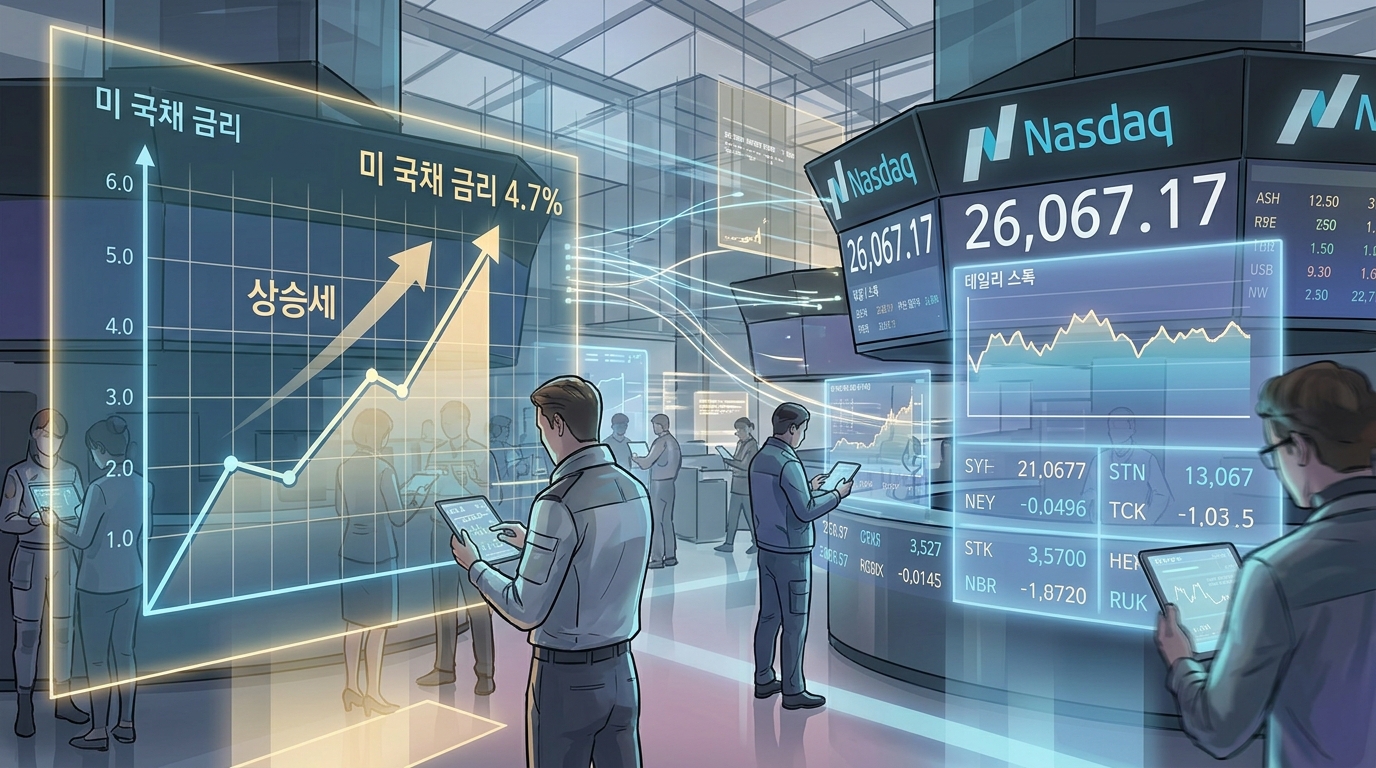
Hello, this is Daily Stock. Today, we will conduct an in-depth analysis of the complex interactions between U.S. Treasury yields and core real economic indicators, and how they impact the technology-heavy Nasdaq market.
[Image: /stdaily/uploads/202608/gen_6a879562eb2a20.22426223.png]
Key Summary
- The 10-year U.S. Treasury yield (US10Y) rebounded slightly during intraday trading to around 4.697%, attempting to re-enter the 4.7% range.
- July Consumer Price Index (CPI) slowed to 3.4% YoY, and Producer Price Index (PPI) came in flat (0.0%) MoM, showing that inflationary pressures are easing.
- On the other hand, July retail sales plunged by 0.6% MoM, raising concerns over a consumer slowdown and unfolding a "Two-speed Economy" scenario.
- Amid a prolonged high interest rate environment, market attention is focused on whether the aggressive AI capital expenditures (CAPEX) of the Magnificent Seven (M7) big tech companies can serve as a key support line to defend valuation multiples.
Summary of Current Situation
Recently released inflation indicators in the U.S. are showing signs of stabilization.
July headline CPI rose 3.4% YoY, moderating from the previous month (3.5%), and core CPI also decreased to 2.5%.
Producer prices (PPI) also came in flat (0.0%) MoM and rose 4.7% YoY, suggesting that upward pressure has eased.
However, July retail sales, a leading indicator of the real economy, dropped -0.6% MoM, significantly missing the market expectation of 0.1% and warning of weakening consumer strength.
Although this has somewhat cooled the possibility of further monetary tightening, policy uncertainty remains as hawkish members within the Federal Reserve still favor rate hikes.
The 10-year U.S. Treasury yield is trading slightly higher around 4.697%, driven by a combination of concerns over the Fed maintaining its tight monetary stance and oil prices rebounding due to visible tensions in the Middle East.
[Image: /stdaily/uploads/202608/gen_6a87956c6baf94.70030241.png]
As of today's intraday (provisional) session, domestic markets, the Nasdaq, and the USD exchange rate are recorded as follows:
| Index / Exchange Rate | Intraday Provisional Figures | Key Trends / RSI / Daily Change |
|---|---|---|
| **KOSPI** | 6,769.48 | Ongoing volatility management phase |
| **KOSDAQ** | 826.27 | Selective movements centered on small-to-mid caps |
| **NASDAQ** | 26,067.17 | Profit-taking centered on Big Tech amid high interest rate pressure |
| **KRW/USD** | 1,392.00 KRW | Strong dollar pressure due to prolonged high interest rates |
According to our proprietary Fear & Greed Index, the KOSPI Fear & Greed Index is currently Neutral (51.5), compared to Neutral (50.5) one week ago, Extreme Fear (17.3) one month ago, and Neutral (58.1) three months ago.
The Nasdaq Fear & Greed Index is currently recording Neutral (52.5), seeking stabilization from a structure of Greed (66.6) one week ago, Fear (37.9) one month ago, and Neutral (55.9) three months ago.
Financial Analysis
With the 10-year U.S. Treasury yield reaching 4.7%, the corporate financial health of tech companies is significantly more robust than during past rate-hiking cycles.
The average net debt ratio of S&P 500 growth companies and Nasdaq 100 constituents remains well-controlled, and their vast holdings of cash and cash equivalents keep short-term default risk very low.
However, because big tech companies' annual AI infrastructure capital expenditure (CAPEX) is projected to surpass $800 billion combined, the rising cost of capital and opportunity cost in a high interest rate environment have emerged as financial burdens.
As the 10-year Treasury yield—the benchmark for funding costs—remains high, the net present value (NPV) of massive investments is discounted further, intensifying the pressure to quickly monetize AI investments.
Valuation
A 4.7% Treasury yield acts as strong downward pressure, forcing a downward adjustment of price-to-earnings (P/E) multiples for growth stocks.
This is because as the expected return on risk-free Treasury bonds rises, the required return on the stock market (Equity Risk Premium) also increases.
Currently, the forward P/E of the Nasdaq 100 index remains high compared to its historical average, meaning it possesses vulnerability that could lead to sharp price volatility even with minor macroeconomic shocks.
In particular, the Nasdaq index maintaining the 26,067.17 level despite the shock of a -0.6% retail sales figure (which signals a real economic slowdown) is analyzed as a result of expectations for AI-driven productivity improvements supporting valuation multiples from below.
[Image: /stdaily/uploads/202608/gen_6a8795763e9c14.77889527.png]
Expert and Institutional Analysis
Investment banks (IBs) and major macroeconomic research institutions are deeply analyzing the scenario of the 10-year U.S. Treasury yield settling in the 4.7% range and high interest rates staying "higher for longer."
J.P. Morgan projected that following the Federal Reserve's July decision to freeze rates (3.50% to 3.75%), a divergence emerged as three hawkish members argued for a hike, which could lead to an additional 25bp hike near the end of the year.
Conversely, some macro research institutions interpret that despite high oil price concerns, if July employment indicators (-23,000 jobs) and the retail sales slump persist, the Fed will eventually abandon further tightening and keep rates frozen.
The Conference Board reported that the Leading Economic Index (LEI) rose 0.2%, turning positive for the first time in six months, but raised concerns over slowing consumption among low- and middle-income families due to high inflation and high interest rates.
Ultimately, institutions believe the future engine of economic growth is highly likely to transition into a "dual economic structure" driven by big tech's massive AI-related business investments rather than household consumption.
Risk Factors
First, concerns over delayed return on investment (ROI) for AI.
Companies are continuing massive CAPEX, but if tangible revenue growth and margin improvements do not materialize, multiples could contract rapidly under a high Treasury yield environment.
Second, the potential for Stagflation.
With oil prices showing upward pressure due to geopolitical instability in the Middle East and tensions in the Strait of Hormuz, while consumption indicators are slowing down, the dilemma of high inflation and low growth poses a fatal risk to Nasdaq valuations.
Third, widening VIX volatility due to monetary policy uncertainty.
Even if volatility in U.S. Treasury yields is temporarily controlled through treasury buyback programs, anxiety over reigniting inflation and divided opinions among Fed members will test the broader financial market's resilience.
Investment Outlook Summary
Investing in the Nasdaq in a 4.7% interest rate era requires a conditional scenario approach that differs from models used during traditional periods of liquidity expansion.
If inflation cools slower than the pace of slowing retail sales, high real interest rates will persistently pressure the valuation of growth stocks across the board.
Therefore, rather than high-multiple tech stocks driven purely by expectations, a reasonable strategy would be to focus on ultra-large big tech companies that have proven earnings visibility, sufficient capital, and are free from the impact of high interest expenses.
As this is a volatile market where Treasury yields swing based on macroeconomic data, a wise approach combining fractional buying and portfolio diversification is highly recommended.
Investor Checklist Q&A
Q1. If the 10-year U.S. Treasury yield nears 4.7%, will Nasdaq stocks unconditionally fall?
A1. Not necessarily. While rising Treasury yields apply discount rate pressure on multiples, if robust corporate earnings and growth potential from AI infrastructure expansion overwhelm this pressure, stock prices can still trend upward in a conditional manner.
Q2. What is the practical implication of the -0.6% drop in July retail sales on the stock market?
A2. It signifies a decline in household consumption strength, raising short-term worries of an economic slowdown. At the same time, it serves as a double-edged sword by weakening the Fed's justification for additional monetary tightening, thereby supporting expectations for policy relief.
Q3. Why are Treasury yields not falling despite slowing Consumer (CPI) and Producer (PPI) prices?
A3. Although inflation data is moderating, yields are supported by selling pressure driven by concerns over sustained high oil prices, split stances among Fed officials regarding rate adjustments, and geopolitical tensions in the Middle East.
Q4. What are the key economic indicators to watch closely in this macro environment?
A4. It is crucial to monitor upcoming U.S. Personal Consumption Expenditures (PCE) price index, energy price trends, and labor indicators like weekly jobless claims to gauge the critical thresholds of consumption and employment.
Q5. What is a rational asset allocation strategy for investors in this environment?
A5. A valid strategy is to consolidate holdings around large-cap tech companies with outstanding cash flow generation, while keeping a portion of assets in yield-bearing high-interest vehicles or short-term bonds to hedge against sudden market multiple corrections.