Hello. This is Daily Stock, precisely analyzing key trends in the US stock market and global financial markets.
[Image: /stdaily/uploads/202608/gen_6a83a0fc3b7344.41824406.png]
Key Summary
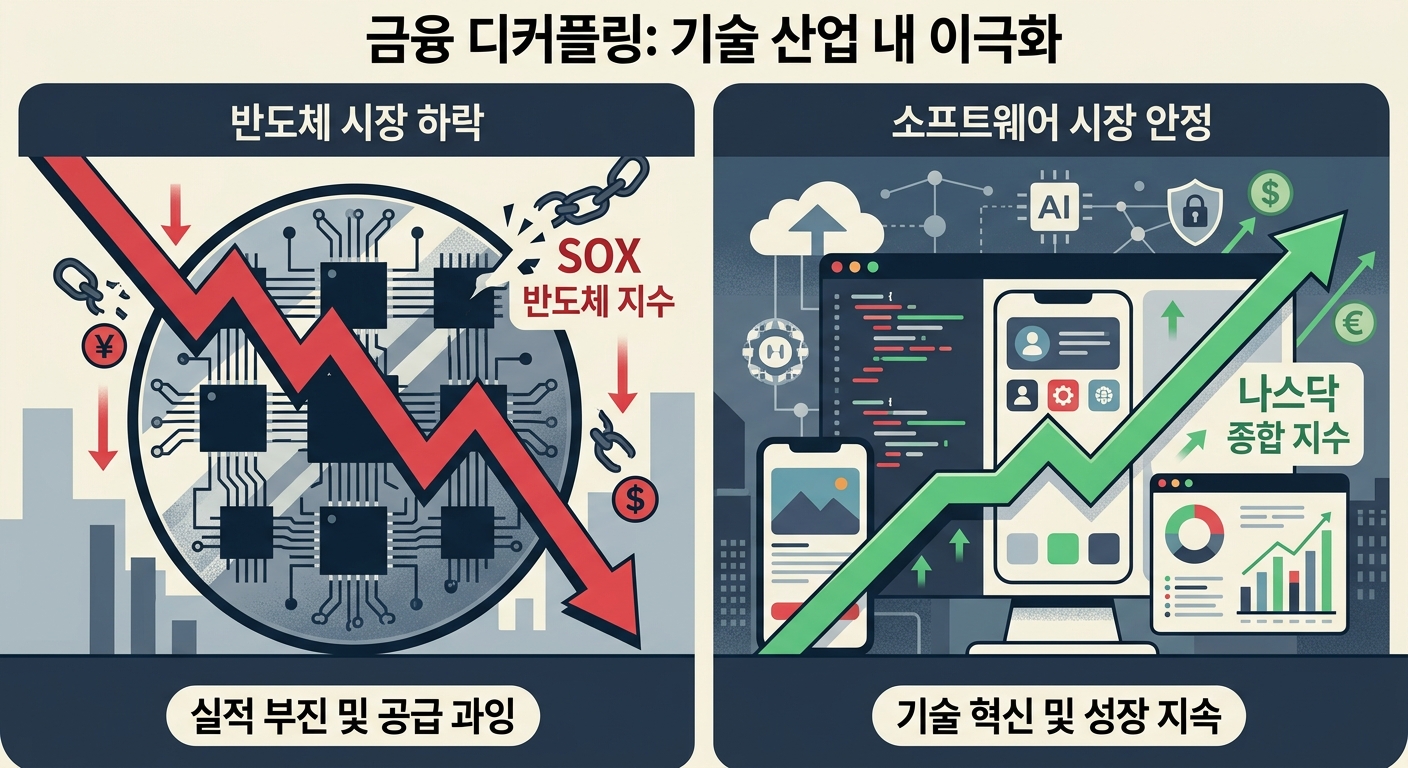
- **Deepening Decoupling**: In 2026, while the Philadelphia Semiconductor Index (SOX) shows extreme downward volatility, the Nasdaq Index is maintaining a relatively solid flow thanks to the defensive power of non-semiconductor Big Tech and the software sector, highlighting a clear decoupling phenomenon.
- **Silicon vs. Application**: The hardware-manufacturing-centered 'Silicon Layer', which directly benefited from capital expenditures (CapEx), entered a technical correction due to valuation burdens and concerns over prolonged high interest rates. Meanwhile, the 'Application Layer' commercializing AI technology is increasing its market attractiveness based on its independent cash-generating power.
- **Difference in Macro Sensitivity**: High oil price concerns stemming from Middle East geopolitical risks and upward pressure on the US 10-Year Treasury Yield (US10Y) hit the energy-intensive semiconductor foundry ecosystem harder, acting as a key trigger to widen the gap between the indices.
---
Market Overview
As of intraday on August 18, 2026 (tentative), domestic and international financial markets are showing a clear temperature difference.
KOSPI is recording 7,143.32, and KOSDAQ is at 866.76.
The Nasdaq Index, a benchmark for global tech stocks, is fluctuating around the 26,644.91 level, and the USD/KRW exchange rate is seeing increased volatility at 1,415.00 KRW.
Amidst these movements, looking at Daily Stock's proprietary Fear & Greed Index allows us to gauge market sentiment defenses in real-time.
Currently, the KOSPI Fear & Greed Index is in the Neutral phase (55.6), showing a recovery in sentiment from Extreme Fear (17.5) a week ago and Extreme Fear (11.6) a month ago.
On the other hand, the Nasdaq Fear & Greed Index currently stands at Neutral (60), stepping back slightly from the Greed phase (64.7) a week ago but maintaining a stable flow compared to the Fear level (37.2) a month ago.
The unique 'decoupling' market trend—where overall tech stock fear does not spread despite the recent sharp volatility of the Philadelphia Semiconductor Index (SOX)—is a major backdrop for the Nasdaq sentiment holding onto Neutral.
| Index and Indicator Category | Value as of Aug 18, 2026 Intraday (Tentative) | Recent Market Sentiment Phase (Fear & Greed) | Key Macro Sensitivity Factor |
|---|---|---|---|
| **KOSPI** | 7,143.32 | Neutral (55.6) | Exchange rate volatility and Asian IT supply/demand |
| **NASDAQ** | 26,644.91 | Neutral (60.0) | US 10-Year Treasury yield, Big Tech earnings |
| **Philadelphia Semiconductor (SOX)** | 12,745.0 (Daily quote unconfirmed) | Technical correction and widening volatility | Foundry operating costs, CapEx sustainability |
| **USD/KRW Exchange Rate** | 1,415.00 KRW | Widening FX market volatility | US Fed rate outlook, Middle East geopolitical risk |
---
Financial Analysis
Recently, the financial functional relationship between semiconductor companies and general platform Big Tech companies has completely broken away from the past one-way synchronization formula.
While the capital expenditure (CapEx) scale of hyperscalers like Microsoft, Alphabet, and Meta continues to expand, the market has now begun to focus not simply on 'how many chips they buy' but 'how they generate profits by buying chips.'
Nvidia, Broadcom, and ASML, which are at the forefront of the semiconductor value chain, have continued to break all-time high earnings records. Yet, their stock prices showed an unusual trend of plunging at the time of the announcements.
This is because infrastructure construction costs were excessively pre-reflected, raising concerns about margin deterioration.
On the other hand, software and platform companies with high Free Cash Flow (FCF) ratios on their balance sheets and relatively less hardware capital expenditure burden are executing stable cash returns based on solid operating profit margins.
As a result, even if temporary bottlenecks or unit price adjustments occur in semiconductor equipment or memory chip supply chains, a financial defense mechanism is working so that the earnings fundamentals of the overall Nasdaq are not significantly damaged.
[Image: /stdaily/uploads/202608/gen_6a83a1054cf6d7.56632358.png]
---
Valuation
From a valuation perspective, the multiple re-rating of the SOX Index and the Nasdaq 100 Index is starkly diverging.
Until recently, the Forward Price-to-Earnings (Forward PER) ratio of the constituent stocks of the SOX Index was granted an excessive Artificial Intelligence (AI) premium, greatly exceeding its historical ceiling of 35x.
However, as they entered a technical bear market with a drop of about 25% from their recent peaks, the Forward PER of core chip stocks, including Nvidia, is rapidly returning to levels below their past 5-year averages.
An interesting point in this correction process is that in 2026, the number of days the SOX Index plummeted by more than 3% in a single day reached 24 times, far exceeding the historical annual average of 14 times.
While the semiconductor sector experiences such extreme multiple de-rating, the Nasdaq Index maintains a stable multiple.
This is because device platform leaders like Apple and high-margin cloud services like Microsoft are successfully offsetting the semiconductor declines in terms of index weight.
Consequently, the path of extreme semiconductor stock price volatility infecting the entire Nasdaq market is being partially blocked.
---
Expert & Institutional Analysis
Wall Street and global investment institutions cautiously evaluate the recent decoupling as a positive process of 'market breadth diversification' that improves market health.
Global market research firms analyze that rather than a crack in the fundamentals of the semiconductor industry itself, it is closer to a healthy Mean Reversion period where investors' expectations, which had run too far ahead, are returning to reality.
Some global investment banks (IBs) emphasized, "The majority of S&P 500 and Nasdaq constituents do not manufacture AI chips, but are located in the software sector that applies them to control costs and increase efficiency."
They explained that due to these structural characteristics, even if semiconductor chip operation or supply control risks occur, margin profits in the application area can actually be defended.
In addition, seasonal factor analysis suggests that the period from late summer to autumn has historically been a weak period for the semiconductor index.
Experts suggest that rather than fearing a temporary index collapse, investors should use the period when multiple attractiveness is restored after the seasonal autumn correction as an opportunity to rebuild long-term portfolios.
---
Risk Factors
Although the decoupling with the Nasdaq suppresses the contagion of semiconductor volatility, systemic risk factors that cannot be ignored still remain.
- **Concerns over Delayed AI Monetization**: If hyperscalers reduce long-term capital expenditure budgets or adjust their pace, this could lead to valuation contraction across the software infrastructure ecosystem, not just the silicon layer.
- **Geopolitical Conflicts and Supply Chain Costs**: Continued tension in the Middle East and the resulting oil price volatility continue to increase the operating cost burden of global foundry Fabs that consume massive amounts of power.
- **Retreat of Interest Rate Expectations**: If the US 10-Year Treasury Yield remains high due to stronger-than-expected inflation indicators, it could limit the upside of tech stocks overall, which have been granted high multiples based on long-term growth potential.
---
Investment Outlook Summary
Keep in mind that the dominant market paradigm may have reached an inflection point, shifting from a hardware expansion phase to an actual value-creation phase.
Rather than blindly following only the rebound of the Philadelphia Semiconductor Index as in the past, a strategy of diversifying portfolios into companies that maximize capital efficiency within the Nasdaq is advantageous at this stage.
Instead of being shaken by short-term index plunges, investors need to precisely track individual companies' free cash flows and whether their actual AI business models are working.
For the semiconductor sector under strong correction pressure, a split-purchase perspective should be maintained, balanced with positioning that considers relative strength scenarios for high-value-added software and platform leaders.
---
Investor Checklist Q&A
Q1. What is the fundamental reason for the decoupling between the SOX Index and the Nasdaq?
A1. While the silicon manufacturing sector to which semiconductor companies belong is exposed to massive infrastructure cost burdens and supply chain bottleneck risks, the service and software companies that make up the majority of the Nasdaq have strong unique cash flows and flexible cost-handling capabilities, resulting in differing stock price trends.
Q2. What is the macro background behind the sharp increase in the number of plunges of the SOX Semiconductor Index in 2026?
A2. As energy costs rose due to global geopolitical conflicts and upward pressure on the US 10-Year Treasury Yield persisted, the volatility of semiconductor stocks that had been granted excessive multiples was stimulated much more sharply than the historical average.
Q3. The earnings of semiconductor hardware companies are at an all-time high, so why did the stock prices correct?
A3. Because market expectations were reflected far ahead of the actual speed of earnings growth. Even if earnings were announced positively, if doubts arose regarding future guidance uncertainty or CapEx sustainability, profit-taking sell-offs repeatedly poured out.
Q4. What is the secret of the Nasdaq 100 Index showing a certain level of defense despite the semiconductor slump?
A4. The strong capital power of hyperscalers, who are the subjects of infrastructure cost investment, and the stable profit growth of large non-semiconductor stocks (platforms, healthcare, consumer tech, etc.) are supporting the bottom of the index.
Q5. What indicators should be prioritized regarding the semiconductor sector in the future?
A5. You must check whether major Big Tech companies change their semi-annual and quarterly capital expenditure (CapEx) plans, trends in energy unit prices at foundry hubs, and whether the US 10-Year Treasury Yield stabilizes.
---