Hello, this is Daily Stock.
[Image: /stdaily/uploads/202608/gen_6a824f6f120e00.63146989.png]
Key Takeaways
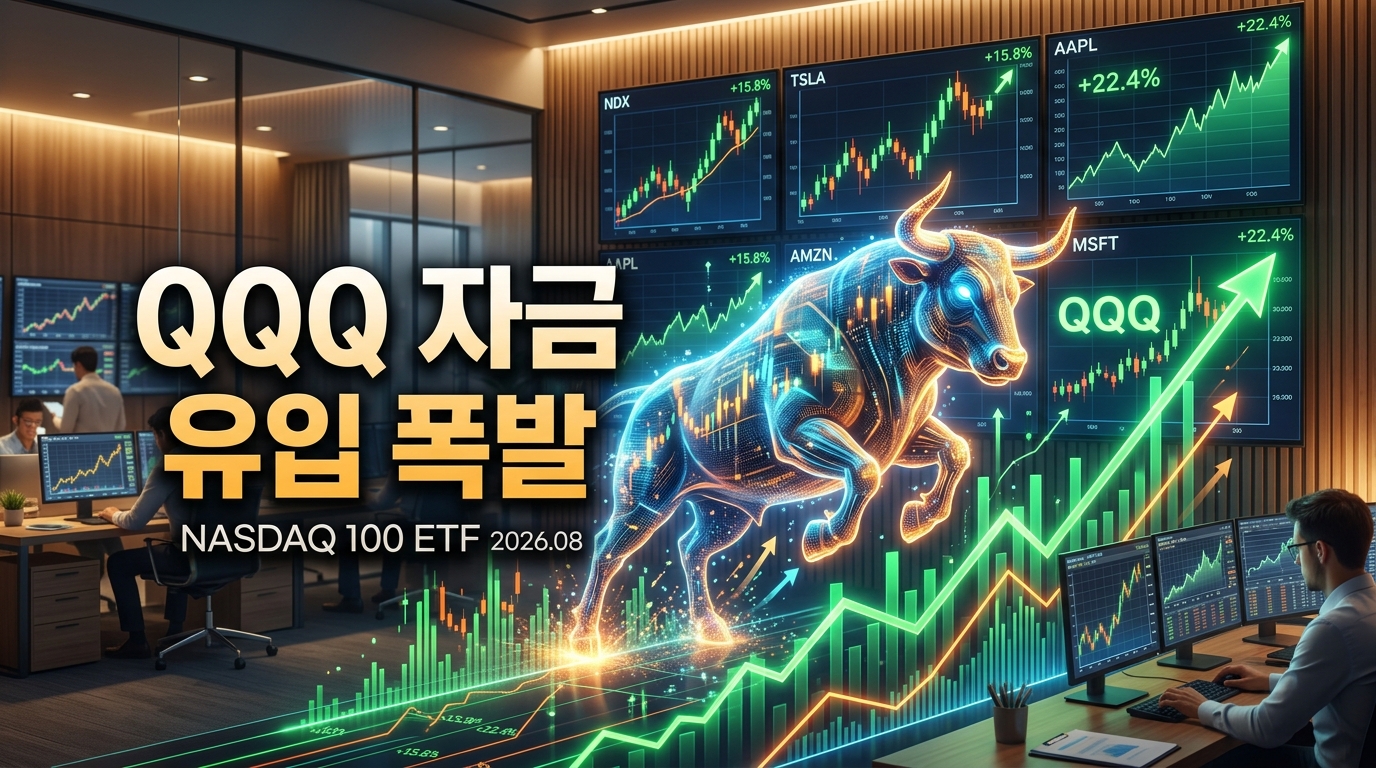
- **Massive Capital Surge in Past Two Weeks**: QQQ, the leading ETF tracking the Nasdaq 100 Index, experienced a record-breaking net inflow of approximately $14.5 billion in just two weeks starting in early August.
- **Beneficiary of Semiconductor Profit-Taking**: Investors have been taking profits from highly volatile semiconductor-themed ETFs (such as SOXX and SMH) and shifting their portfolios into the relatively stable, big tech-focused QQQ.
- **Challenge from New Low-Fee ETFs**: BlackRock and State Street have launched new low-cost Nasdaq-tracking ETFs with 0.10% fees, signaling a fierce market share war against the traditional heavyweight QQQ (0.18% fee).
Market Overview
As of today's trading session (August 17, 2026, tentative), the Nasdaq index stands at 26,729.16 points, while the USD/KRW exchange rate has reached 1,418.00 KRW.
According to Daily Stock's Fear and Greed Index, the Nasdaq is currently in the 'Greed (65)' phase. This indicates that market buying sentiment remains robust despite concerns over high valuations, compared to 'Greed (64.4)' a week ago and 'Neutral (41.1)' a month ago.
In August, the U.S. stock market hovered near record highs, buoyed by solid earnings season results and a rebound in artificial intelligence (AI) trades.
During this period, QQQ, the flagship proxy for the Nasdaq 100 index, absorbed $10.18 billion in the first week of August and $4.29 billion in the second week, proving the strong resilience of tech-focused demand.
In particular, a net inflow of about $4.95 billion occurred in a single day in early August, showing that both institutional and retail investors are continuing to place heavy bets on the long-term growth of big tech.
This is interpreted as a combination of dip-buying and portfolio restructuring following the deep correction in the semiconductor sector in July.
Financial Analysis
It is worth closely examining the asset size (AUM), portfolio structure, and expense structure of the QQQ ETF.
As of August 2026, QQQ's Assets Under Management (AUM) reached approximately $481 billion, while its sister fund, QQQM, boasts a massive scale of $102 billion.
Beyond being a simple tech fund, it has established itself as a core benchmark for global stock markets and a gigantic pool of liquidity.
| Item | Invesco QQQ Trust (QQQ) | Invesco NASDAQ 100 ETF (QQQM) | iShares Nasdaq 100 ETF (IQQ) | SPDR Portfolio Nasdaq 100 ETF (QNDX) |
|---|---|---|---|---|
| **Assets Under Management (AUM)** | Approx. $481 billion | Approx. $102 billion | Newly Launched | Newly Launched |
| **Expense Ratio (Fee)** | 0.18% | 0.15% | 0.10% | 0.10% |
| **Key Features** | High volume & liquidity | Low-cost alternative for long-term investors | Ultra-low fee competitor | Ultra-low fee competitor |
QQQ portfolio companies invest an average of 11.8% of their revenue into research and development (R&D), significantly outperforming the S&P 500 average (9.4%) and the average of non-QQQ companies (1.7%).
This strong R&D spending translates into securing patents for future innovations and building high-value business models, serving as a core driver supporting long-term fundamentals.
Valuation
The recent capital inflows are closely tied to the positive visibility of the earnings season.
As big tech companies' AI-related capital expenditure (CAPEX) begins to translate into tangible revenue and margin improvements, a process of justifying Nasdaq 100 multiples (P/E) is underway.
However, the persistent high level of the 10-year US Treasury yield (US10Y) continues to exert discount pressure on tech valuations.
With the USD/KRW exchange rate high at 1,418.00 KRW, domestic investors must also keep in mind the distortion of returns when converted to KRW due to the 'currency effect.'
Currently, while acknowledging the valuation risks of large-cap growth stocks, the market is fostering an environment where buying is favored due to the lack of viable alternatives and strong long-term fundamentals.
[Image: /stdaily/uploads/202608/gen_6a824f76b26e12.23594423.png]
Analyst and Institutional Insights
A team of analysts led by Jefferies global strategist Steven DeSanctis noted in a recent report, "Investor confidence in QQQ remains steadfast despite market-wide volatility."
The consecutive net inflows indicate that structural demand to reposition portfolios around big tech is supporting the market, moving beyond mere short-term trading.
ETF analysis firms VettaFi and Morningstar are focusing on how the fee-cutting competition will reshape the market landscape.
This comes as BlackRock launched the 'iShares Nasdaq 100 ETF (IQQ)' with a 0.10% fee, and State Street countered with the 'SPDR Portfolio Nasdaq 100 ETF (QNDX)' also priced at 0.10%.
Experts analyze that while this low-cost competition could eat into QQQ's market share in the short term, QQQ’s overwhelming daily trading volume and tight spreads remain indispensable tools for institutional investors.
Risks to Watch
However, there are potential risk factors that investors must remain vigilant about.
First is the possible delay in the monetization of AI investments.
While big tech companies are pouring astronomical amounts of cash into AI infrastructure, valuation downside pressure could mount rapidly if actual software and cloud revenue contributions fail to meet expectations.
Second is the potential pullback in Fed rate-cut expectations and volatility in the Dollar Index (DXY).
If the timing of rate cuts is delayed or inflation shows signs of rebounding, the Nasdaq 100—with its high concentration of high-multiple tech stocks—is highly susceptible to a spike in the Volatility Index (VIX) relative to other indices.
Third is the reallocation risk among asset managers due to fee competition.
If retail capital focused on long-term accumulation quickly shifts to IQQ or QNDX, which are about 0.08% percentage points cheaper, the net liquidity growth of QQQ itself could slow down.
Investment Perspective
In conclusion, the record-breaking capital inflows into QQQ concentrated in August highlight the market’s strong confidence in the mid-to-long-term innovation drivers of big tech.
In the short term, liquidity rotating out of individual sectors like semiconductors is flowing into index ETFs, acting as a buffer.
However, given the intensifying competition from new low-cost ETFs and high Treasury yields, a cautious approach utilizing a split-purchase strategy is advised.
Rather than blindly following trends, investors would do well to maintain portfolio resilience by observing quarterly guidance of individual big tech names and micro-level AI monetization trends from multiple angles.
Frequently Asked Questions
Q1. What is the main driver behind the recent sudden surge in QQQ inflows?
A1. Following the sharp drop in the semiconductor sector in July, strong buy-the-dip demand returned. Additionally, solid earnings reports from big tech companies restored confidence in AI growth potential, prompting a massive rotation of capital into relatively safe, large-cap stocks.
Q2. What is the difference between QQQ and the newly launched 0.10% fee Nasdaq ETFs?
A2. BlackRock's IQQ and State Street's QNDX offer a fee of 0.10%, which is significantly cheaper than QQQ's 0.18%, making them advantageous for long-term investing. On the other hand, QQQ boasts overwhelming liquidity and massive trading volume, which minimizes spread costs during short-term trading.
Q3. Is it wise to invest in QQQ when the exchange rate is at 1,418.00 KRW?
A3. Buying dollar-denominated assets when the exchange rate is high carries the risk of FX losses if the exchange rate falls (KRW strengthens) in the future. However, considering the dollar's role as a hedge asset and the growth potential of the Nasdaq, an incremental dollar-cost averaging strategy can still be effective.
Q4. Is Daily Stock's Fear and Greed Index 'Greed (65)' phase a buy signal?
A4. The greed phase indicates that buying sentiment in the market is highly active, but it also implies that excessive optimism is priced in, raising concerns about a short-term peak. Therefore, rather than chasing rallies, dollar-cost averaging utilizing market volatility is a safer approach.
Q5. Between QQQ and QQQM, which fund is more suitable for long-term investors?
A5. For long-term and recurring investments, QQQM, which has a lower expense ratio of 0.15%, or the recently launched ultra-low-cost Nasdaq 100 ETFs with 0.10% fees, could be better options in terms of cost savings.