Hello, this is Daily Stock, sharply analyzing core supply and demand trends in domestic and global financial markets.
Executive Summary
Recently, as the volatility of the KOSPI market has expanded and regulations on single-stock leverage have strengthened, the capital landscape of the domestic equity ETF market is shaking.
The inflow of capital into domestic asset ETFs, which had continued since the beginning of the year, turned into a temporary net outflow in August, as investors are clearly turning their attention to foreign assets such as major US indices.
However, as retail investors tired of individual stock volatility choose index ETFs tracking the KOSPI 200 as a diversified investment tool, mixed supply and demand patterns are also observed, with the net assets of certain large products exceeding 10 trillion won.
Current Status Summary
[Image: /stdaily/uploads/202608/gen_6a800ec2e63c76.70575578.png]
As of August 15, 2026, the KOSPI index closed at 6,977.94 points, entering a mild volatility control section.
According to Daily Stock's proprietary Fear & Greed Index, the KOSPI Fear & Greed Index stands at 55.6 (Neutral), indicating that investment sentiment is gradually stabilizing compared to the Extreme Fear stage of one week ago (17.5) and one month ago (11.6).
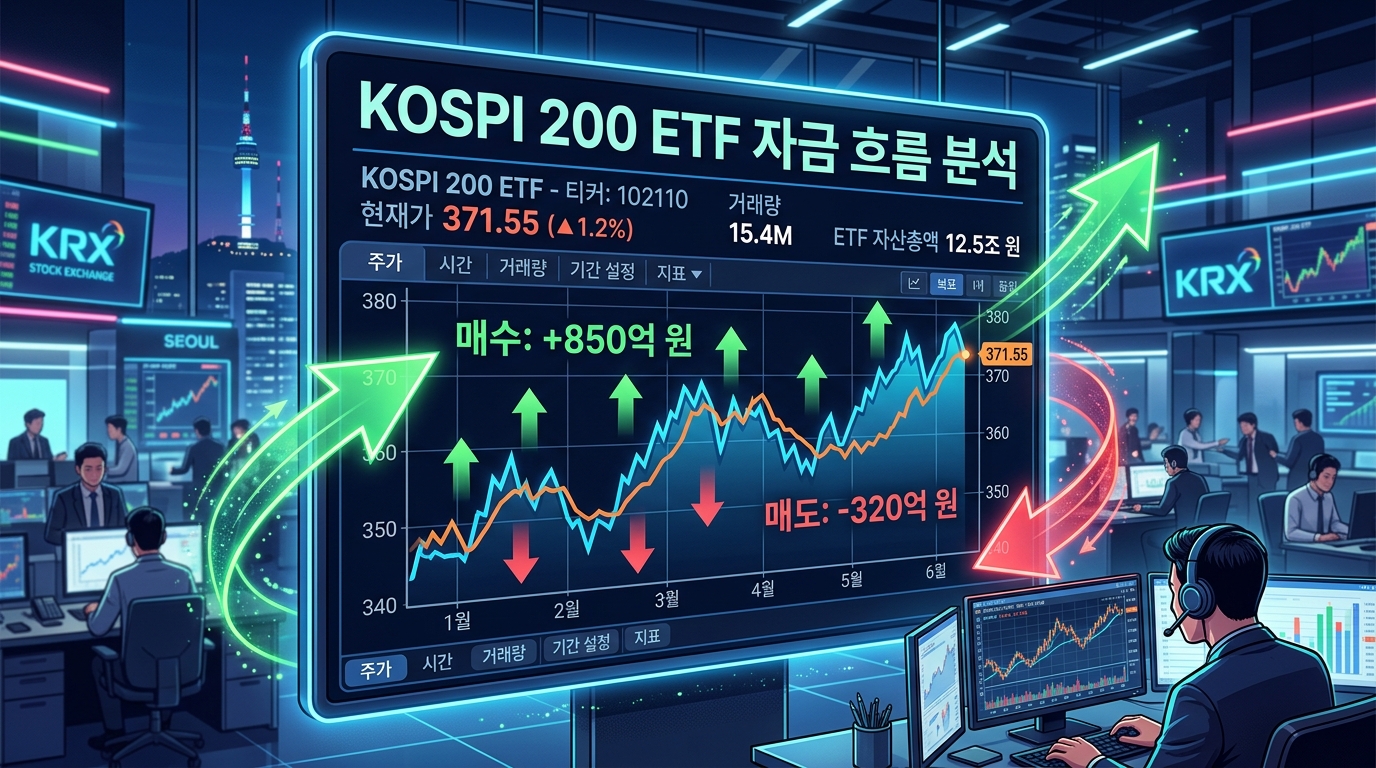
However, in terms of supply and demand, approximately 715 billion won flowed out of domestic asset ETFs in early August (as of the 3rd to 6th), recording the first weekly net capital outflow of this year.
On the other hand, during the same period, 323 billion won net flowed into foreign asset ETFs, showing a clear shift of investors tired of the "roller coaster" domestic stock market to global indices such as the US S&P 500 or Nasdaq 100.
[Image: /stdaily/uploads/202608/gen_6a800ece6fe6e1.60928906.png]
Financial Analysis
Looking at the scale and costs of major domestic KOSPI 200 ETFs, investment strategies differ depending on inflow patterns and cost structures for each product.
For example, Samsung Asset Management's 'KODEX 200' is mainly used for short-term trading based on overwhelming trading volume and market capitalization, while Mirae Asset Global Investments' 'TIGER 200' has absorbed a large amount of long-term installment investment capital utilizing its relatively low fees.
In particular, for 'TIGER 200 ETF', the net purchase amount by retail investors since the beginning of the year exceeded 1.0371 trillion won (as of August 13), and its net asset size grew significantly to 10.3539 trillion won.
The table below summarizes the key financial indicators and characteristics of major domestic KOSPI 200-tracking ETFs.
| Product Name (Ticker) | Manager | Net Assets (AUM, as of August 2026) | Actual Expense Ratio (Annual) | Key Characteristics |
|---|---|---|---|---|
| **KODEX 200** (069500) | Samsung Asset Management | Around 23 trillion KRW | Approx. 0.150% | Largest scale in Korea, optimal liquidity makes it advantageous for short-term trading |
| **TIGER 200** (102110) | Mirae Asset Global Investments | Approx. 10.3539 trillion KRW | Approx. 0.050% | Net retail buying exceeded 1 trillion KRW since beginning of the year, suitable for long-term investment |
| **RISE 200** (443540) | KB Asset Management | Around 150 billion KRW | Approx. 0.017% | Maximizes cost efficiency with the lowest level of management fees in Korea |
| **WON 200** (438100) | Woori Asset Management | Approx. 106.4 billion KRW | Approx. 0.050% | Gaining popularity with a monthly dividend distribution structure |
Valuation
As the KRW/USD exchange rate remains high at 1418.50 won, the price attractiveness of large-cap KOSPI 200 stocks may be highlighted from the perspective of foreign investors.
However, with the Nasdaq Fear & Greed Index recording 65 (Greed) and the momentum of foreign assets remaining solid, an illusion is occurring where the relative attractiveness of domestic assets is being diluted.
The 12-month forward price-to-earnings ratio (Forward PER) of the KOSPI 200 stays near the bottom of its historical average, leading to assessments that the valuation itself belongs to the undervalued territory.
However, because earnings expectations for top-tier semiconductor giants like Samsung Electronics and SK Hynix have been adjusted downwards and concerns over a global economic slowdown have not been fully resolved, this undervaluation charm is not immediately translating into capital inflows.
Analyst & Institutional View
Market experts analyze that the recent outflow of capital from domestic asset ETFs is not simply due to market pessimism.
The consensus is that the "Single-Stock Leverage ETF Investment Restriction Regulation," which took effect on July 31, acted as a key variable in capital movement.
Following the strengthening of regulations, it is estimated that 290 billion won and 7200 billion won in capital withdrew from single-stock leverage products for Samsung Electronics and SK Hynix, respectively.
Institutional analysts interpret that some of the departed capital moved to representative index leverage ETFs, such as KOSPI 200 Leverage or KOSDAQ 150 Leverage, to avoid regulations, while the rest was dispersed into US Big Tech or global index products.
Risk Factors
The biggest risk factor is the soaring KRW/USD exchange rate (1,418.50 won) and the resulting continuous instability of foreign capital.
If foreign investors continue to sell in the KOSPI spot and futures markets due to concerns over foreign exchange losses, the KOSPI 200 index itself could face downward pressure, causing the net asset value of large ETFs to decline together.
In addition, the continuous shift of domestic investors to foreign assets poses a risk of becoming a boomerang that weakens the liquidity provision of major domestic index ETFs and shrinks trading value.
Uncertainties in US monetary policy and signs of a global economic slowdown are also factors that lower the earnings visibility of KOSPI 200 components, which are heavily populated by export-oriented companies.
Investment Perspective Summary
Overall, the current KOSPI 200 ETF market is in a tight tug-of-war between retail demand for index diversification to avoid extreme volatility in individual stocks and capital outflow demand seeking to leave for global markets.
The steady inflow of capital into representative index types like TIGER 200 is a positive signal showing that a domestic long-term and installment-type investment culture is taking root.
In the short term, the return of foreign capital accompanied by exchange rate stabilization is expected to be an important key that will determine whether KOSPI 200 ETFs turn back to full-scale capital inflows.
Therefore, it seems wise for investors to securely lock up a portion of their assets in KOSPI 200 index-type ETFs while constructing a scenario to diversify portfolios in connection with exchange rate trends and global macro indicators.
Investor Checklist Q&A
Q1. What is the difference between a KOSPI 200 ETF and a general KOSPI ETF?
A1. While a general KOSPI ETF attempts to track all stocks listed on the KOSPI market, a KOSPI 200 ETF selects and tracks only the top 200 large-cap stocks with excellent market representation and liquidity, making it more sensitive to large-cap market trends.
Q2. What is the biggest reason for capital leaving the domestic ETF market recently?
A2. It is a combination of retail investors, weary of the domestic stock market's volatility in early August, moving their capital to major US indices, and large-scale capital leaving high-risk products due to the tightening of single-stock leverage ETF regulations at the end of July.
Q3. Why does the single-stock leverage regulation affect KOSPI 200 ETF capital flows?
A3. As barriers to entry for 2x leveraged products on Samsung Electronics or SK Hynix rose, some investment capital moved to KOSPI 200 index leverage or major index ETFs with fewer regulations as alternatives.
Q4. Which KOSPI 200 ETF is advantageous for long-term installment investment?
A4. Since minimizing accumulated management fees and hidden actual costs is important for long-term investments, low-cost products such as TIGER 200 (0.05%) or RISE 200 (0.017%) can be relatively advantageous.
Q5. What is the impact of a rising exchange rate (weakening Won) on KOSPI 200 ETF returns?
A5. A rising exchange rate can be positive for long-term performance due to foreign exchange gains for export-oriented conglomerates in the KOSPI 200, but in the short term, it is highly likely to act as downward pressure on the index by encouraging foreign investors to withdraw capital.