Hello, this is Daily Stock.
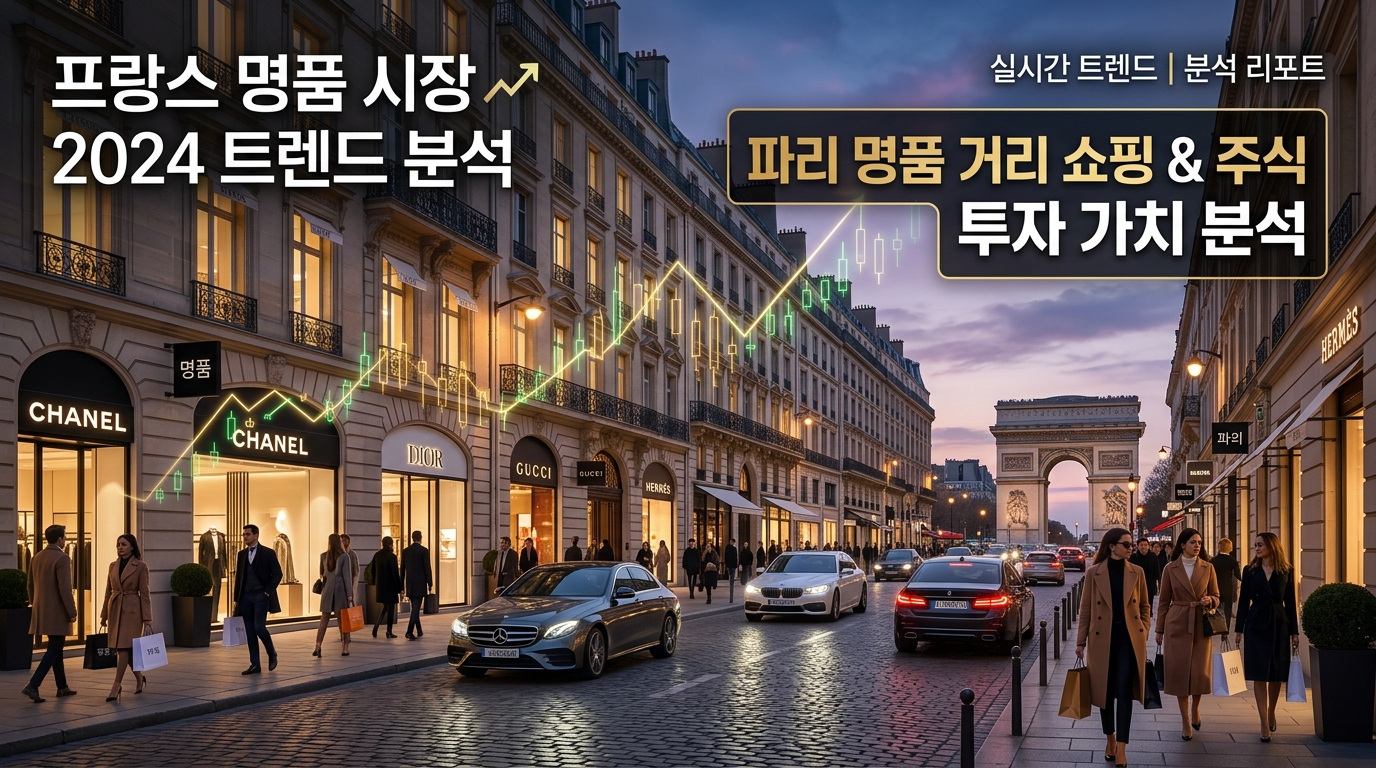
Against the backdrop of subtle shifts in global financial markets, we present an in-depth analysis of France's flagship index, the CAC40, and the latest consumer trends among European luxury brands.
[Image: /stdaily/uploads/202608/gen_6a7b71f176f486.69335406.png]
Key Highlights
Recently, global stock markets have been experiencing a distinct fundamental decoupling among three main regions: the United States, Europe, and Asia.
France's CAC40 index, a barometer for European stock markets, is showing a recovery trend, attempting to stabilize around the 8,710 level on the back of a rebound in luxury brand earnings.
In particular, the first-half 2026 earnings results of major luxury firms confirm the differential pricing power of top-tier ultra-luxury brands and robust demand in the US market.
However, the Asian market, led by China, is increasingly expected to undergo an 'L-shaped' or gradual 'U-shaped' recovery scenario—entering a stabilization phase rather than experiencing a sharp rebound.
---
Current Market Summary
As of intraday trading today on August 12, 2026 (provisional), domestic and international financial market indicators are showing highly dynamic movements.
Currently, the KOSPI stands at 6,345.53 points, and the KOSDAQ is at 857.84 points. In the US, the Nasdaq index is at 26,461.15 points, while the USD/KRW exchange rate is at 1,414.60 won.
According to the Daily Stock Fear & Greed Index, the KOSPI Fear & Greed Index currently sits in the "Fear" (21.5) stage.
While this is a slight improvement compared to "Fear" (26.4) one week ago and "Extreme Fear" (12.6) one month ago, it still reflects cautious investor sentiment.
Conversely, the US Nasdaq Fear & Greed Index is currently in the "Greed" (65) stage, up one step from "Neutral" (60) a week ago, signaling a revival in aggressive buying sentiment centered on growth stocks.
Amid this three-pole decoupling among the US, Europe, and Asia, France's CAC40 index is hovering around the 8,715-point mark as of August 11, 2026 local time.
While global manufacturing and services PMIs show regional divergence, the European Central Bank's (ECB) monetary easing stance coupled with the gradual recovery of European luxury consumption is supporting the index's floor.
[Image: /stdaily/uploads/202608/gen_6a7b71fbb396e2.77677492.png]
---
Financial Analysis
The H1 2026 earnings of the big three European luxury powerhouses—LVMH, Hermès, and Kering—diverged based on each company's brand equity and product portfolio.
Hermès, which boasts an ultra-high-end lineup, maintained peerless growth, whereas LVMH, with its diversified portfolio, and Kering, which is undergoing structural restructuring, posted gradual recoveries in line with market estimates.
| Company | H1 2026 Revenue | Revenue Growth Rate (YoY) | Operating Profit Margin (OP Margin) | Key Features & Trends |
|---|---|---|---|---|
| **LVMH** | €38.6 billion | +2% (Organic growth basis) | 22.5% | Strong performance in Watches & Jewelry (+9%) and Sephora drove overall results. |
| **Hermès** | €8.16 billion | +6% (Constant exchange rate basis) | 41.0% | Unrivaled demand for leather goods continues; explosive growth in the Americas (+17%). |
| **Kering** | €14.75 billion (Reflects annualized estimate) | +2% (Q2 organic growth rebound) | 25.04% (EBITDA margin basis) | Gucci's revenue decline eased (-2%), marking its first positive quarterly turn in three years. |
Hermès adhered to its craftsman supply and quality-first philosophy, proving resilient demand to the extent that shortages of leather goods persist.
LVMH also benefited from recovery trends in the US market and its new store opening strategy, despite ongoing geopolitical noise.
Kering is evaluated as entering a bottoming-out and rebounding phase, with its Gucci rebranding efforts gradually bearing fruit.
---
Valuation
Currently, valuations in the European luxury sector have adjusted to reasonable levels compared to their five-year historical averages.
Hermès, the standout performer, continues to command a steep premium in terms of Price-to-Earnings (P/E) ratio, driven by its overwhelming earnings durability.
LVMH, trading in the €480 range alongside the stabilization of its highly weighted Fashion & Leather Goods division, offers long-term investors an attractive valuation window for dollar-cost averaging.
Kering trades below the sector average P/E, highlighting its undervaluation relative to asset value; however, the timing of its valuation re-rating will depend on the speed of Gucci's full normalization.
---
Expert and Institutional Analysis
Global investment banks (IBs) and consulting firms maintain a cautious yet optimistic view on the recovery pace of the European luxury market.
In a recent report, Bain & Company projected that while personal luxury consumption in China may not reach previous historical highs, the influx of upper-middle-class consumers prioritizing "value consumption" will drive a gradual recovery.
Major institutions such as Bernstein are focusing on a paradigm shift in luxury consumption.
They analyze that the trend of "Quiet Luxury"—which emphasizes product sustainability and heritage over logo-heavy conspicuous consumption—is becoming entrenched.
Furthermore, they view positively that the Americas region is acting as a strong pillar for the luxury market, supported by robust consumption among the wealthy.
[Image: /stdaily/uploads/202608/gen_6a7b72044a7662.12102348.png]
---
Risk Factors
The most immediate risks remain global macroeconomic uncertainties and geopolitical tensions.
China's ongoing real estate market slump and employment anxiety delay consumer sentiment recovery, putting pressure on local boutique revenues.
In addition, prolonged military conflict in the Middle East could dampen global aviation demand and tourist inflows, hurting duty-free sales at flagship stores in mainland Europe.
Moreover, euro exchange rate volatility could create negative translation effects, such as rising costs and reduced operating profits, for European conglomerates that report earnings in their local currency.
---
Investment Outlook
In the era of US-Europe-Asia three-pole decoupling, investing in the European luxury sector must be approached from a perspective of "thorough differentiation within the same industry."
Ultra-luxury brands with no price resistance, like Hermès, can excellently perform a defensive role within a portfolio despite market volatility.
On the other hand, LVMH with its enhanced valuation attractiveness, or Kering which is starting to ride recovery momentum, represent scenarios that could yield larger capital gains during a mid-to-long-term economic rebound.
Therefore, rather than reacting oversensitively to short-term quarterly results, investors would do well to adopt a selective allocation strategy based on a brand's intrinsic pricing power and global diversification capabilities.
---
Investment Checklist
Q1. What is the recent trend of the French CAC40 index, where European luxury stocks are listed?
- Supported by the easing of earnings concerns for luxury companies, the CAC40 index is actively attempting to establish a foothold at the 8,710 level, showing a solid range-bound movement.
Q2. What was the most notable segment in LVMH's earnings?
- As of H1 2026, the Watches & Jewelry division grew by 9% organically, serving as a driver, alongside strong performance from retail divisions such as Sephora.
Q3. What are the unique strengths and concerns for Hermès?
- Hermès maintains powerful pricing power through strict supply management based on craftsmanship. However, its production limits mean that even when demand surges, rapid revenue spikes can be difficult to achieve.
Q4. Has the risk of slowing luxury consumption in China been fully resolved?
- Rather than being fully resolved, it is in an "L-shaped" or "U-shaped" recovery phase, bottoming out and gradually stabilizing. Unlike in the past, a structural shift is occurring where consumers scrutinize utility and brand heritage.
Q5. What are the most important macro indicators to watch when investing in the luxury sector?
- Investors should monitor in real-time the performance of US stock markets (which dictate the purchasing power of the wealthy in major nations), global tourist flows (directly linked to European boutique sales), and euro exchange rate volatility.
---