Welcome to Daily Stock, delivering deep insights by capturing the close-knit movements of the global stock markets.
[Image: /stdaily/uploads/202608/gen_6a777d29dd5a77.52190118.png]
Key Summary
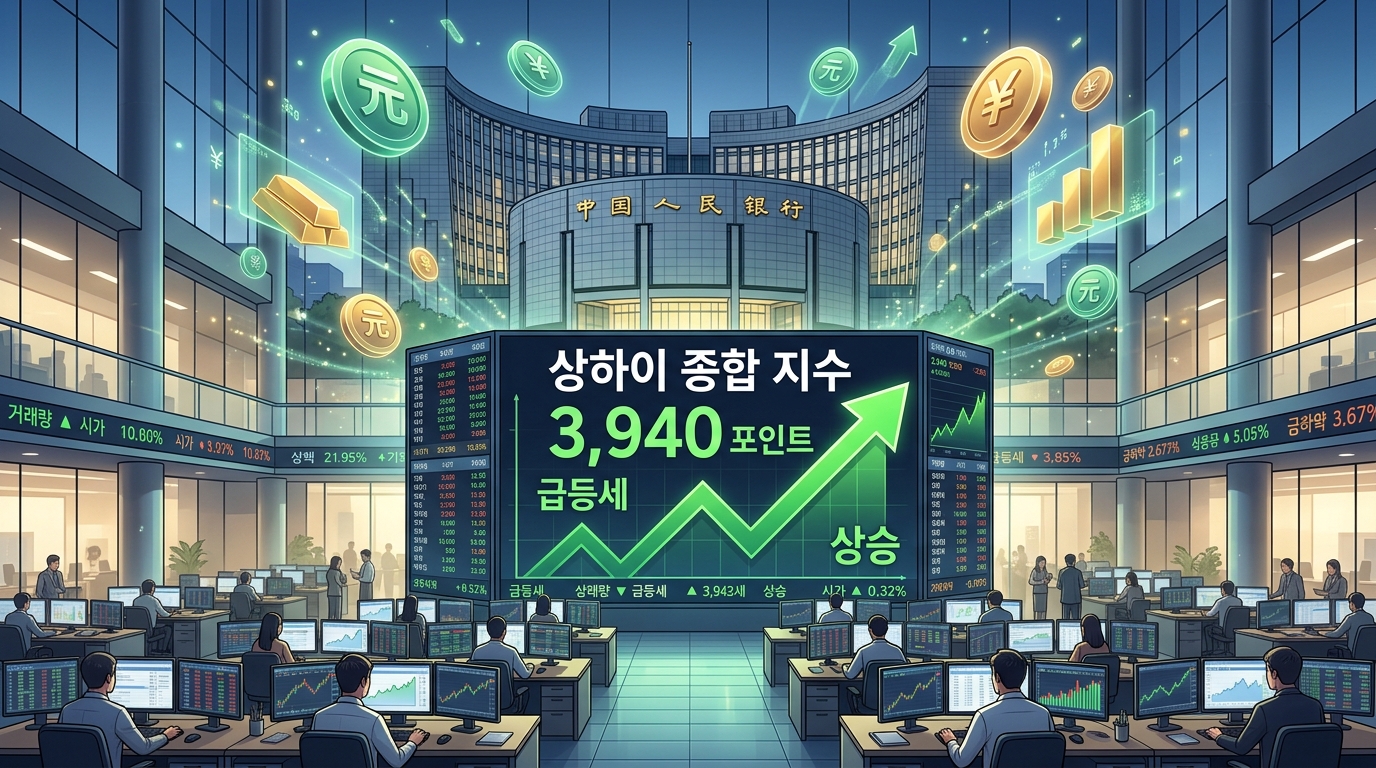
Driven by a strong rebound in tech stocks, the Shanghai Composite Index surged to the 3,940.04 level, marking its fourth consecutive session of gains.
The People's Bank of China (PBOC) reaffirmed its accommodative monetary policy stance for the second half of the year and launched a massive 500 billion yuan reverse repo operation to inject ample liquidity.
Amid deepening fundamental decoupling between the US, Europe, and Asia, focus is on when China will deploy its interest rate cut card to counter stagnant domestic demand and margin call pressures.
---
Current Market Overview
On August 7, 2026, the Shanghai Composite Index finished the day up 1.02% at 3,940.04.
Buying interest converged on AI-related technology shares, including Contract Research Organizations (CROs), Co-Packaged Optics (CPO), and Printed Circuit Boards (PCBs), driving the broader market upward.
However, looking underneath the surface, the blue-chip CSI 300 index tumbled 13% in July, while the Shanghai Composite Index shed about 5% during the same period.
In this process, the number of margin trading accounts plummeted by 22.12% month-on-month, showing that the impact of leverage liquidation is still lingering.
The PBOC has held its benchmark Loan Prime Rate (LPR) steady for 14 consecutive months, keeping the 1-year rate at 3.0% and the 5-year rate at 3.5%.
However, at its mid-year work conference on August 1, the central bank pledged a "reasonably accommodative monetary policy," strongly signaling counter-cyclical measures and potential rate cuts in the third quarter.
Furthermore, to reduce its reliance on the US dollar amidst ongoing US-China trade tensions, the PBOC has purchased gold for 21 consecutive months, bringing its cumulative reserves past 76.08 million ounces as part of its de-dollarization strategy.
---
Financial Analysis
China's second-quarter GDP growth came in at 4.3% year-on-year, disappointing the market.
This fell short of the lower bound of Beijing's annual target of 4.5% to 5.0%, effectively marking the slowest expansion in three and a half years.
China's new bank loans for July are expected to reach only around 45 billion yuan, indicating a sharp credit stagnation compared to June's 1.61 trillion yuan.
As loan demand from private firms and households dried up, the PBOC aggressively injected 500 billion yuan (approx. $74 billion) on August 5 through a 3-month reverse repurchase (reverse repo) operation.
This serves as a monetary shield to prevent liquidity depletion and block a vicious cycle in the real economy.
[Image: /stdaily/uploads/202608/gen_6a777d33dcf289.53041408.png]
---
Valuation
The average price-to-earnings (P/E) ratio of the Shanghai Stock Exchange is hovering around 17.00x, suggesting valuation pressures are not overly demanding.
Despite global recession fears, gold prices remain supported near historically high levels of $4,250 per ounce, with commodity market liquidity helping anchor Chinese asset values.
In the US, the Nasdaq index (NASDAQ: 26,690.62) has rallied in anticipation of Federal Reserve rate cuts, pushing our Fear and Greed Index to 63.7 (Greed).
In contrast, South Korea's stock market suffered from the listing shock of ChangXin Memory Technologies (CXMT) last month and the global AI bubble narrative, dragging the KOSPI (KOSPI: 6,258.77) Fear and Greed Index down to 17.1 (Extreme Fear).
These contrasting trends highlight a clear "tri-polar decoupling" structure between the US (gearing up for easing), China (pursuing its own survival policies), and South Korea (stuck with frozen interest rates due to high exchange rates and debt burdens).
---
Comparison of Major Global Indices and Monetary Policies
| Index Class | Shanghai Composite (SSEC) | Nasdaq (NASDAQ) | KOSPI (KOSPI) |
|---|---|---|---|
| **Current Index** | 3,940.04 (Latest Close) | 26,690.62 (Daily Close) | 6,258.77 (Daily Close) |
| **Key Monetary Policy** | PBOC Accommodative (LPR 1Y 3.0%) | Fed rate cut expectations priced in | BOK's limited room for easing |
| **Fear & Greed Index** | N/A (Sharp drop in retail margin trading) | **63.7 (Greed)** | **17.1 (Extreme Fear)** |
| **Commodities / FX** | Gold purchases for 21 consecutive months | Dollar Index trending downward | USD/KRW Exchange Rate around 1,411.00 won |
---
Expert and Institutional Analysis
Wen Bin, chief economist at China Minsheng Bank, noted, "As the pace of US rate cuts could accelerate, the PBOC finally has more room to maneuver and boldly lower its benchmark policy rates."
Experts analyze that this unconditional 500 billion yuan fund injection is more than just a short-term adjustment; it is the first step toward potential reserve requirement ratio (RRR) cuts and broad-based benchmark rate reductions.
Wang Qing, chief macro analyst at Golden Credit Rating, also analyzed, "To strengthen the quality of financial policies in the second half, the PBOC has no choice but to maximize coordination with fiscal and industrial policies."
In particular, the prevailing view is that the PBOC's massive purchase of 19.9 tons of gold in July is not merely asset accumulation, but a strategic preventive action against potential escalations in US trade and tech sanctions.
---
Risk Factors
The most critical risk is a potential "liquidity trap" materializing, where households and businesses refuse to spend or invest despite ample monetary easing.
Tensions and technological/diplomatic disputes with the US also weigh heavily on the market.
As the US imposed sanctions on imports of Chinese components, Beijing countered by restricting exports of dual-use drone materials to the US, adding uncertainty to commodity supply chains and foreign trade balances.
Additionally, if ChangXin Memory Technologies (CXMT)—which absorbed massive domestic capital as a rising memory chip star—faces limitations in its global market share expansion, short-term investment sentiment, mostly dominated by state-owned capital, could quickly freeze.
---
Investment Outlook
Thanks to the PBOC's prompt liquidity injection, the Chinese stock market demonstrated meaningful resilience, reclaiming the 3,940 level.
Under the tri-polar decoupling of the US, Europe, and Asia, the PBOC's expansionary stance could serve as a powerful catalyst for the Shanghai Index once Western capital starts rotating back to Asian markets.
However, because domestic economic stagnation and trade frictions remain deeply intertwined, investors are advised to monitor whether monetary easing translates into actual economic data recovery, rather than rushing into impulsive chasing buys.
---
Investor Checklist Q&A
Q1. What is the specific reason behind the PBOC's recent massive 500 billion yuan reverse repo operation?
A1. With Q2 GDP growth dropping to 4.3% and household and corporate credit demand plunging, the central bank injected emergency funds to ensure stability within the banking system.
Q2. Is there a possibility that the LPR (Loan Prime Rate), which has been frozen for a long time, will be cut in the second half of this year?
A2. Given that Beijing signaled counter-cyclical measures and the US is preparing to ease, a cut to either the RRR (Reserve Requirement Ratio) or benchmark loan rates is highly anticipated within the third quarter.
Q3. What is the impact of the ongoing trade and tech retaliations between the US and China?
A3. Although conflicts persist over US robotics regulations and China's drone export controls, the direct shock to global investment sentiment has remained a short-term volatility factor rather than disrupting structural market trends.
Q4. How should we interpret the PBOC buying gold for 21 consecutive months?
A4. As US-China confrontations persist amidst geopolitical risks, expanding physical gold reserves is viewed as a defensive measure to decrease dependence on the US dollar.
Q5. How was the recent listing of a Chinese semiconductor company linked to the plunge in the Korean market (KOSPI)?
A5. The highly successful listing of ChangXin Memory Technologies (CXMT) triggered foreign selling of major South Korean semiconductor stocks. However, considering the actual gap in advanced node technology and global market share, some analysts view this as a temporary panic sell.