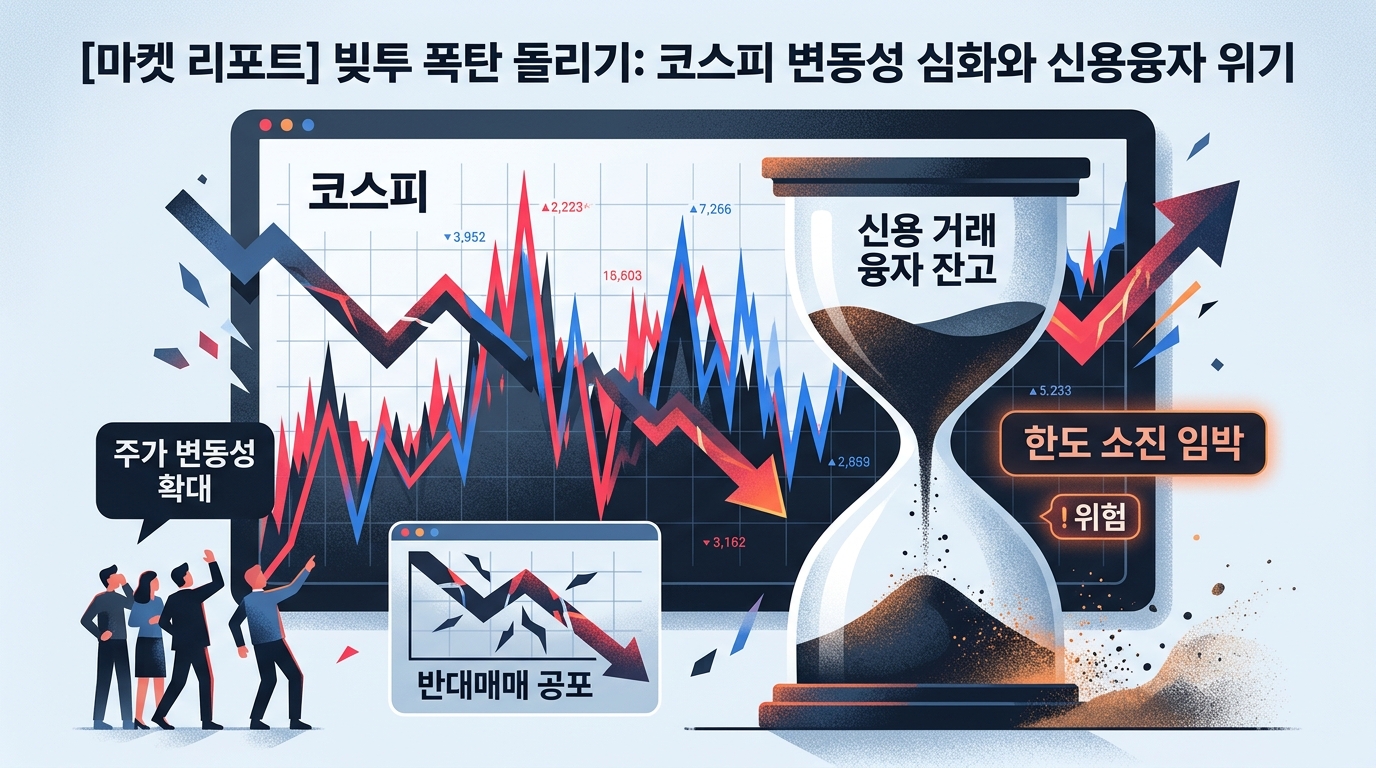
The recent KOSPI market has been experiencing sharp index fluctuations, and volatile margin loan balances of individual investors are triggering short-term supply-demand instability.
[Image: /stdaily/uploads/202608/gen_6a76d468e73501.64384665.png]
Key Summary
- **Volatile Margin Balances**: The margin loan balance, which had dropped to the 27 trillion won range during the late-July correction, surged by over 1 trillion won in a single day to reach the 28 trillion won range on August 5 as the stock market rebounded.
- **Secondary Decline and Burden**: However, with the KOSPI index falling back to close at 6,258.77 on August 7, concern is rising that the leveraged "debt-investing" flows that entered looking for a short-term bounce may face margin call pressure again.
- **Deposit Outflow**: Financial investment deposits (idle trading cash) plummeted by approximately 7.2 trillion won in a single day, maximizing capital flow volatility in the market.
- **Liquidity Risks**: With volatility indicators and our proprietary Fear & Greed Index signaling extreme fear, investors must guard against a forced liquidation scenario driven by collateral shortfalls in the event of further declines.
---
Market Overview
As of the close on August 7, 2026, the KOSPI index ended at 6,258.77, down 37.61 points (0.60%) from the previous trading day.
Previously on August 5, the KOSPI had successfully rebounded by 3.76% in a single day (6,598.26), temporarily bringing a sense of relief to the market.
Individual investors immediately increased their margin trading to buy the dip, sending the outstanding margin loan balance up by 1.0141 trillion won in just one day.
However, as the index retreated back to the 6,200 level within two days, the leveraged positions taken for short-term gains have turned into a market burden.
In fact, according to Daily Stock's proprietary Fear & Greed Index, the KOSPI is currently recording 17.1 (Extreme Fear), reflecting continued cold investor sentiment following 17.8 a week ago and 13.1 a month ago.
---
Financial Analysis
Key financial and liquidity indicators—including margin loan balances, investor deposits, and forced liquidations in the domestic stock market—are showing steep volatility cycles.
| Classification | August 4, 2026 (Near annual low) | August 5, 2026 (Rebound point) | Change |
|---|---|---|---|
| **Margin Loan Balance** | 27.4038 trillion KRW | 28.4179 trillion KRW | +1.0141 trillion KRW |
| **Investor Deposits** | 110.4071 trillion KRW | 103.2125 trillion KRW | -7.1946 trillion KRW |
| **Daily Forced Liquidations** | 31.5 billion KRW (based on accounts receivable) | 11.7 billion KRW | -19.8 billion KRW |
Following consecutive forced liquidations during the late-July plunge, the margin balance fell below 30 trillion won for the first time in about six months, bottoming out in the 27 trillion won range.
However, as soon as the index bounced on August 5, speculative retail buying rushed back in, while investor deposits fell sharply due to IPO subscription refunds and conversion into actual stock purchase funds.
While daily forced liquidations temporarily eased to 11.7 billion won, the renewed slide in the index has raised red flags for maintaining required collateral ratios.
---
Valuation
When the KOSPI was hovering near its historical highs, the margin loan balance exceeded 38 trillion won, indicating extreme overheating.
[Image: /stdaily/uploads/202608/gen_6a76d475444c20.13820678.png]
Although the ratio of the margin balance to total market capitalization temporarily decreased during the recent sell-off, the relative burden can actually intensify if the speed of the index's decline outpaces the reduction in leverage.
Currently, the KOSPI 6,200 level is considered an area where supply-demand overhang has eased somewhat.
However, considering that the 1 trillion won in new margin debt that entered during the short-term rebound was executed at or above the 6,500 level, these positions are highly likely already in a loss-making zone at the current index level (6,258.77).
If further declines threaten previous lows, a vicious cycle could be triggered where forced liquidations due to collateral shortfalls break through valuation floors.
---
Analyst & Institutional Commentary
Some market analysts evaluate that the recent rebound in margin balances cannot be viewed as a complete recovery of risk-on sentiment.
Kim Min-gyu, an analyst at KB Securities, advises that it is too early to assume that deleveraging (debt reduction) is entirely over in this correction.
This is because some retail investors are magnifying supply-demand distortions by quickly moving capital from single-stock margin trading to high-risk leveraged ETFs or IPO subscriptions.
On the other hand, Kim Dong-won, head of research at KB Securities, analyzes that the excessive leverage unwinding and liquidity shocks that caused the semiconductor-led drop in July have largely passed their peak.
There is also a mid-term view that once the intense supply-demand instability clears, corporate fundamentals and earnings will gradually take center stage.
---
Risk Factors
The most critical risk factor is the potential scenario of collateral shortfalls and automated forced liquidations in the event of a second leg down.
In margin trading, if the collateral maintenance ratio (typically 140%) is not met due to falling stock prices, brokerage firms will forcibly sell the shares (forced liquidation).
Already in late July, individual investors suffered substantial principal losses, with accounts receivable forced liquidations exceeding 100 billion won for two consecutive days.
On top of this, the KRW/USD exchange rate remains elevated at around 1,411.00, creating a macroeconomic environment where aggressive foreign capital inflows are hard to expect.
With the US Nasdaq Fear & Greed Index lingering in the "Greed (63.7)" stage and facing valuation pressures, any renewed global stock market correction could cause KOSPI margin liquidation pressure to accelerate the index's decline.
---
Investment Outlook
Currently, the KOSPI market can be described as walking on thin ice from a supply-demand perspective.
While the rapid inflow of dip-buying is strong enough to add 1 trillion won in margin debt in a single day, it also indicates that much of the market is backed by "short-term debt capital" highly vulnerable to downside volatility.
Therefore, rather than rushing to buy on leverage at this juncture, priority should be given to confirming whether margin balances stabilize downward over time.
Unless exchange rate stability and foreign net buying in both cash and futures return, investors must keep in mind that sudden spikes in short-term margin debt can act as a boomerang that amplifies market volatility.
---
Investor Checklist Q&A
Q1. Why did the margin loan balance surge so suddenly?
- When the KOSPI index rebounded by over 3% on August 5, retail investors who saw it as a bottom-buying opportunity rapidly increased their purchases using leverage.
Q2. Is an increase in margin balance positive for stock prices?
- In the short term, it can drive prices up by expanding purchasing power. However, if the index declines again, it turns into potential forced liquidation volume that can exacerbate sharp market falls.
Q3. Under what conditions are forced liquidations executed?
- When a stock price decline pushes the collateral value below the maintenance ratio required by the brokerage (usually 140%), and the investor fails to top it up within a specified deadline, the shares are forcibly sold.
Q4. What caused the investor deposits to plummet by over 7 trillion won in a single day?
- Along with the conversion of cash into stocks due to the market rebound, it was also affected by temporary cash outflows from subscription funds returning after major public offerings that were taking place at the time.
Q5. What strategy should individual investors adopt at this stage?
- In a high-volatility environment, it may be effective to adopt a conservative approach: avoiding excessive leverage and waiting to see if supply-demand anxieties settle and foreign buying stabilizes.