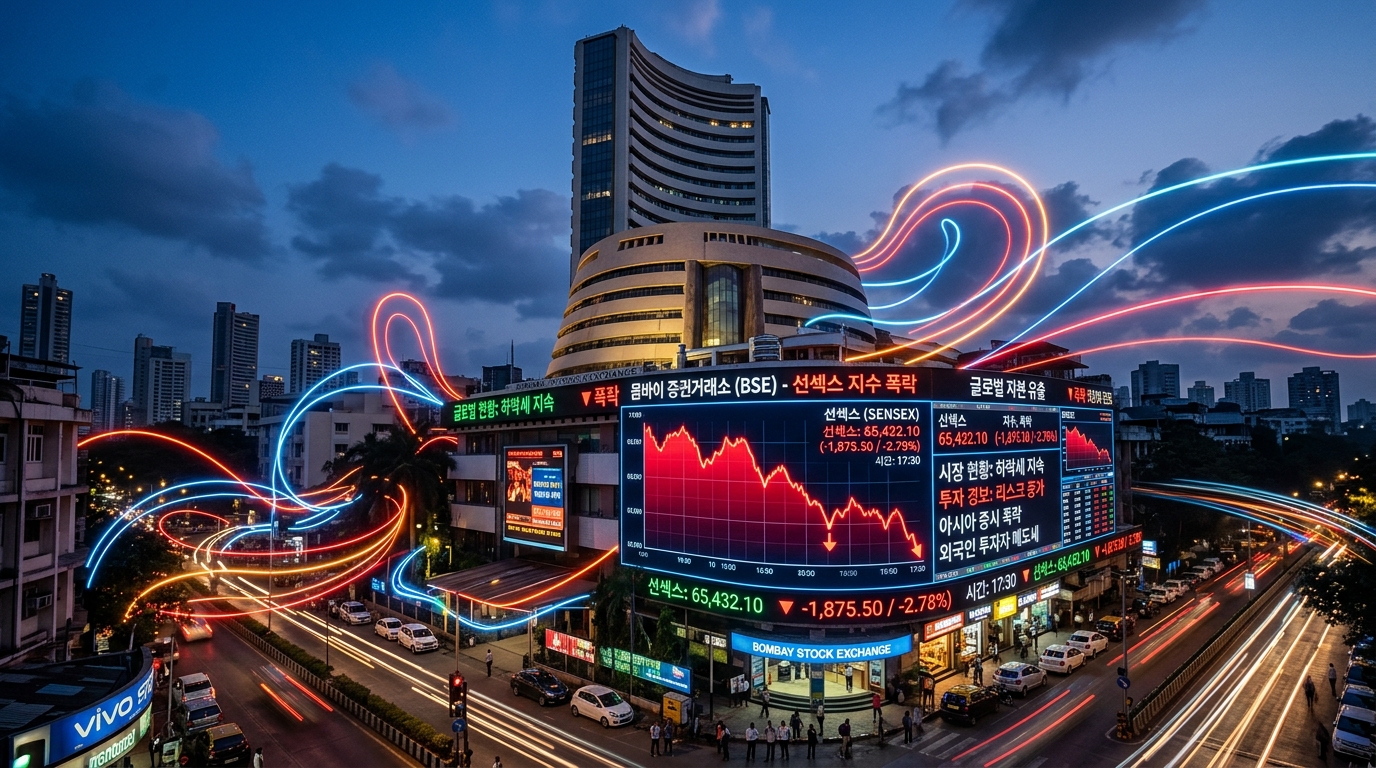
As the tri-polar decoupling of global financial markets accelerates, India's SENSEX index is undergoing short-term corrections amid persistent volatility in foreign capital flows and macroeconomic pressures.
![Image: /stdaily/uploads/202608/gen_6a762b8e303a21.74199770.png]
Key Summary
India's benchmark index, the BSE SENSEX, closed at 78,447.46 as of August 7, 2026, undergoing a short-term correction.
Consequently, investors are once again focusing on the routing of global capital flows and the relative attractiveness of market valuations.
A strong defensive trend continues as domestic institutional investors (DIIs) buffer the massive Foreign Portfolio Investor (FPI) outflows seen in the first half of 2026.
Notably, Indian domestic institutional investors have recorded net purchases for 36 consecutive months, serving as a critical safety net for the market.
Key variables currently driving volatility include overvaluation concerns, rebounding commodity prices, and the implementation of the Securities and Exchange Board of India's (SEBI) new Closing Price Session (CAS) mechanism.
Against the backdrop of a tri-polar decoupling among the US, Europe, and Asia, it is crucial to examine whether India's unique growth fundamentals remain intact.
Current Status Summary
On August 7, 2026, the Indian BSE SENSEX index closed at 78,447.46, down 507.30 points (-0.64%) from the previous trading day.
Upward pressure on global oil prices and resurfacing geopolitical uncertainties in the Middle East prompted profit-taking sales.
Recently, Indian Foreign Portfolio Investors (FPIs) sustained heavy selling pressure for four consecutive months from March to June.
Fortunately, FPI flows turned positive in July, posting a net inflow of 20,200 crore rupees (approx. KRW 3.23 trillion), which temporarily paved the way for a rebound.
However, in early August, crude oil price fluctuations combined with geopolitical risks restricted the pace of foreign capital inflows once again.
Additionally, temporary volatility arose as the market adapted to the new Call Auction Session (CAS) for closing price determination, introduced by SEBI on August 3.
In contrast, as of August 8, 2026, South Korea's KOSPI closed at 6,258.77 and KOSDAQ at 798.81, while the NASDAQ index recorded 26,606.12 and the USD/KRW exchange rate stood at 1,410.00.
At the same time, according to Daily Stock's proprietary Fear & Greed Index, the KOSPI Fear & Greed Index is currently pointing to a state of Extreme Fear (17.1).
This demonstrates continued frozen sentiment compared to Extreme Fear (17.8) a week ago and Extreme Fear (13.1) a month ago.
Conversely, the NASDAQ Fear & Greed Index is currently Neutral (59.6), showing relatively favorable investment sentiment compared to Neutral (45.2) a week ago and Fear (39.8) a month ago.
![Image: /stdaily/uploads/202608/gen_6a762b9a182220.82480790.png]
Financial Analysis
The financial fundamentals of the Indian stock market are backed by robust macroeconomic indicators and a gradual recovery in corporate earnings.
While corporate performance, particularly in the IT and financial sectors, meets market expectations, demand-and-supply volatility remains a concern.
According to data from the National Securities Depository Limited (NSDL), cumulative FPI equity net outflows reached 241,617 crore rupees in 2026.
Fortunately, during the previous fiscal cycle, DIIs posted a record net inflow of 8.5 trillion rupees (approx. 8.5 lakh crore), which was more than enough to offset the foreign exodus.
In particular, the steady popularity of Systematic Investment Plans (SIPs) among retail investors has empowered domestic institutions with massive capital mobilization.
Consequently, the shareholding of DIIs in the Indian equity market rose to an all-time high of 17%, whereas the FPI shareholding fell to 15.8%, its lowest level in 15 years.
The following is the monthly trend of Foreign Portfolio Investor (FPI) equity flows in the Indian stock market during 2026:
| Month (2026) | Net FPI Equity Inflow (Unit: Crore Rupee) | Key Market Characteristics & Events |
|---|---|---|
| **January** | -35,962 | Outflow due to high valuation burdens at the start of the year |
| **February** | +22,615 | Technical buying triggered by low-valuation perception |
| **March** | -117,775 | Global geopolitical concerns and massive portfolio rebalancing |
| **April** | -60,847 | Delays in key rate cuts and currency exchange pressures |
| **May** | -32,963 | Caution regarding uncertainties surrounding the general elections |
| **June** | -49,340 | Outflow to other emerging markets amid the global AI focus |
| **July** | +20,200 | Rebound driven by earnings season expectations and currency stabilization |
| **August (as of 6th)** | +12,455 | Limited buying amid reignited geopolitical risks |
Valuation
Currently, the valuation of the Indian SENSEX index carries a premium relative to other emerging markets.
While robust domestic consumption growth and demographic dividends serve as supportive factors, multiples near historical peaks act as entry barriers for fresh capital.
Global market analysts evaluate that valuations of Indian large-cap stocks have entered a relatively fair range.
However, mid- and small-cap segments remain in a short-term overshooting territory, carrying higher downside pressure when volatility escalates.
In addition, India's limited direct exposure to the global artificial intelligence (AI) and semiconductor supply chain drives has hindered multiple expansion.
As global active funds looking to capitalize on the "chip trade" diversified into Taiwan and South Korea, the relative attractiveness of the Indian stock market has faced a test.
![Image: /stdaily/uploads/202608/gen_6a762ba2701d18.13445564.png]
Expert & Institutional Analysis
Major domestic and international financial institutions offer mixed outlooks on the short-term direction of the Indian stock market.
Local brokerages, such as Emkay Global, raised concerns over a slowdown in relative corporate earnings growth and noted the possibility of a moderate index correction in the second half of the year.
Global asset manager Kotak Institutional Equities presented a scenario where FPI inflows remain stagnant for the time being.
They pointed out that India's heavy reliance on commodity imports (specifically crude oil and gas) relative to other emerging markets makes it vulnerable to rising energy prices.
Conversely, analysts at Geojit Financial Services emphasize the stability of the Indian rupee and India's solid macroeconomic resilience.
From their perspective, diversification capital looking to avoid the extreme volatility of other Asian markets dominated by semiconductor exposure will eventually find its way into the Indian market in the long term.
Risk Factors
The most immediate risk is the volatility of international oil prices (around the $83-per-barrel mark for Brent crude) and energy costs driven by instability in the Middle East.
Because India imports most of its crude oil, rising oil prices directly lead to a deteriorating current account balance and inflationary pressures, restricting the central bank's policy flexibility.
Second, institutional adjustments in the Indian stock market may cause short-term confusion.
The new Closing Auction Session (CAS) system introduced by SEBI was initially blamed for magnifying Net Asset Value (NAV) volatility for arbitrage funds.
Lastly, there is a "seesaw" risk tied to the strength of China's economic stimulus plans during the reshuffling of global liquidity.
If further monetary easing by the People's Bank of China (PBOC) or large-scale government fiscal stimulus materializes, a sector rotation could occur as global foreign capital shifts from India back to mainland China.
Investment Perspective Summary
In conclusion, the Indian SENSEX index is highly likely to demonstrate downside resilience in the face of global market instability, supported by robust domestic institutional capital (DII) and improving market structures.
Even under FPI selling pressure, the influx of retail Systematic Investment Plans (SIPs) is serving as a strong pillar of support.
However, because valuation pressures are not fully resolved, a dollar-cost averaging approach to buy on dips rather than chasing rallies is presented as a rational alternative.
Under the global tri-polar decoupling framework, it appears useful to closely monitor commodity price trends and monetary policy shifts in major economies while maintaining a diversified portfolio perspective.
Investor Checklist Q&A
Q1. What are the main reasons behind the recent decline in the Indian SENSEX index?
A1. Upward pressures on inflation driven by rising international oil prices and geopolitical tensions in the Middle East sparked profit-taking.
Additionally, technical volatility from the newly introduced Call Auction Session (CAS) closing price mechanism by SEBI contributed to the decline.
Q2. What is the secret behind the Indian stock market holding up without crashing despite foreign capital outflows?
A2. This is due to the strong net buying trend of Indian domestic institutional investors (DIIs).
Supported by retail cash inflows through Systematic Investment Plans (SIPs), DIIs have successfully counteracted foreign selling by maintaining net purchases for 36 consecutive months.
Q3. Why is foreign capital leaving India for other emerging markets in 2026?
A3. It is driven by India's high historical valuations and its relatively low direct benefit from the global AI and semiconductor rally.
Foreign investors tend to rebalance their portfolios toward Taiwan, South Korea, and China, where valuations are relatively lower or the share of IT hardware is higher.
Q4. Is the current valuation level of the Indian stock market appropriate?
A4. Many analysts evaluate that the large-cap segment is close to a fair valuation range.
However, the mid- and small-cap segments remain overvalued relative to historical averages, requiring caution as they pose a risk of sharper declines during volatile markets.
Q5. What will be the key to a future rebound in the Indian stock market?
A5. Stabilizing international oil prices and entering a global interest rate-cut cycle to restore emerging market liquidity are essential.
Furthermore, it is critical that the earnings growth of major Indian companies during the second-half earnings season proves strong enough to quell overvaluation debates.