Hello, this is Daily Stock, delivering the fastest and most accurate pulse of the domestic and international financial markets.
[Image: /stdaily/uploads/202608/gen_6a7582e8ddc722.91727311.png]
Key Summary
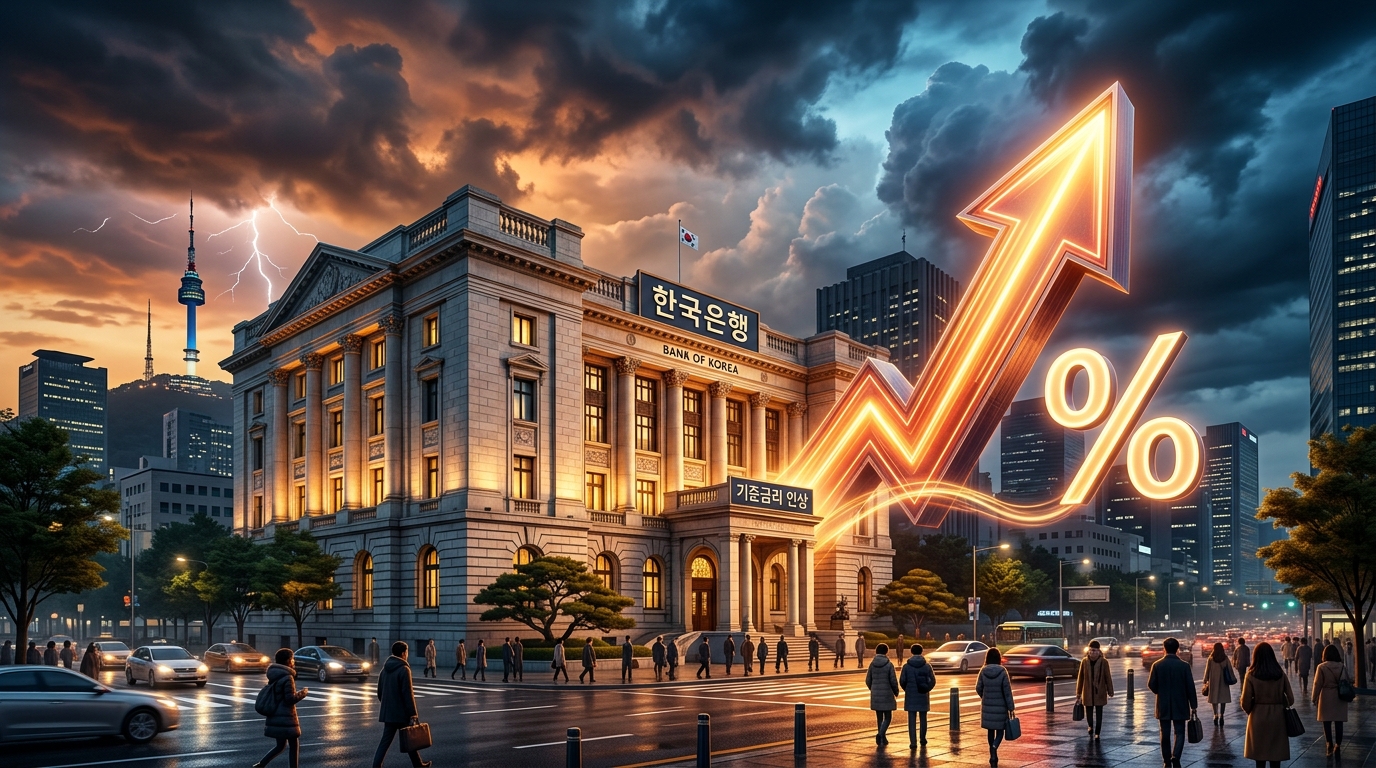
While the Bank of Korea (BOK) abruptly raised its benchmark interest rate to 2.75% on July 16 for the first time in 3 years and 6 months, the recently released minutes of the Monetary Policy Committee (MPC) reaffirmed a hawkish stance, leaving the door open for further increases.
Strong economic growth driven by a semiconductor boom, persistent high inflation, and concerns over financial imbalances centered around real estate in the Seoul metropolitan area were highlighted as the core reasons behind the unanimous decision to raise the rate.
Current Status Overview
In its July MPC meeting, the Bank of Korea officially signaled its shift toward monetary tightening by raising the base interest rate by 0.25 percentage points from the previous 2.50% to 2.75%.
According to the minutes released on August 4, MPC members expressed strong vigilance against supply shocks resulting from the prolonged Middle East conflict, as well as upward pressure on import prices driven by the high foreign exchange rate.
In particular, they unanimously agreed that a preemptive interest rate hike was essential, as rising housing prices in the metropolitan area and growing household loans were fueling financial imbalances.
[Image: /stdaily/uploads/202608/gen_6a7582f232eb23.94322837.png]
Financial Analysis
An interest rate hike can temporarily improve the net interest margin (NIM) of major commercial banks, positively impacting profitability indicators in the financial sector.
However, as the burden of interest payments on households and vulnerable borrowers intensifies, the financial risk of potential delinquency rate increases within the banking sector is also growing.
In the case of large export stocks, robust earnings driven by surging demand for AI semiconductors are offsetting the burden of high borrowing costs, but the financial health of domestic demand-focused companies is showing signs of divergence.
| Key Indicator (As of 2026-08-07) | Figure and Status |
|---|---|
| KOSPI Index | 6,258.77 |
| KOSDAQ Index | 798.81 |
| NASDAQ Index | 26,348.35 |
| USD/KRW Exchange Rate | 1,416.20 KRW |
| BOK Base Interest Rate | 2.75% per annum |
| KOSPI Fear & Greed Index | 18.4 (Extreme Fear) |
| NASDAQ Fear & Greed Index | 59.6 (Neutral) |
Valuation
With the USD/KRW exchange rate remaining elevated at 1,416.20 KRW, foreign investors are adopting a conservative supply and demand stance to shield against foreign exchange losses.
The KOSPI Fear & Greed Index, calculated by Daily Stock, currently stands at 18.4, indicating a state of 'Extreme Fear.' This shows that market sentiment is highly suppressed compared to one week ago (17.8) and one month ago (12.8).
On the other hand, the NASDAQ Fear & Greed Index sits at 59.6 (Neutral), clearly illustrating a psychological decoupling from the Korean stock market.
The simultaneous rise in exchange rates and interest rates increases the real valuation appeal of Korean treasury bonds, while exerting pressure on KOSPI large-cap stocks to adjust their multiple expansions.
Expert & Institutional Analysis
Market experts are closely examining scenarios where the BOK's shift toward tightening does not end as a one-off event but leads to additional hikes.
Global investment bank BNP Paribas predicted that while the BOK will freeze rates at its upcoming August meeting, it could implement further hikes in October and January of next year, bringing the terminal rate to the 3.25% range.
Institutional investors analyze that volatility in response to macroeconomic data will increase, given that committee members defined future meetings as 'live meetings' (meetings where rate adjustments remain a possibility) in the minutes.
Risk Factors
The biggest risk is that if the high-interest-rate stance is prolonged, the debt-repayment capabilities of households and small-and-medium enterprises (SMEs) could rapidly deteriorate, potentially spreading into instability across the entire financial system.
Furthermore, if surging international oil prices due to a worsening Middle East conflict and high exchange rates persist, a stagflationary pattern could emerge where inflation and economic growth are simultaneously damaged.
Additionally, there is a risk that the tightening policy may accelerate a slump in domestic consumption, highlighting the structural vulnerability of the domestic economy, which heavily relies on booming semiconductor exports.
[Image: /stdaily/uploads/202608/gen_6a7582fb24c782.42790802.png]
Investment Perspective Summary
As upward pressure on exchange rates and interest rates remains valid in the short term, maintaining a defensive portfolio centered on large-cap export stocks with excellent cash flows and low debt ratios could be an alternative.
With the KOSPI Fear & Greed Index staying in the 'Extreme Fear' zone (18.4), it seems wise to avoid excessive leverage investing and weigh the timing for split purchases while monitoring the BOK's next monetary policy decision and exchange rate trends.
In the long run, confirming the peak of the interest rate hike cycle will serve as a catalyst for normalizing the valuation of large-cap KOSPI stocks.
Q&A with Daily Stock
Q1. What is the decisive reason behind the Bank of Korea's rate hike for the first time in 3 years and 6 months?
A1. The primary reasons are to defend against rising inflation pressures triggered by instability in the Middle East, curb the exchange rate depreciation of the Korean won, and cool down overheating in household loans and the metropolitan real estate market.
Q2. How likely are future rate hikes based on the MPC minutes?
A2. A majority of MPC members expressed hawkish views, warning that inflation and financial stability risks persist and that the tightening stance should continue, keeping the possibility of an additional rate hike within the year open.
Q3. How does the benchmark rate hike affect large-cap KOSPI stocks and market liquidity?
A3. A rate hike increases the discount rate, putting pressure on stock market valuations. When combined with a high exchange rate, it particularly acts as a factor limiting the inflow of foreign investment capital.
Q4. What is the upcoming schedule for the Bank of Korea's interest rate decisions?
A4. There are three remaining monetary policy decision meetings to determine the base rate in 2026: August 27, October 22, and November 26.
Q5. What strategy should investors adopt in the current market phase?
A5. Since the KOSPI sentiment index is in 'Extreme Fear' (18.4), rather than aggressive chase-buying, it appears more advantageous to take a concentrated approach focusing on semiconductor and large export stocks that maintain robust earnings strength even in a high-interest-rate environment.