Hello, this is Daily Stock, delivering sophisticated analyses of core technology stock trends in the Nasdaq market and the financial paradigms of hyperscaler enterprises.
[Image: /stdaily/uploads/202608/gen_6a73cee72d18d9.44872654.png]
Summary
Amazon (AMZN) has once again demonstrated the overwhelming dominance of its cloud business, AWS, through its earnings release for the second quarter of fiscal year 2026.
AWS revenue growth surged 37% year-on-year to $42.2 billion, marking its fastest pace of growth in 18 quarters.
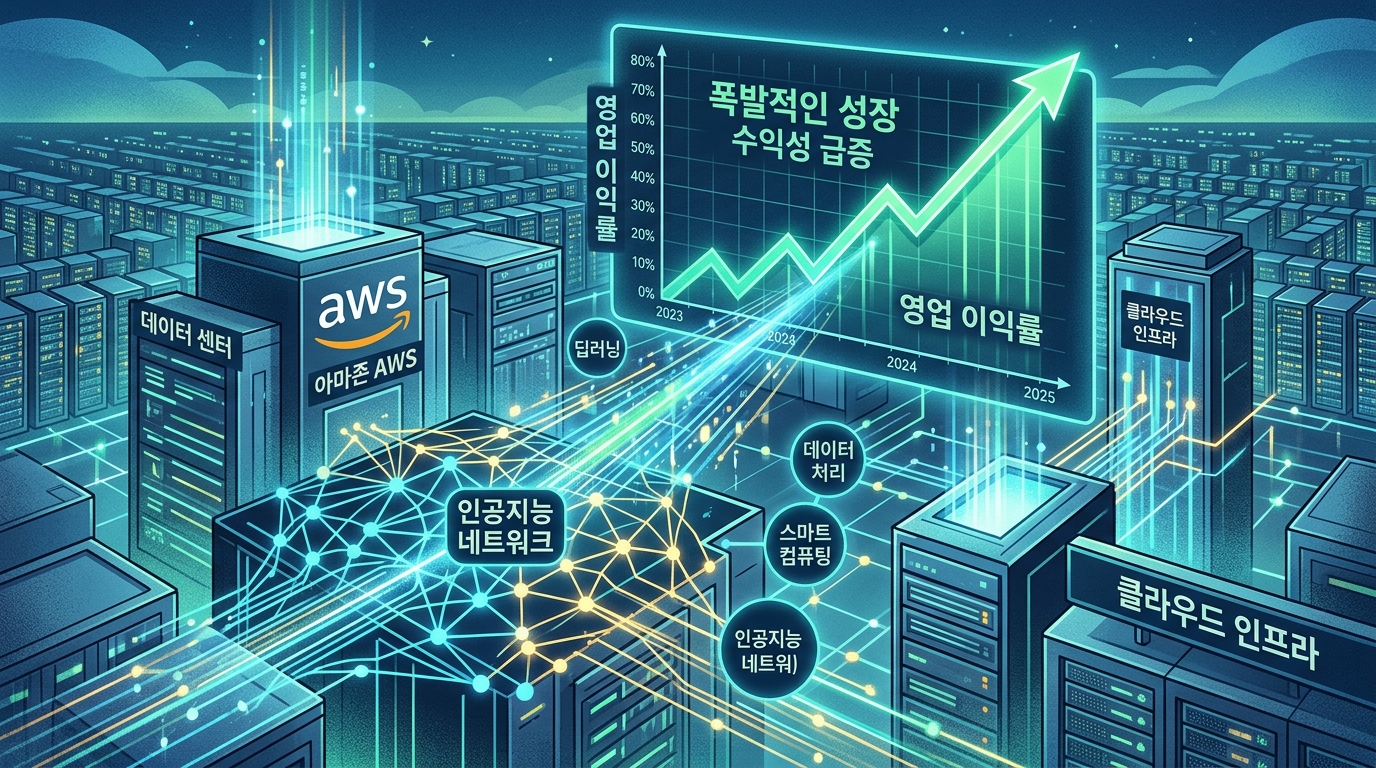
In particular, AWS's operating margin rose vertically from 32.9% in the same period last year to 39.4%, completely erasing the market's concerns over AI margin dilution.
At the same time, Amazon raised its 2026 annual capital expenditure (CapEx) guidance from the previous $200 billion to $220 billion, igniting the infrastructure hegemony war.
Market Overview
Recently, the Nasdaq market underwent a correction amid strong skepticism over whether big tech companies' massive AI investments (CapEx) are actually translating into monetization.
Whenever companies like Google or Meta raised their capital expenditure guidance, the market reacted sensitively with multiple contraction.
However, through this earnings release, Amazon has directly proven with numbers a virtuous cycle in which invested capital returns entirely as high-margin operating profit.
As of 09:00 KST, the US stock market is closed, but as of intraday on 2026-08-06 (provisional), Amazon's stock price hovered around $272.65, experiencing a slight breathing spell in the aftermath of major shareholder stock sale plans.
Currently, the global macro environment is putting pressure on tech valuations amid the strength of the US 10-Year Treasury Yield (US10Y).
Looking at the major domestic and international market data as of today, 2026-08-06, the KOSPI recorded 6,487.13, KOSDAQ 801.00, Nasdaq 26,363.44, and the USD/KRW exchange rate 1,421.50, showing continued volatility.
[Image: /stdaily/uploads/202608/gen_6a73cef19cbfd5.69946850.png]
Financial Analysis
Amazon's total revenue for the second quarter of 2026 increased 20% year-on-year to $200.6 billion, conquering the $200 billion quarterly revenue milestone for the first time in history.
Consolidated operating profit jumped 43% to $27.5 billion, with AWS accounting for $16.6 billion of the operating profit, driving approximately 60% of total profits.
| Classification | Q2 2025 (Actual) | Q2 2026 (Actual) | YoY Change (%) |
|---|---|---|---|
| **Consolidated Revenue** | $167.7 Billion | $200.6 Billion | +20.2% |
| **Consolidated Operating Profit** | $19.2 Billion | $27.5 Billion | +43.2% |
| **AWS Revenue** | $30.8 Billion | $42.2 Billion | +37.0% |
| **AWS Operating Profit** | $10.2 Billion | $16.6 Billion | +62.7% |
| **AWS Operating Margin** | 32.9% | 39.4% | +6.5%p Increase |
| **2026 Annual CapEx Guidance** | - | $220.0 Billion | +10% Up from Previous |
However, it should be noted that the official net income of $62.6 billion (diluted EPS of $5.75) includes a $53.4 billion pre-tax non-operating valuation gain on its stake in AI startup Anthropic, which creates a temporary illusion of net profitability.
In addition, due to the surge in infrastructure investment, the trailing twelve months (TTM) cumulative free cash flow (FCF) turned negative to -$7.6 billion, reflecting the cash strain from accelerating capital expenditure amid rising high bandwidth memory (HBM) prices.
Valuation
According to Daily Stock's proprietary Fear & Greed Index data, the Nasdaq Fear & Greed Index is currently Neutral (59.7), compared to Fear (34.7) one week ago, Fear (32.5) one month ago, and Neutral (55) three months ago.
On the other hand, the KOSPI Fear & Greed Index is currently Fear (30.1), compared to Extreme Fear (11.9) one week ago, Extreme Fear (12.5) one month ago, and Greed (67.7) three months ago, indicating that investment sentiment in the local market is significantly more subdued compared to global tech stocks.
Amazon's 12-month Forward P/E is around 22x, which is reasonably valued compared to other hyperscalers maintaining high multiples like Microsoft or Alphabet.
This is backed by powerful margin leverage, where every 1% improvement in AWS's operating margin increases consolidated operating profit by approximately $6 billion.
Nevertheless, the record-high annual capital expenditures of $220 billion and the resulting depreciation burden are factors that suppress short-term free cash flow recovery.
Therefore, in a high-interest rate macro environment, there is a possibility that this will act as a factor limiting the upside of the stock multiple in the short term.
[Image: /stdaily/uploads/202608/gen_6a73cefa4b1d15.73703107.png]
Analyst and Institutional Insights
Wall Street investment banks (IBs) praised the earnings, calling it the most intuitive case of AI data center investments translating back into revenue and high margins.
Right after the earnings release, UBS maintained a "Buy" rating on Amazon along with a target price of $318.00, acknowledging its robust fundamentals.
BMO Capital Markets also raised its target price from $355.00 to $360.00, firmly maintaining its "Outperform" rating.
Analysts pointed out that a backlog of $496.0 billion guarantees AWS's future growth, and the full-scale deployment of its in-house chips, Graviton5 and Trainium, will reduce reliance on expensive Nvidia GPUs and strengthen its profitability leadership.
Risk Factors
The most concerning areas are the financial burden and temporary liquidity pressures caused by excessive capital expenditures.
CapEx spending for this quarter reached $54 billion, temporarily exceeding quarterly operating cash flow, while long-term debt has also shown a cumulative increase.
On the supply-demand side, founder Jeff Bezos filed a plan to sell 15 million shares worth approximately $4.07 billion, prompting short-term profit-taking sentiment among investors.
Furthermore, if price inflation for core components like HBM continues due to the acceleration of the AI infrastructure race, margins could face long-term pressure.
In addition, European regulatory authorities, such as the UK Financial Conduct Authority (FCA), are moving to bring big tech cloud providers under direct supervision by classifying them as critical risk-management suppliers in the financial system, which increases medium-to-long-term compliance costs.
Investment Perspective
Through this earnings release, Amazon showed an unrivaled profit improvement trend, proving itself not just as a retail giant but as a highly profitable generative AI cloud platform leader.
Its adoption of in-house silicon accelerators and double-digit growth in the high-margin advertising division (+26%) serve as strong defensive moats protecting Amazon compared to other big tech firms.
However, as the company has entered a phase where free cash flow is negative due to historic capital expenditures, investors must carefully observe whether aggressive investments translate fully into long-term cash generation capability.
Therefore, it may be advantageous to look past the temporary illusion of net profit valuation gains and take a gradual, split-entry approach based on a cash flow turnaround scenario.
[Image: /stdaily/uploads/202608/gen_6a73cf05617a36.67917225.png]
Investor Checklist Q&A
Q1. What are the specific reasons behind the explosive surge in AWS's operating margin to 39.4%?
A1. It is due to a significant increase in the utilization of in-house designed chips (Graviton, Trainium), which substantially reduced expensive third-party semiconductor costs, alongside the extension of the useful life for infrastructure assets like servers and exploding demand for high-margin AI rentals.
Q2. Will raising the annual capital expenditure guidance to $220 billion pose a financial risk?
A2. While it drains free cash flow in the short term, AWS's backlog is accumulating exponentially at approximately $496.0 billion, meaning capital recovery is already secured through long-term contracts. Therefore, it is viewed as a stepping stone for long-term profits.
Q3. Is the quarterly net income of $62.6 billion reflective of actual business performance?
A3. No, the core operating profit is $27.5 billion. Most of the net income is the result of a $53.4 billion one-time pre-tax non-operating valuation gain on its stake in the investee Anthropic, so tracking performance based on core operations is necessary.
Q4. How should the announcement of Jeff Bezos's $4 billion stock sale be interpreted?
A4. It is a planned, diversified sale based on pre-scheduled SEC Rule 10b5-1 trading plans. However, the process of supplying shares to the market is acting as a short-term supply-demand drag, limiting the stock's upside.
Q5. What are the key risk indicators that investors should monitor closely going forward?
A5. Key indicators include whether data center inflation intensifies, the speed of returning to positive free cash flow (FCF) despite increased CapEx, and changes in regulatory oversight regarding cloud monopolies and financial risks by authorities in various countries.