[Image: /stdaily/uploads/202608/gen_6a74314f6cc426.03921089.png]
Hello, this is Daily Stock, delivering clear insights into capital market trends based on data and facts.
Executive Summary
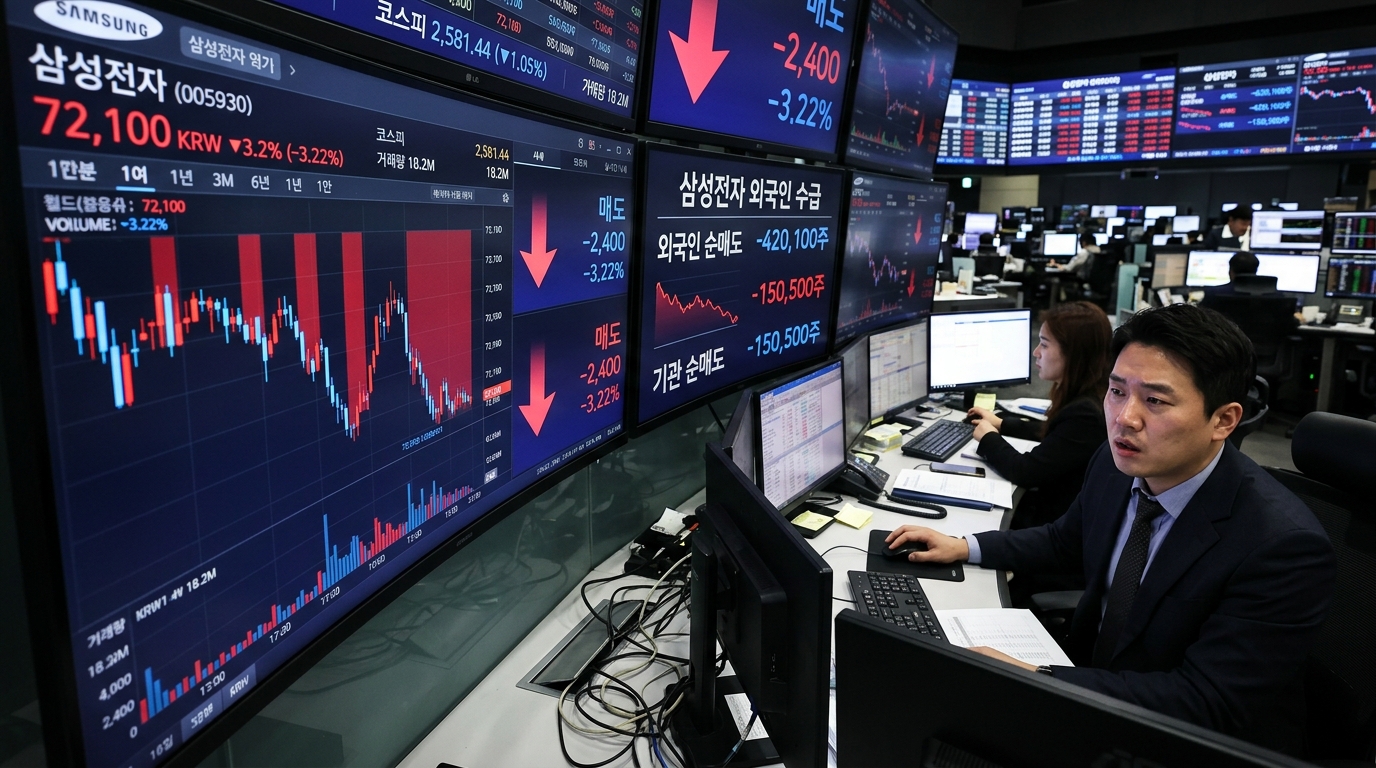
As of the market close on August 6, 2026, the KOSPI index retreated to the 6,200 level, dragged down by weak US chip stocks and short-term profit-taking. Amid this, Samsung Electronics (005930) also recorded a sharp decline, leading to heightened supply and demand volatility.
Despite posting record-high operating profit for the second quarter, Samsung Electronics is experiencing a tug-of-war as foreign investors rapidly alternate between buying and selling in the short term.
Particularly, the foreign ownership rate fell to its lowest level since the global financial crisis in early August, and a sharp increase in stock loan balances suggests both downward pressure and rebound scenarios, requiring a thorough analysis of supply and demand.
Market Summary
In the KOSPI market on August 6, 2026, Samsung Electronics closed at 230,500 won, down 15,500 won (6.30%) from the previous day.
Just the day before on August 5, foreigners net bought more than 2.29 million shares, lifting the stock to 246,000 won. However, the gains were mostly wiped out in just one day as foreign net selling of 3.06 million shares re-emerged.
In terms of supply and demand, the most notable aspect is that as of August 3, Samsung Electronics' foreign ownership rate plummeted to 46.7%, marking the lowest level in about 16 years since the 2009 global financial crisis.
Furthermore, as of the end of July, Samsung Electronics' stock loan balance reached 94.66 million shares, jumping 27.4% in a single month, showing that downward bets—such as securing ammunition for short selling by foreign investors—are on the rise.
[Image: /stdaily/uploads/202608/gen_6a743159823135.19757009.png]
Financial Analysis
Nevertheless, Samsung Electronics' fundamentals remain stronger than ever.
According to the finalized Q2 2026 results announced by Samsung Electronics, consolidated revenue reached 171.4995 trillion won, and operating profit hit 89.4924 trillion won.
This represents a 130.0% year-on-year surge in revenue and a whopping 1,813.8% surge in operating profit, rewriting its record-high quarterly performance.
In particular, the Device Solutions (DS) division, in charge of semiconductors, achieved an operating profit of 89.2 trillion won thanks to record-high sales of DRAM and NAND, accounting for 99.7% of the total operating profit.
| Category | Q2 2026 Results | QoQ Growth | YoY Growth |
|---|---|---|---|
| **Revenue** | 171.4995T KRW | +28.1% | +130.0% |
| **Operating Profit** | 89.4924T KRW | +56.4% | +1813.8% |
| **Net Income** | 71.6T KRW | +52.0% | - |
| **Operating Margin** | 52.2% | +9.2%p | - |
Valuation
As of March 2026, Samsung Electronics' financial indicators show a PER of around 13.51x and a PBR of 2.33x, highlighting its relative undervaluation compared to industry peers.
Its debt-to-equity ratio is stable at 30.15%, its quick ratio stands at 205.56%, and its reserve ratio is at 50,140.02%, maintaining extremely robust financial health.
In addition, based on its shareholder return policy of 50% of Free Cash Flow (FCF), the dividend yield is estimated to reach an attractive level supported by high earnings.
Despite this strong cash-generating power and attractive valuation, the prevailing view is that the stock price does not fully reflect its record performance due to the supply and demand imbalance.
Expert and Institutional Analysis
Global securities firms and investment banks (IBs) interpret the decline in foreign ownership not as deteriorating fundamentals, but as a result of index rebalancing and mechanical portfolio adjustments.
Analysts point out that passive fund outflows played a major role, as Samsung Electronics' weight in the MSCI Emerging Markets (MSCI EM) Index fell to 6% in July, while Taiwan's TSMC maintained 15%, widening the gap to 9 percentage points.
Experts believe that once mechanical selling pressures, such as semi-annual index reviews, reach their final stages, the risk of further downside will be limited. They project that foreign investors are likely to flow back in as HBM4 sales for AI servers become visible in the second half of the year.
Accordingly, some foresee that supply and demand will improve under a scenario where supply chain diversification and next-generation product sales performance are confirmed in the second half.
[Image: /stdaily/uploads/202608/gen_6a74316525ade6.57460403.png]
Risk Factors
In the short term, the biggest risk factor is the global AI big tech investment slowdown theory and concerns over the semiconductor cycle reaching a 'peak-out.'
Particularly, if the US Nasdaq index enters a correction phase and volatility in the overall US chip index widens, foreign capital outflows from South Korea's top two chipmakers could prolong.
Additionally, Samsung Electronics' stock loan balance and short selling volume, which have ballooned since late July, could act as a trigger that limits the strength of any short-term rebound and fuels volatility.
With the USD/KRW exchange rate remaining high at 1,426.20 won as of today, pressure on foreign investors to withdraw funds due to concerns over foreign exchange losses is also cited as a key risk linked to the FX market.
Investment Outlook Summary
At a time when record-high second-quarter earnings intersect with the lowest foreign ownership in 16 years, Samsung Electronics' stock price is passing through a phase heavily driven by supply and demand.
As Daily Stock's KOSPI Fear & Greed Index is currently in the 'Extreme Fear (17.5)' stage, it is necessary to preemptively monitor when overall market panic selling subsides and foreign supply-demand stabilizes.
Some cautious analyses suggest that a gradual weight-adjustment approach based on valuation attractiveness would be effective under a scenario where short covering (unwinding of stock loans) and bottoming of foreign ownership are observed.
Rather than reacting to short-term volatility, a prudent approach is required to consistently track the HBM4 supply schedule and the normalization of global passive funds' portfolios in the second half of the year.
Investor Checkpoints Q&A
Q1. What is the specific reason for foreign ownership falling to a 16-year low?
A1. A combination of factors, including global passive funds adjusting their weights in the MSCI EM index, funds shifting toward Taiwan's TSMC, and mechanical rebalancing due to the surging USD/KRW exchange rate, contributed to the decline.
Q2. Why is the stock price falling despite posting record-high Q2 earnings?
A2. Because the stock market tends to price in future expectations beforehand. Following the stellar earnings announcement, short-term downward bets, such as concerns over an AI peak-out and a surge in stock loan balances, acted strongly.
Q3. How will the surging stock loan balance affect the stock price moving forward?
A3. While it increases short-term downward pressure as it represents standby funds for short selling to drive down the stock price, it can turn into a powerful upward catalyst through short covering when the stock bottoms out and rebounds.
Q4. What does the current KOSPI Fear & Greed Index indicate?
A4. Daily Stock's KOSPI Fear & Greed Index is currently at 'Extreme Fear (17.5).' This indicates that while panic selling and market contraction have increased the attractiveness of low-entry points, the current phase is also accompanied by high volatility.
Q5. What key supply and demand indicators should investors keep an eye on?
A5. Investors should comprehensively monitor whether foreign investors shift to net daily spot/futures buying, the reduction trend of the stock loan balance which has surpassed 94 million shares, and the stabilization of the exchange rate.