Hello. This is DailyStock, analyzing the deep flows of global financial markets to deliver valuable investment insights.
[Image: /stdaily/uploads/202608/gen_6a723715d284e7.02981754.png]
Executive Summary
US commercial crude inventories have plummeted far more than market expectations, raising alarms about the depletion of the global oil supply cushion.
Adding to the concern, inventories at Cushing, Oklahoma—the physical delivery point for WTI crude futures—have dropped near operational limits, sparking worries of potential physical delivery delays.
However, emerging prospects of a diplomatic breakthrough between the US and Iran led to a sharp intraday drop in international oil prices, presenting a market characterized by alternating tension and relief.
Current Status Summary
According to the US Energy Information Administration (EIA), commercial crude inventories for the week ending July 24 fell by 7.167 million barrels from the previous week to 404.5 million barrels.
This far exceeded the market's expected drawdown of 600,000 barrels, placing stocks approximately 7% below the five-year seasonal average.
Notably, inventories at the Cushing hub dropped to 18.6 million barrels, threatening their lowest level since 2014.
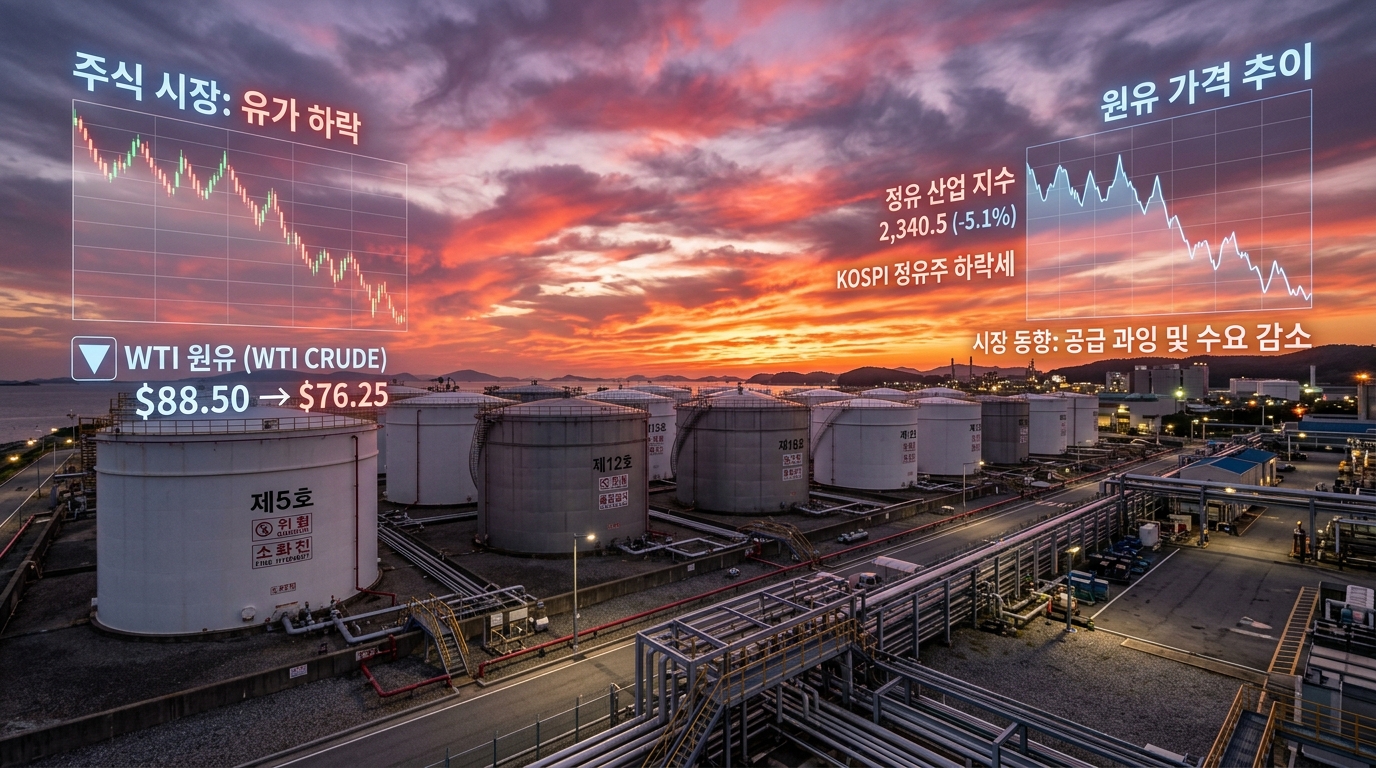
In contrast, as of August 4, 2026, WTI crude futures fell sharply by 5.23% to settle around $76.14 per barrel.
This came as news that the US and Iran entered the final stages of talks to open the Strait of Hormuz abruptly eased supply disruption fears.
Financial Analysis
Key indicators of the US crude supply chain reflect both tight physical supply-demand dynamics and high refinery utilization rates.
While commercial inventories and the Strategic Petroleum Reserve (SPR) fell simultaneously, refinery utilization rates actually rose, demonstrating robust short-term consumption.
| Classification | Most Recent Release | Week-on-Week Change | Analysis & Key Notes |
|---|---|---|---|
| Commercial Crude Inventories | 404.5 million barrels | -7.167 million barrels | 7% below the 5-year average |
| Strategic Petroleum Reserve (SPR) | 307.7 million barrels | -3.8 million barrels | Buffer capacity reduced due to ongoing emergency releases |
| Cushing Hub Inventories | 18.6 million barrels | -771,000 barrels | Warning alert as levels near "Tank Bottom" |
| Refinery Operating Rate | 97.2% | +1.1%p | Rising run rates accelerating crude consumption |
| US Daily Crude Production | 13.8 million bpd | Unchanged | Remaining near historical highs |
Despite US daily crude production holding steady at 13.8 million barrels per day, refinery operating rates surged to 97.2%, driving the steep inventory decline.
These indicators suggest that physical crude market supply capacity has become extremely constrained.
Valuation
Currently, global equity markets are experiencing severe fundamental decoupling among the US, Europe, and Asia.
The US market remains relatively strong, backed by robust employment data and solid domestic demand, with the Nasdaq index trading around 25913.90.
The Nasdaq's Fear & Greed Index stands at Neutral (50.5), reflecting a stabilized sentiment compared to Fear (37.9) a week ago and Fear (32.5) a month ago.
In contrast, Asian markets are suffering deep slumps, exposed to oil price volatility and strong foreign exchange pressures.
The KOSPI closed intraday (provisional) down at 6358.95 and the KOSDAQ at 780.72, while the USD/KRW exchange rate soared around 1427.40 won.
Consequently, the KOSPI's Fear & Greed Index is indicating Extreme Fear (15.7), remaining stuck in a slump following last week (12.6) and last month (15.1).
In Europe, the upside for valuations remains capped amid the ECB's prolonged high-interest-rate stance, contracting manufacturing PMI, and easing oil price scenarios.
Expert & Institutional Analysis
In a recent report, global investment bank TD Economics assessed that the crude oil market has not bought "insurance" to absorb supply shocks, but has merely bought "time."
While temporary crises have been averted through SPR releases and rerouting shipping lanes, any additional shock when land inventories are depleted to their limits could trigger explosive price reactions.
The International Energy Agency (IEA) also analyzed in its July report that while global "oil on water" has increased, making total inventories appear higher on paper, immediately available onshore commercial inventories continue to decline.
Oil analysts forecast that crude prices stand at a crossroads—either stabilizing in the low $70s or breaking above the $90 level again—depending on the outcome of US-Iran diplomatic talks.
Risk Factors
The most immediate risk is the instability of geopolitical negotiations surrounding the Strait of Hormuz.
Should diplomatic mediation by the US administration fail to reach a dramatic agreement, supply disruption fears could reignite, potentially sending oil prices soaring again.
A second risk is Cushing hub inventories hitting "Tank Bottom."
If inventories fall below the minimum volume required to physically maintain pipeline transportation, severe bottlenecks could occur across the physical trading market.
Lastly, there is a capital outflow risk in emerging Asian markets due to global liquidity tightening and deepening decoupling.
When volatile energy prices couple with a strong dollar, it drives up import costs, significantly reducing the flexibility of monetary policy.
[Image: /stdaily/uploads/202608/gen_6a72372061e513.10505886.png]
Investment Perspective Summary
Therefore, current WTI inventory fluctuations and geopolitical noise serve as highly critical variables for portfolio diversification.
While the energy sector can act as a useful hedge during rising tensions, investors should exercise caution as sharp profit-taking could occur if a diplomatic solution is reached.
Particularly when Asian stock markets like South Korea's are in a state of extreme fear, a defensive approach targeting sectors that benefit from lower oil prices via cost reductions may be advantageous.
It is advisable to closely monitor upcoming EIA inventory data and the potential US-Iran agreement while executing phased trading scenarios.
Investment Checklist
Q1. How does the decline in US crude inventories affect domestic refining stocks?
A1. A sharp drop in crude inventories acts as a short-term catalyst for oil prices, boosting expectations for refining margins. However, if global economic slowdown concerns overlap, the upside may be capped.
Q2. Why is Cushing inventory so important in financial markets?
A2. Cushing is the physical delivery point for WTI futures contracts. If inventories fall below operational limits, it can lead to physical delivery delays and extreme price volatility.
Q3. How will oil prices move depending on whether US-Iran diplomatic talks succeed or fail?
A3. If the talks succeed, oil prices could stabilize down into the low $70s due to eased supply fears. If they fail, supply concerns could reignite, potentially pushing prices back above the $90 level.
Q4. What does the current gap between the KOSPI and Nasdaq Fear & Greed Indexes suggest?
A4. While the Nasdaq remains at a Neutral (50.5) level, the KOSPI is in Extreme Fear (15.7), highlighting the deepening decoupling of emerging markets that are highly vulnerable to external variables.
Q5. In a tri-polar global decoupling, what macroeconomic path do crude inventory changes trigger?
A5. While the US, with high energy self-sufficiency, absorbs shocks relatively well, import-dependent Asian countries face simultaneous pressure from rising import costs and currency weakness (USD/KRW at 1427.40 won).