Hello, this is Daily Stock.
Summary
Ahead of its Q2 2026 earnings release, Wells Fargo (WFC), a major U.S. financial institution, is actively driving asset growth following the official lifting of the Federal Reserve's asset cap restriction.
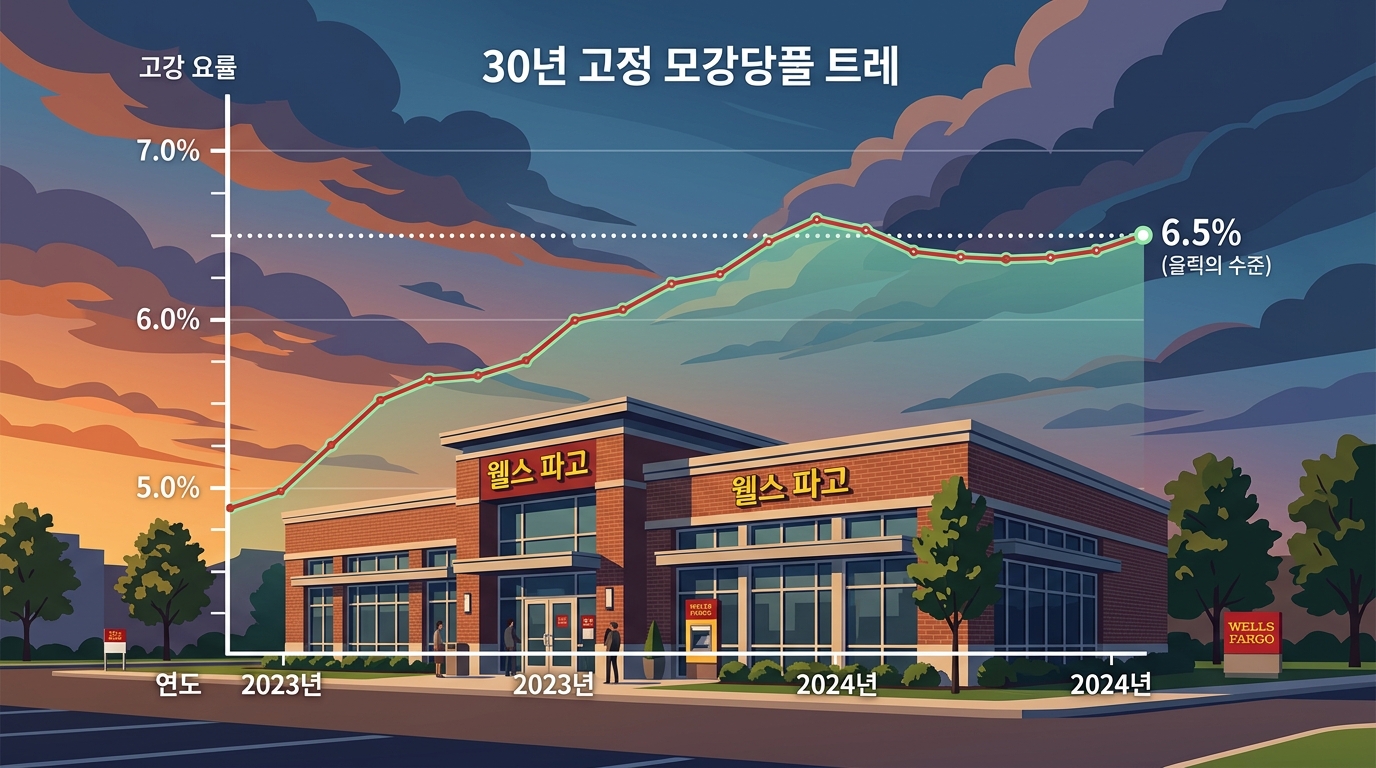
However, amid escalating geopolitical tensions in the Middle East and rising oil prices, the average U.S. 30-year fixed mortgage rate remains sticky at around 6.49%. This margin pressure scenario in the mortgage sector continues to act as a headwind that may limit stock price upside.
[Image: /stdaily/uploads/202607/gen_6a5536054af9e5.48908280.png]
Current Market Overview
The global macroeconomic environment is experiencing an intensifying "tri-polar decoupling" among the United States, Europe, and Asia, with each region moving in distinct directions.
The U.S. maintains relatively resilient economic strength, though prolonged high-interest rate concerns persist due to surging energy prices. In contrast, Asian markets have faltered, with South Korea's KOSPI index slipping to intraday levels of 6806.93 (provisional), consolidating deep into "Extreme Fear" (12.1) territory on its local fear-and-greed index.
Meanwhile, the Nasdaq has demonstrated relative resilience, holding in "Neutral" (49.5) territory at 25915.64. However, the USD/KRW exchange rate has surged to approximately 1,497.70 won, escalating liquidity pressures across emerging markets.
[Image: /stdaily/uploads/202607/gen_6a55360e61ff46.72831748.png]
Financial Analysis
Wells Fargo's consensus revenue for Q2 2026 is projected at $21.87 billion, representing a 4.7% year-over-year increase. Consensus estimates for Earnings Per Share (EPS) range between $1.71 and $1.74.
With the $1.95 trillion asset cap—which constrained Wells Fargo for seven years—officially lifted last year, the bank has unlocked the capacity to attract commercial deposits and expand assets. Nonetheless, the home lending division continues to shrink due to persistently high mortgage rates.
| Metrics | Q2 2026 Consensus Estimate | YoY Change (Projected) | Remarks |
|---|---|---|---|
| **Total Revenue** | Approx. $21.87 billion | +4.7% | Reflects improved deposit & non-interest income post-asset cap removal |
| **Earnings Per Share (EPS)** | Approx. $1.71 ~ $1.74 | +12% ~ +13% | Driven by share buybacks and ongoing efficiency gains |
| **Net Interest Income (NII)** | Approx. $12.36 billion | +5.6% | Driven by accelerated interest margin growth from asset expansion |
| **Mortgage Banking Revenue** | Approx. $228.7 million | Slight decline | Impacted by slowing home buying volume due to high interest rates |
Valuation
Wells Fargo's stock has recently hovered around $87.16, trading at a forward P/E ratio of approximately 13x. This represents a significant valuation discount compared to the S&P 500 average (approx. 25x).
While a conservative Discounted Cash Flow (DCF) model places its intrinsic value in the $74–$75 range, downside protection is provided by an 11% dividend hike ($0.50 per share) enacted following the Fed’s 2026 stress test, alongside an authorized $26 billion share buyback program.
Analyst & Institutional Consensus
Wall Street analysts maintain a constructive outlook, expressing confidence in the gradual upward trajectory of Net Interest Income (NII) now that asset growth restrictions are removed.
Bank of America (BofA) and UBS raised their target prices to $102 and $104 respectively, keeping Wells Fargo as a top pick. The prevailing view is that delayed Federal Reserve rate cuts could actually help asset-sensitive large banks maintain solid Net Interest Margins (NIM).
Risk Factors
The most significant challenge for Wells Fargo lies in the potential deterioration of the U.S. housing market and household credit metrics.
With Freddie Mac's 30-year fixed mortgage rate hovering above 6.49% and rising crude prices rekindling inflation fears, the Fed may delay rate cuts. This prolongs high borrowing costs, elevating mortgage default risks for middle-to-low-income households.
Furthermore, prolonged slowdown concerns in Asia and geopolitical risks across global supply chains could cool corporate investment demand, stalling growth in the commercial lending segment.
Investment Perspective
Wells Fargo is well-positioned to benefit from internal tailwinds like the asset cap removal and a broader trend toward financial deregulation in the United States.
However, the macroeconomic burden of a cooling housing market—stifled by home loan rates near 6.5%—and potential increases in consumer credit losses remain critical risks that investors must monitor closely.
Investor FAQ
Q1. What is the key metric to watch in Wells Fargo's Q2 2026 earnings release?
A1. Rather than EPS, focus on the Net Interest Income (NII) trajectory. With the asset cap removed, the key indicator of Wells Fargo's long-term growth is whether interest profitability is normalizing through commercial funding and core loan expansion.
Q2. Why do U.S. 30-year fixed mortgage rates remain so high?
A2. Rising oil and commodity prices, fueled by Middle East geopolitical tensions, have renewed inflationary pressures. Consequently, halted Fed rate cuts and rebounding Treasury yields have kept mortgage rates near the 6.5% mark.
Q3. How does sticky mortgage pricing negatively impact Wells Fargo's financials?
A3. It dampens new home buying demand and halts refinancing activities. This weakens non-interest fee income in home lending and raises the burden of loan loss provisions.
Q4. What positive shareholder return initiatives has Wells Fargo announced recently?
A4. Following the successful passage of the Fed's 2026 stress test, the bank raised its quarterly dividend by approximately 11% to $0.50 per share and continues to execute its multi-billion-dollar share repurchase program.
Q5. How attractive is Wells Fargo's valuation compared to other Wall Street banks?
A5. Trading at a forward P/E of roughly 13x, its valuation premium is very low. Having been constrained by regulations longer than peers, the stock holds unique conditional appeal as a value play in the financial sector now that its asset growth engine is restored.