Hello.
This is Daily Stock, providing objective, data-driven analysis of key macroeconomic indicators and policy trends in global financial markets.
[Image: /stdaily/uploads/202608/gen_6a70e5ab40f9e8.09861183.png]
Key Summary
- **PMI Rebound and Structural Limits**: The Eurozone's manufacturing PMI for July 2026 continued its recovery trend, recording 51.9. However, it reveals structural limitations, as growth heavily relies on depleting existing order backlogs amid sluggish new orders.
- **Inflation Rebound and ECB's Dilemma**: With the Eurozone's Consumer Price Index (CPI) rebounding to 2.9% month-on-month in July, the possibility of further tightening or prolonged high interest rates is emerging following the European Central Bank's (ECB) decision to freeze key interest rates.
- **Tri-polar Decoupling and Asset Allocation**: While the US (Nasdaq at 25,939.90) and Asia (KOSPI at 6,257.45) diverge based on their respective monetary policy paths and fundamentals, European equities are maintaining a tight balance between manufacturing warmth and inflation vigilance.
Market Overview
On the surface, the Eurozone's economic indicators show a modest recovery, but a closer look at the detailed metrics reveals clear qualitative limitations in its growth.
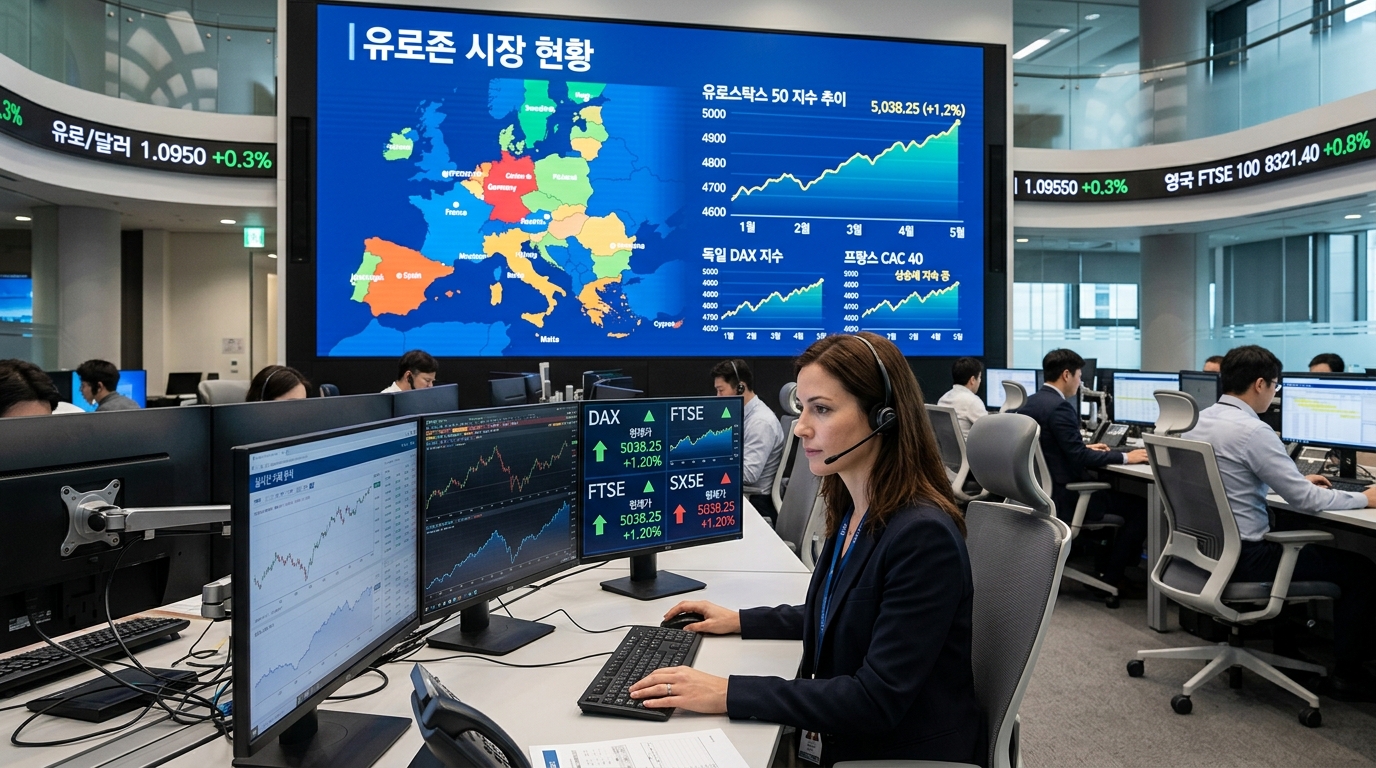
The final Eurozone Manufacturing Purchasing Managers' Index (PMI) for July, released on August 3, 2026, rose slightly to 51.9 from 51.4 in the previous month, marking a three-month high.
However, the inflow of new orders remains extremely sluggish, meaning a significant portion of the increase in factory operating rates was achieved by depleting previously accumulated order backlogs.
At the same time, the Eurozone CPI for July rebounded to 2.9% from 2.8% in the previous month, driven by rising energy prices due to instability in the Middle East.
Consequently, the future monetary policy path of the ECB, which froze its deposit rate at 2.25% during its policy meeting on July 23, is becoming increasingly obscured.
Expectations for further rate cuts within the year are dampening in the market, while scenarios for additional tightening in September or a prolonged period of high interest rates are cautiously emerging.
Financial Analysis
Growth rates and inflation metrics among major Eurozone nations are deepening fundamental imbalances (decoupling) between countries.
The Eurozone's preliminary real Gross Domestic Product (GDP) for the second quarter of 2026 grew by 0.4% quarter-on-quarter, beating market expectations of 0.2%.
However, country-specific data reveals that while Spain (0.7%) led overall growth, core economies like Germany (0.2%), France (0.2%), and Italy (0.2%) barely managed positive growth under downward pressure.
On the inflation front, supply chain disruptions and commodity market volatility pushed energy inflation to 10.0%, adding downward rigidity to the overall inflation rate.
[Image: /stdaily/uploads/202608/gen_6a70e5b6272553.35615409.png]
| Country/Region | Q2 2026 GDP (QoQ) | Final July 2026 Manufacturing PMI | July 2026 Inflation Rate (Prelim) |
|---|---|---|---|
| **Eurozone** | 0.4% | 51.9 | 2.9% |
| **Germany** | 0.2% | 52.2 (Flash) | 2.8% |
| **France** | 0.2% | broad stagnant | 2.4% |
| **Spain** | 0.7% | broad stagnant | 3.8% |
| **Italy** | 0.2% | expansion slowing | 2.9% |
Valuation
European equities recently closed near record highs, supported by gradual economic stabilization and resilient corporate earnings.
The German DAX index hit an intraday historic high of 26,001.31 (provisional) on the last trading day, August 3, 2026, while the Euro Stoxx 50 index also rallied to 6,426.50.
The 12-month forward price-to-earnings (Forward P/E) ratio of European large-cap stocks remains relatively undervalued compared to US tech stocks, offering valuation appeal.
However, looking at the Daily Stock Fear & Greed Index with the Nasdaq trading at 25,939.90 (as of 04:00 KST, August 4, 2026, provisional), temperature differences between markets are clear.
The Nasdaq Fear & Greed Index currently stands at 45.1 (37.6 a week ago, 32.5 a month ago, 49.8 three months ago), indicating a neutral sentiment.
In contrast, South Korea's KOSPI is trading at 6,257.45 with its Fear & Greed Index at 17.4 (12.5 a week ago, 19.8 a month ago, 66.5 three months ago), remaining deeply entrenched in "Extreme Fear."
In this tri-polar decoupling phase across the US, Europe, and Asia, European equities face dual forces—attractive relative valuation versus concerns over prolonged ECB tightening—which may limit further upside.
Professional & Institutional Analysis
Global financial institutions are focusing on the "loss of momentum" hidden behind the temporary rebound in Eurozone manufacturing.
Chris Williamson, Chief Business Economist at S&P Global Market Intelligence, warned that while European factories showed a temporary summer production spurt, the lack of improvement in new orders poses a risk of slowing recovery momentum heading into autumn.
Bert Colijn, Senior Economist at Dutch investment bank ING, pointed out that geopolitical tensions could transmit energy cost pressures to Eurozone households and businesses.
He noted that unless Middle East risks are permanently resolved, potential inflationary pressures could flare up, dealing an additional shock to year-end inflation data.
Finnish financial group Nordea also assessed that core Eurozone inflation is likely to remain above the ECB's 2.0% target throughout 2026 and 2027, supporting scenarios of potential rate hikes rather than cuts.
Risk Factors
- **Production Cliff from Sluggish New Orders**: Although the manufacturing PMI is rising, new orders are not growing in tandem, risking a temporary production slowdown after autumn once existing backlogs are depleted.
- **Geopolitical Conflicts and Supply Chain Disruptions**: Continued tensions in the Gulf and the Middle East remain direct triggers for volatility in crude oil and natural gas prices.
- **Declining Rhine Water Levels and Logistics Bottlenecks**: Heatwaves and high temperatures are sharply reducing water levels in Germany's Rhine River, a key European logistics artery, potentially disrupting raw material procurement for chemical and heavy industries.
[Image: /stdaily/uploads/202608/gen_6a70e5bef22af3.70093285.png]
- **Climate Transition Framework Regulations**: The ECB's decision to expand climate transition risks in collateral assessments (applying hair cuts of up to 5%) raises concerns about indirect tightening, as funding costs will rise for companies lagging in green initiatives.
Investment Perspective
From an investment perspective, Eurozone assets can be a strong alternative for short-term earnings defense compared to US and emerging markets, but investors should remain cautious of the lack of organic improvement in private demand.
The rebound in manufacturing PMI (51.9) and the GDP surprise (0.4%) support the market floor, but expectations of the ECB maintaining a hawkish stance due to rising inflation will likely cap valuation re-rating.
Investors should monitor the excessive contraction in Asian markets (KOSPI) and technical trends in the Nasdaq, while considering Eurozone sectors with low external regulatory risks and stable domestic revenue bases as defensive options.
In particular, close attention should be paid to upcoming commodity inventory trends and the ECB's policy direction in the autumn.
FAQ
Q1. Can the Eurozone manufacturing PMI rebound in July 2026 be interpreted as an entirely positive signal?
A1. While the recovery of the manufacturing PMI to 51.9 is encouraging, it was driven more by clearing backlog orders rather than a surge in new orders, leaving the sustainability of the recovery in doubt.
Q2. Why did the ECB freeze interest rates at its July meeting?
A2. To strike a balance between rising energy price risks from geopolitical instability and signs of real economic contraction, the ECB held its deposit rate at 2.25%, maintaining a data-dependent, cautious stance.
Q3. Why did the Eurozone's July inflation data rise again?
A3. Geopolitical shocks in the Middle East drove energy sector inflation up to 10.0%, while service sector prices also faced upward pressure.
Q4. What is the impact of the ECB's recently expanded "climate transition collateral framework"?
A4. It reduces the recognized value of collateral, such as corporate bonds of high-carbon emitting companies, by up to 5% when commercial banks pledge them. This is expected to tighten funding for carbon-heavy firms.
Q5. How does current investment sentiment in the Korean stock market (KOSPI) differ from global markets?
A5. As of intraday trading on August 4, 2026, the KOSPI Fear & Greed Index stands at 17.4 ("Extreme Fear"), whereas the Nasdaq equivalent is at 45.1 ("Neutral"), highlighting a clear decoupling.