Hello, this is Daily Stock, delivering the key context of global financial markets.
[이미지: /stdaily/uploads/202609/gen_6aa995d6352472.07674666.png]
Executive Summary
LVMH (MC), the top market-cap luxury heavyweight driving France's CAC 40 index, has entered a sharp share price correction phase after taking a direct hit from weakening Chinese consumer sentiment.
As middle-class spending on "entry-level luxury" slows down amid China's property market slump and high youth unemployment, the multiple re-rating thesis across the broader European luxury sector is being put to the test.
While US equity markets hold ground on the back of resilient AI- and Big Tech-centered capital expenditure, European index relative strength is softening due to its heavy reliance on luxury and manufacturing, highlighting a clear tri-polar decoupling across the US, Europe, and Asia.
Investors should take a multifaceted look at the actual stimulative effects from the People's Bank of China (PBOC) and the pace of European Central Bank (ECB) monetary easing, rather than viewing this solely as an oversold dip.
Current Market Overview
Global financial markets are displaying an unmistakable tri-polar decoupling.
The US stock market continues to justify elevated valuations driven by relatively resilient domestic consumer demand and Big Tech earnings defense; however, the Daily Stock Nasdaq Fear & Greed Index currently stands at Fear (30.3), showing elevated caution compared to Greed (64.3) a month ago.
In contrast, Asian emerging markets and Europe are clearly exhibiting fundamental fatigue.
Domestic Korean markets also stand at KOSPI 6627.26, KOSDAQ 812.41, and USD/KRW at 1360.30, with the KOSPI Fear & Greed Index showing a rapid intraday cooling to Fear (25) from Neutral (50.9) last week (provisional basis).
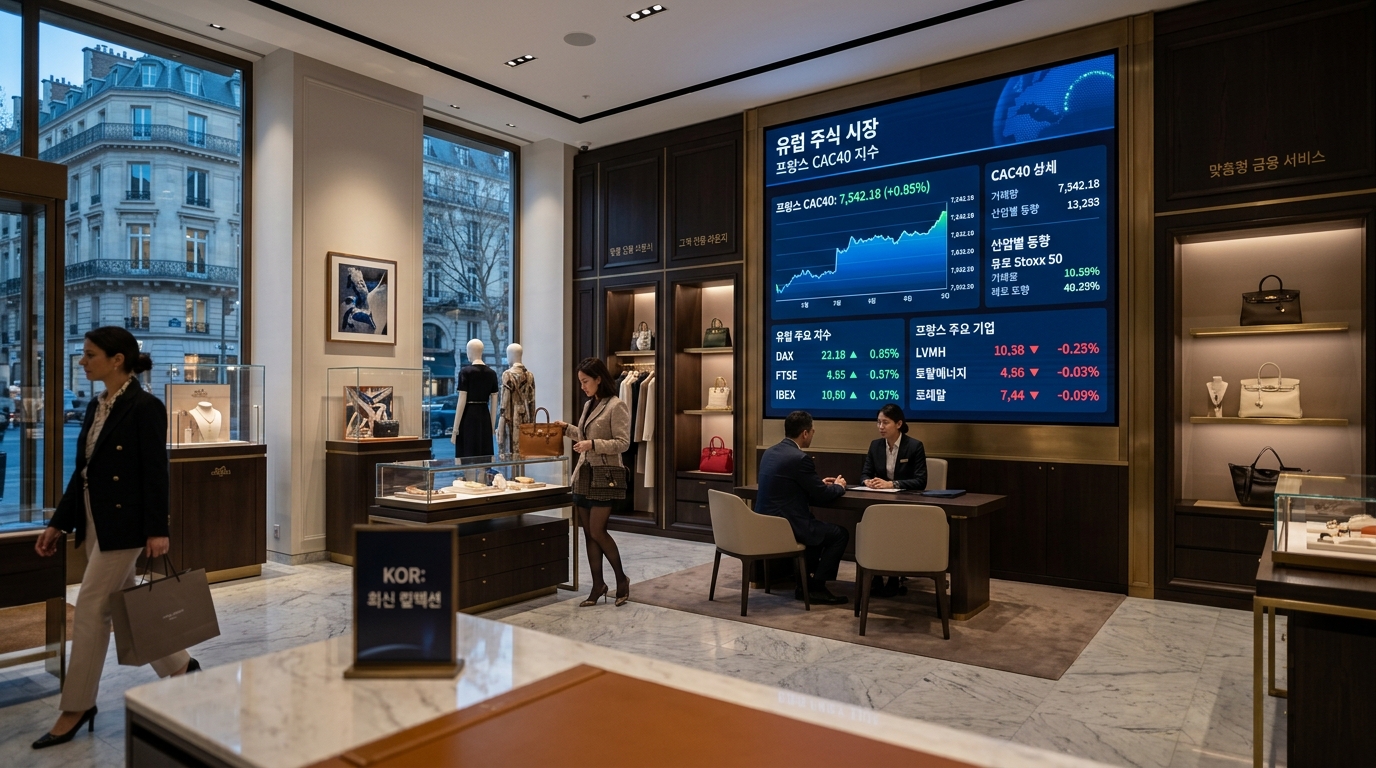
France's CAC 40, the heart of European equity markets, has an absolute dependency on luxury, with the Big 4 luxury and beauty names—LVMH, Hermès, Kering, and L'Oréal—accounting for over 30% of total index market capitalization.
However, LVMH shares on Euronext Paris have retreated toward multi-year lows, and selling pressure has intensified as major investment banks such as Bernstein consecutively lowered their target prices.
| Market Region | Benchmark Index / Stock | Key Drivers | Relative Strength & Policy Environment |
|---|---|---|---|
| **United States (North America)** | S&P 500 / Nasdaq 100 | AI capex and defensive employment indicators | Resilient but valuation overhang persists; watching Fed pivot trajectory |
| **Europe** | France CAC 40 / LVMH (MC) | Luxury brand exports and China dependency | Manufacturing PMI weakness; rising calls to accelerate ECB rate cuts |
| **Asia (Asia/China)** | Hang Seng / China CSI 300 | Real estate downturn and deflationary pressure | Continued PBOC liquidity injections; prolonged delay in domestic consumer recovery |
Financial Analysis
LVMH's earnings trajectory clearly indicates that the explosive post-pandemic "revenge spending" cycle has drawn to a close, transitioning into a phase of structural normalization and deceleration.
Revenue growth in the Fashion & Leather Goods division (Louis Vuitton, Dior, etc.)—the core pillar contributing over half of group operating profit—has slowed to single digits or stalled entirely.
Continued organic revenue declines across Greater China (Asia excluding Japan), which previously spearheaded double-digit growth, remain a major headwind for earnings recovery.
While luxury sales in Japan temporarily benefited from the weak yen, the rebound of the yen combined with brand pricing harmonization strategies is gradually normalizing overseas outbound shopping demand.
Meanwhile, the Wines & Spirits division (Moët & Chandon, Hennessy cognac, etc.) is merely defending subdued margins amid wholesale inventory destocking across major economies and a pullback in premium spirits consumption.
The aggressive price-hike playbook used to counter rising input costs is running into limitations, as volume declines increasingly offset price increases across the financial statements.
[이미지: /stdaily/uploads/202609/gen_6aa995e0d08d65.84905909.png]
Valuation
With LVMH's latest confirmed levels trading in the €400–€420 range (intraday quotes unconfirmed), the stock has reached valuation multiples not seen in 5 to 6 years.
Its 12-month forward price-to-earnings (P/E) ratio, which historically traded above 25x–30x, has compressed toward the high teens to low 20s, deepening its multiple discount relative to past cycles.
However, market experts are cautious about labeling this purely as an "undervaluation opportunity."
As cracks appear in the fundamental pillar of the luxury industry—"pricing power"—analysts are concurrently cutting forward earnings per share (EPS) estimates.
Unlike Hermès, which continues to protect its premium multiple thanks to a heavy concentration of ultra-high-net-worth clients, LVMH faces a dual challenge due to its higher exposure to affluent and aspirational consumers.
Consequently, any sustained share price rebound will rely not on multiple expansion, but on tangible proof that Chinese retail traffic and earnings growth rates have hit bottom.
Expert & Institutional Insights
Global investment banks are significantly lowering their expectations for LVMH and the broader European luxury sector.
Bernstein recently lowered its price target on LVMH from €570 to €520, citing decelerating growth in Louis Vuitton's Fashion & Leather Goods unit in China along with growing product affordability issues.
HSBC also adopted a more conservative stance, noting that sluggish mainland Chinese demand and geopolitical uncertainties are capping organic top-line growth across the luxury industry.
Experts emphasize that while brand desirability itself remains largely intact, the cumulative aggressive price hikes over the past few years have hit consumers' breaking point, turning high price points into entry barriers.
Taking broader Asian macroeconomic conditions into account, consensus suggests that a meaningful luxury turnaround is unlikely until further PBOC liquidity support and fiscal stimulus translate directly into higher household disposable income.
Additionally, while European Central Bank (ECB) monetary easing helps support Eurozone domestic demand, analysts assess that it alone cannot trigger a fundamental rebound for LVMH, given its overwhelmingly global revenue exposure.
Risk Factors
The most critical risk is the entrenched "negative wealth effect" caused by the prolonged slump in the Chinese property market.
As Chinese middle-class consumers who experienced asset depreciation rein in conspicuous consumption and pivot toward practical spending, any recovery in luxury sales could face prolonged delays.
Second is the threat of global geopolitical conflicts and supply chain disruptions.
Tensions in the Middle East around the Strait of Hormuz and energy supply anxieties are lifting crude oil prices, raising concerns over reignited global inflation.
A rebound in oil prices erodes the real purchasing power of European and global consumers while dampening long-haul international travel and duty-free shopping.
Third is the potential backlash from the rise of domestic brands and trade friction.
The rise of "Guochao" (patriotic consumer trends) in China, increasing preference for domestic brands, and intellectual property friction with Western labels are injecting immediate volatility into brand perception and store foot traffic.
Investment Perspective
The French CAC 40 luxury sector, including LVMH, is currently traversing a transition phase, shifting from "growth stocks" to "cyclical value plays."
Therefore, even if European equities look valuation-attractive relative to the US amidst this tri-polar decoupling, it remains premature to project a sustained trend rally beyond a technical rebound until concrete turnarounds appear in Chinese domestic consumption data.
From an investment strategy standpoint, a cautious approach utilizing dollar-cost averaging is warranted over aggressive accumulation.
A prudent scenario involves closely tracking rebounds in global manufacturing and services PMIs, monitoring actual sell-through trends around major Chinese shopping events like Golden Week, and maintaining active risk management throughout.
Investor Checkpoint Q&A
Q1. What is the primary reason behind LVMH's persistent share price weakness?
A. While consecutive years of aggressive price increases met consumer resistance, entry-level luxury demand collapsed sharply due to the real estate downturn and youth employment headwinds in mainland China, its primary growth engine.
Q2. Why is the French CAC 40 index so closely correlated with LVMH's stock performance?
A. Luxury and beauty companies—such as LVMH, Hermès, Kering, and L'Oréal—account for more than 30% of the CAC 40's total weighting, meaning earnings slowdowns in the luxury sector directly lead to relative underperformance for the broader index.
Q3. Where does the European luxury sector stand within the global tri-polar decoupling structure?
A. While the US establishes distinct momentum on Big Tech AI capital expenditure and Asia focuses on curbing deflationary forces, Europe is heavily dependent on luxury exports to China and durable goods, making it directly vulnerable to global consumption polarization.
Q4. Can PBOC stimulus measures act as an immediate catalyst for LVMH?
A. While liquidity injections can boost near-term market sentiment, there is a time lag before stabilization in property values—the core of household wealth—translates into improved consumer sentiment and tangible foot traffic in retail stores.
Q5. Which macroeconomic indicators should investors monitor most closely going forward?
A. Investors should comprehensively monitor Chinese retail sales and consumer confidence indices, the ECB's rate-cut cadence, and whether surges in energy prices dampen global aviation and tourism expenditures.