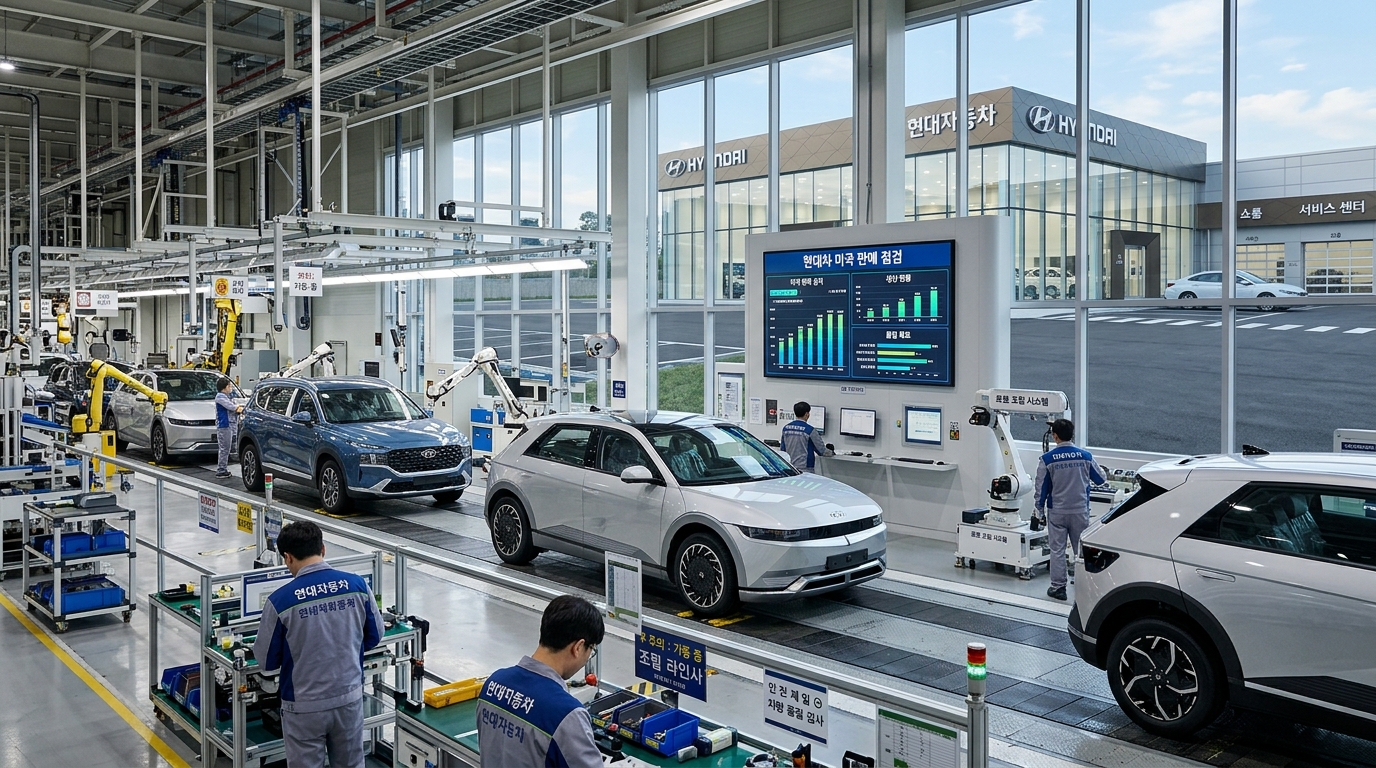
Hello, this is the financial writer from Daily Stock. Today, we will conduct a comprehensive review of the U.S. sales and business performance of Hyundai Motor (005380), one of the most dynamic performers in terms of earnings and sales among KOSPI large-cap stocks.
Key Summary
- In the first half of 2026, cumulative U.S. sales reached a historic high of 489,656 units for Hyundai Motor alone, with hybrid electric vehicles (HEVs) driving this quantitative growth.
- On the other hand, consolidated revenue for the second quarter of this year hit an all-time high of 49.2153 trillion KRW, but operating profit fell 20.8% year-on-year to 2.8509 trillion KRW, impacted by rising raw material prices and parts supply disruptions.
- With the valuation of KOSPI large-caps being tested amid high exchange rates and high interest rates, the key lies in whether the company can defend its profitability through production normalization and the launch of new models in the second half of the year.
[Image: /stdaily/uploads/202607/gen_6a6af6da377797.53153562.png]
Current Situation Summary
Through its Q2 2026 earnings results announced on July 23, Hyundai Motor received a report card showing clear top-line growth contrasted with a slowdown in profitability. Even amid the general contraction of global automotive demand, its growth centered on hybrid vehicles in the U.S. market was fierce.
In fact, Hyundai Motor and Kia's U.S. sales in the first half of 2026 reached 920,383 units, up 3.0% year-on-year, breaking the previous record for the first half of any year. Of this, Hyundai Motor recorded 489,656 units, a 2.7% increase, which includes U.S. sales of 39,088 units (a 4.6% increase) for the Genesis luxury brand.
However, behind this glory lay the shadow of rising cost ratios. Due to a fire at Anjeon Industry and chain fires at Hyundai Mobis's India plant, the supply of parts for major high-margin models was constrained, leaving global wholesale sales at 991,885 units, down 6.9% year-on-year.
As a result, on July 30, 2026, Hyundai Motor closed at 347,500 KRW, down 1.70% from the previous day (353,500 KRW). On this day, institutional investors net purchased 158,267 shares, while foreign investors net sold 143,339 shares, adding downward pressure to the stock price.
According to Daily Stock's own Fear & Greed Index, the KOSPI is currently in the "Extreme Fear (11.9)" phase. This is a decline from the "Extreme Fear (17.3)" recorded a week ago, reflecting an intensifying preference for safe-haven assets across the market as global macroeconomic concerns spread.
Financial Analysis
Hyundai Motor's financial statements for the second quarter of this year benefited from the strong dollar, as the average USD/KRW exchange rate remained at 1,502 KRW, up 7.0% year-on-year. However, the cost of goods sold (COGS) ratio rose 1.1 percentage points year-on-year to 82.2%, intensifying cost pressures.
The key factor limiting profitability was the surge in raw material procurement costs, such as plastics, caused by the prolonged instability in the Middle East. Additionally, operating losses resulting from high-rate tariffs imposed by the U.S. government reached approximately 900 billion KRW per quarter, eating away at core business profitability.
| Classification | Q2 2026 Performance | YoY Growth Rate | Note |
|---|---|---|---|
| **Global Wholesale Sales** | 991,885 units | -6.9% | Includes impact of fires at parts suppliers |
| **U.S. Market Sales** | 264,587 units | +0.9% | Maintained 6% market share for 5 consecutive quarters |
| **Consolidated Revenue** | 49.2153 trillion KRW | +1.9% | Achieved historic quarterly revenue record |
| **Consolidated Operating Profit** | 2.8509 trillion KRW | -20.8% | Affected by raw material cost rise & tariffs |
| **Net Profit** | 2.8880 trillion KRW | -11.2% | Partially offset by financial & other sectors |
| **Operating Profit Margin (OPM)** | 5.8% | -1.7%p | Deteriorated from 7.5% in the previous year |
[Image: /stdaily/uploads/202607/gen_6a6af6e37b5eb7.31581503.png]
Valuation
Currently, Hyundai Motor's Price-to-Earnings (P&E) ratio (PER) stands at around 9.20x, trading at a slight premium compared to the industry average of 7.59x. Its Price-to-Book (P/B) ratio (PBR) is maintained around 0.77x, indicating that it remains undervalued in terms of asset value.
Recently, the stock price adjusted significantly from its 52-week high of 750,000 KRW to reach the 340,000 KRW range. The burden of valuation has been largely relieved as expectations for a multiple re-rating returned to actual business performance.
Particularly, when comparing valuations between KOSPI 200 large-caps and global automotive peer groups (such as GM, Ford, and Toyota), Hyundai Motor's dividend yield and active corporate value-up program (maintaining a quarterly dividend of 2,500 KRW per common share) serve as a strong floor for the stock.
Expert and Institutional Analysis
Although Hyundai Motor's Q2 operating profit fell short of market consensus, securities analysts suggest this represents an "earnings bottom" caused by temporary parts disruptions. This is because the impact of the fires and production gaps has been sequentially resolved since the end of June.
Recently, DS Investment & Securities maintained its target price of 840,000 KRW in a post-NDR (Non-Deal Roadshow) report, positively evaluating the strong second-half new model cycle and momentum in the robotics division. Conversely, reflecting global macroeconomic uncertainties, Yuanta Securities conservatively lowered its target price to 570,000 KRW, creating a wide gap of up to 330,000 KRW among brokerage houses.
Furthermore, experts analyze that profitability could improve as revenue recognition begins in earnest for the new Tucson, Avante, and Genesis GV80 Hybrid (HEV) models to be deployed in the U.S. market in the second half of the year.
Risk Factors
The largest macroeconomic variable is the ongoing volatility of the USD/KRW exchange rate. As of today, the USD/KRW exchange rate closed at 1,436.70 KRW, maintaining a favorable environment for export enterprises. However, if it shifts to a sharp decline in the future, there is a risk of increased conversion burdens for overseas sales warranty costs.
Additionally, risks of additional high tariffs due to changes in the trade environment after the U.S. presidential election, along with supply chain instability caused by tensions in the Middle East, are persistent factors driving up Hyundai Motor's global production costs.
Delays in the Bank of Korea's interest rate cuts or concerns over additional tightening could also shrink the global auto installment financing market, further freezing consumer sentiment.
[Image: /stdaily/uploads/202607/gen_6a6af6ed7aa673.33647041.png]
Investment Outlook Summary
Hyundai Motor is sustaining its top-line growth by establishing a dominant position in the hybrid segment of the U.S. eco-friendly vehicle market. Although temporary production disruptions dragged the operating profit margin down to the 5% range, this is highly likely to be a one-off issue, making the normalization scenario after Q3 highly viable.
The weakening trend of the Korean Won is a strong support for top-line revenue. However, since the broader index has entered the "Extreme Fear" zone, a staggered buying approach and hedging strategies using preferred shares (which highlight dividend yields) may be more useful than aggressive buying.
In the long run, how quickly the mixed-production flexibility of the Hyundai Motor Group Metaplant America (HMGMA) in Georgia responds to hybrid demand will determine the speed of the stock price recovery.
Investor Checklist Q&A
Q1. What caused the sharp decline in Hyundai Motor's Q2 2026 operating profit?
- A1. It was caused by a combination of production disruptions due to fires at a supplier (Anjeon Industry) and an overseas plant (Hyundai Mobis India), surging raw material prices, and the burden of approximately 900 billion KRW in high U.S. tariffs.
Q2. How are hybrid electric vehicle (HEV) sales performing in the U.S. market?
- A2. In the first half, Hyundai Motor and Kia's hybrid sales in the U.S. surged 65.5% year-on-year to 225,321 units, leading eco-friendly vehicle performance amid high oil prices.
Q3. Is the current stock price and valuation level attractive?
- A3. As of the July 30 closing price of 347,500 KRW, with a P/E ratio of 9.20x and a P/B ratio of 0.77x, the valuation burden is relatively lower compared to previous peaks, placing it in an undervalued range.
Q4. Why is there such a large difference in target prices suggested by securities firms?
- A4. Yuanta Securities conservatively set a target of 570,000 KRW due to global economic slowdown concerns, whereas Eugene Investment & Securities set a target of 900,000 KRW by looking positively at production normalization and new robotics business value in the second half, showing a discrepancy of 330,000 KRW.
Q5. What are the major earnings recovery momentums for Hyundai Motor in the second half?
- A5. Major drivers include the normalization of production disruptions caused by fire accidents, full-scale production at the U.S. Metaplant, and the official U.S. launches of the new Tucson and Avante Hybrids, as well as the high-value Genesis lineup.