Hello, this is Daily Stock, delivering the fastest updates on key changes and liquidity flows in the global financial markets.
Summary
While global stock markets have recently undergone corrections due to concerns over earnings from major US tech companies and semiconductor supply fatigue, Hong Kong's Hang Seng Index is showing relative strength, supported by inflows of Chinese mainland capital (Southbound Capital).
The average daily turnover (ADT) of Southbound Capital is nearing an all-time high of HKD 123.1 billion, providing a solid floor for the index.
In particular, a price-to-earnings (P/E) ratio of 9.8x—less than half of the US Nasdaq—and a historic discount rate of 37% compared to A-shares are acting as powerful catalysts for mainland capital inflows.
Current Market Overview
The global financial market is exhibiting a clearer fundamental decoupling among the US, Europe, and Asia.
While the US Nasdaq Index corrected around the 24,734.91 level, South Korea's KOSPI (5,663.24) and KOSDAQ (662.68) showed sluggish intraday performance (tentative).
The USD/KRW exchange rate also remained high at 1,445.50 won, compounding capital outflow pressure on emerging market equities.
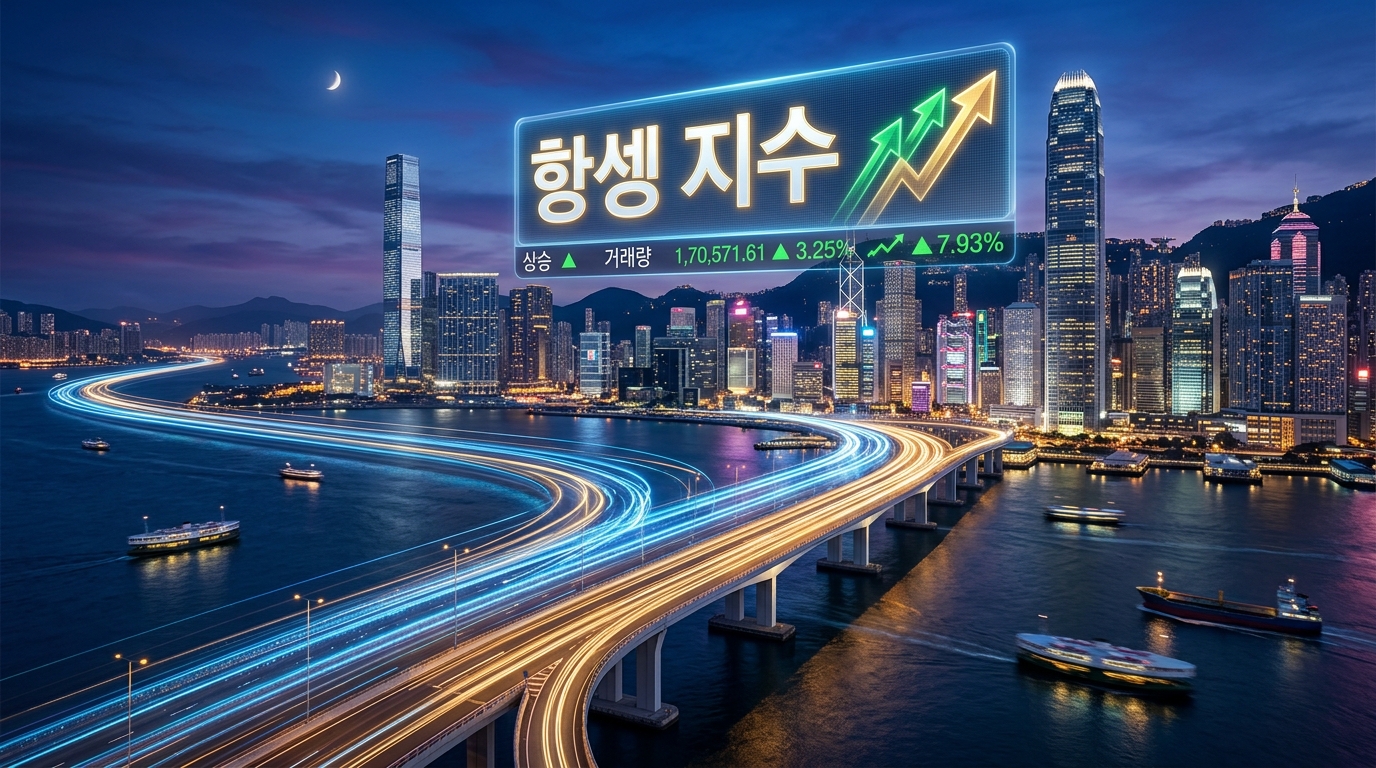
Conversely, the Hong Kong Hang Seng Index surged 1.96% to 25,807.92 points on July 29, hitting an 8-week high, and continues to demonstrate solid downward rigidity during today's intraday trading on July 30 (tentative).
[Image: /stdaily/uploads/202607/gen_6a6a4e6ae45a25.66986159.png]
According to Daily Stock's proprietary Fear & Greed Index, the KOSPI Fear & Greed Index currently stands at Extreme Fear (12.2), freezing further from last week's level of 17.3.
The Nasdaq Fear & Greed Index also dropped to Fear (39.5) from Neutral (43.3) a week ago, reflecting a broader weakening of global risk appetite.
Financial Analysis
The financial metrics supporting capital inflows into the Hong Kong stock market strongly highlight arbitrage opportunities for mainland investors.
The AH Discount index, which measures the price gap of dual-listed "A+H shares" in mainland China and Hong Kong, averages around 37%, indicating that Hong Kong-listed shares are extremely undervalued.
| Indicator | H1 2026 Performance / Value | YoY Change | Key Features & Characteristic Elements |
|---|---|---|---|
| **Southbound Capital ADT** | HKD 123.1 Billion | +10.9% | Record-high mainland liquidity flowing into Hong Kong |
| **Hang Seng Average P/E Ratio** | 9.8x ~ 10.2x | Deepening Undervaluation | Significantly undervalued compared to Nasdaq (28x) and CSI 300 (13.5x) |
| **A+H Share Average Discount (AH Discount)** | Approx. 37% off | Widening Discount | Bargain buy advantages for identical companies listed in Hong Kong |
| **New IPO Fundraising Size** | Approx. HKD 210.2 Billion | +92.1% | Positive momentum driven by mega-IPOs like fast-fashion giant Shein |
Such extreme price advantages present an attractive entry point for mainland Chinese institutional investors building long-term portfolios.
Furthermore, the Hang Seng Tech Index's structural upgrade—incorporating major Chinese generative AI startups such as Zhipu AI and MiniMax into its portfolio—is also seen as a positive development.
Valuation
Compared to major global indices, the Hang Seng Index's valuation appeal is outstanding.
While the Nasdaq trades at a P/E of 28x and mainland China's CSI 300 is at 13.5x, the Hang Seng Index remains at a modest 9.8x P/E.
[Image: /stdaily/uploads/202607/gen_6a6a4e746690e8.63770395.png]
Global hedge funds and mainland capital are pivoting away from overvalued US big tech markets to allocate capital toward undervalued, high-quality Asian equities.
In this rotation, the Hong Kong market is serving as a safe haven, drawing funds away from India's SENSEX (where valuation limits have been tested) and South Korea/Japan (which are hampered by semiconductor sector concerns).
Expert & Institutional Analysis
Experts analyze the recent rebound in the Hong Kong stock market as a resumption of institutional bets on "China Beta" rather than a simple technical bounce.
Global investment banks (IBs) expect Hong Kong to be the primary beneficiary when capital shifts back to emerging markets as the US Federal Reserve enters its rate-cut cycle.
In particular, major Hong Kong-listed platform companies like Xiaomi and Meituan have surged by around 45% and 37%, respectively, over the past month, demonstrating the sheer volume of dip-buying interest.
Additionally, news that fast-fashion giant Shein is targeting a Hong Kong IPO with a valuation of up to $50 billion is further boosting expectations for improved liquidity.
Risk Factors
However, macro risks surrounding the Hong Kong stock market remain substantial, requiring careful vigilance.
First, geopolitical risks, particularly escalating tensions around the Strait of Hormuz, continue to threaten global supply chains.
Although international oil prices temporarily eased to around $88 per barrel, any recurrence of Middle East conflicts could reignite global inflation via commodity price spikes.
[Image: /stdaily/uploads/202607/gen_6a6a4e7cdcc2d8.30254444.png]
Furthermore, if the pace of domestic demand recovery in mainland China lags market expectations, the mid-to-long-term earnings growth of major tech platform companies could be limited.
Investment Outlook
In conclusion, the Hong Kong Hang Seng Index currently possesses dual tailwinds: historically low valuations and massive inflows of mainland capital.
Should the People's Bank of China (PBOC) introduce further monetary easing measures amid global policy decoupling, the scenario for stronger Southbound Capital inflows remains highly plausible.
However, given variables such as geopolitical supply chain instability and US-China trade tensions, a phased buying approach to hedge against temporary volatility appears advisable.
Investor Checklist Q&A
Q1. What exactly is Southbound Capital?
A1. It refers to mainland Chinese capital used by investors to purchase Hong Kong-listed shares through the Stock Connect mutual market access program linking the Shanghai/Shenzhen Stock Exchanges with the Hong Kong Stock Exchange.
Q2. Why is the Hang Seng Index so undervalued compared to other global indices?
A2. Prolonged geopolitical tensions and concerns over China's slowing domestic economy led to massive global capital outflows, driving the index's P/E down to 9.8x, which has recently highlighted its earnings recovery and valuation appeal.
Q3. What does a 37% AH Discount mean for investors?
A3. It means that Hong Kong-listed shares (H-shares) are trading at an average of 37% cheaper than the identical companies' shares listed in the mainland (A-shares), maximizing their price competitiveness.
Q4. What changes were made in the recent Hang Seng Tech Index portfolio reconstitution?
A4. The index has shifted its focus from hardware and e-commerce toward AI technology by newly including innovative next-generation generative AI firms in China, such as Zhipu AI and MiniMax.
Q5. What is the most critical risk that investors should watch?
A5. Key risks include fluctuations in international crude oil and commodity prices driven by geopolitical events like the Strait of Hormuz tensions, and the potential delay in mainland China's long-term domestic economic recovery.