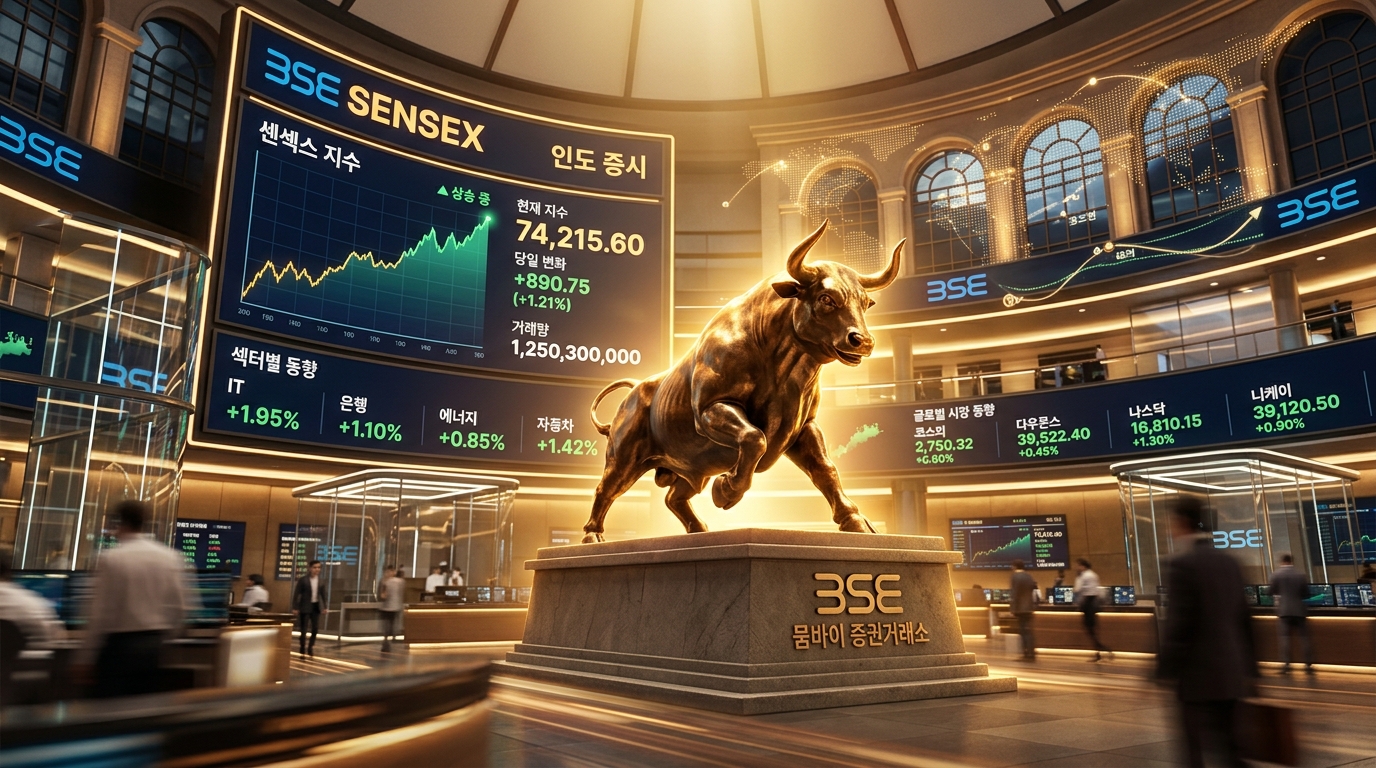
Hello, this is Daily Stock. Today, we will take an in-depth look at the Indian stock market and the shifts in foreign investor demand, which are gaining fresh attention amid the global rotation of capital.
Key Summary
- India's benchmark stock index, SENSEX, is drawing attention as foreign portfolio investors (FPIs) return to buying, despite recent global geopolitical instability and the burden of high oil prices.
- Snapping a record selling streak that persisted through the first half of 2026, foreign capital saw a net inflow of approximately ₹17,227 crore (over $2 billion) into the Indian stock market in July.
- A "decoupling" phenomenon is being detected where global funds, feeling fatigued by concentrated semiconductor investments in East Asia (South Korea, Taiwan), are shifting toward Indian large-cap stocks.
- However, Brent crude prices, which have breached $98 per barrel and threaten the $100 mark, alongside Middle East geopolitical risks, remain variables suppressing further gains in the Indian stock market.
Current Market Overview
- As of intraday trading on July 24, 2026 (tentative), India's BSE SENSEX index has shown a downward trend for the past four consecutive trading sessions, moving around the 76,391.39 level.
- Although India experienced historical foreign capital outflows amounting to 2.6 trillion rupees (approx. $31 billion) during the first half of the year (January to June), FPIs turned sharply to net buyers in July.
- Uncertainty over the US Fed's rate path and global funds' desire to diversify portfolios away from East Asian semiconductor tech stocks have highlighted India's valuation attractiveness.
- However, as Brent crude surged due to energy supply chain risks in the Middle East—such as the Yemen Houthi rebels' attacks on Saudi tankers and US-Iran tensions—the Indian stock market is facing short-term profit-taking pressure.
[Image: /stdaily/uploads/202607/gen_6a626d47534a35.54176264.png]
Financial Analysis
- India's macroeconomic indicators maintain the strongest GDP growth momentum among major economies, backed by robust services and manufacturing PMIs.
- However, the surge in crude oil prices—a commodity for which India heavily relies on imports—is testing its financial health by widening the current account deficit (CAD) and putting downward pressure on the rupee.
- According to the Reserve Bank of India (RBI) report in July, the current account registered a deficit of $2 billion in May 2026, deteriorating significantly from a surplus of $700 million in the same period last year.
| Indicator | Latest 2026 Value & Trend | Notes |
|---|---|---|
| **BSE SENSEX Index** | 76,391.39 level (Intraday tentative) | Weak trend for 4 consecutive sessions |
| **July FPI Net Inflow** | Approx. ₹17,227 crore | First rebound after 4 consecutive months of net selling |
| **YTD Cumulative FPI Outflow** | Approx. ₹2.57–2.6 trillion | Exceeded outflows from the same period in 2025 |
| **Brent Crude Futures** | Around $98.32/barrel (Recent surge) | Driven by escalating Middle East geopolitical crisis |
| **India May Current Account** | $2 billion deficit | Deteriorated from a $700 million surplus YoY |
Valuation
- While the US Nasdaq (Fear & Greed Index: Neutral 43.2) and Eurozone indices fluctuate due to AI bubble concerns and economic slowdown fears, India exhibits relative defensiveness driven by domestic demand.
- Indeed, as of intraday on July 24, 2026 (tentative), South Korea's KOSPI index stands at 7,096.89 and the US Nasdaq is at 25,053.66, reflecting global market volatility.
- Global liquidity, which had been heavily concentrated in the East Asian semiconductor belt (KOSPI Fear & Greed Index: Extreme Fear 14.3), is showing signs of dispersing due to "semiconductor fatigue."
- However, the Price-to-Earnings (P/E) ratio of the SENSEX index sits at the upper end of its historical average, meaning its valuation appeal could dilute rapidly if rising oil prices squeeze corporate margins.
Expert & Institutional Analysis
- The Chief Investment Strategist at Geojit Investments, a leading Indian financial institution, noted, "As the concentration in semiconductor-focused markets like South Korea and Taiwan eases, foreign investors are turning to India as an alternative."
- Morningstar Investment Research Center explained, "The correction phase brought large-cap valuations down to reasonable levels, stimulating selective buying by institutional investors."
- On the other hand, the research team at SBI Securities projected, "While FPI inflows into the bond and stock markets are mixed, the continuity of these capital flows will depend on whether oil prices break past the $100 barrier."
[Image: /stdaily/uploads/202607/gen_6a626d50a1f458.98445592.png]
Risk Factors
- **Middle East Geopolitical Risk & High Oil Prices**: Yemen Houthi attacks on Saudi tankers and intensifying US-Iran tensions push oil prices up, increasing the cost burden on Indian companies.
- **Current Account & Currency Instability**: Rising oil prices increase the demand for import payments, weakening the Indian Rupee and directly widening the current account deficit.
- **US Interest Rate Uncertainty**: The possibility of a prolonged high-interest-rate environment could slow down capital inflows to emerging markets and trigger a repatriation of funds back to dollar assets.
Investment Perspective Summary
- Amid the global three-pole decoupling (softening of US tech stock dominance, European economic sluggishness, and Asian currency weakness), India is in a transitional phase, emerging as a strong alternative destination.
- Although temporary capital outflows from Asia's highly semiconductor-dependent markets have benefited India, the possibility that this is a one-off portfolio rebalancing cannot be ruled out.
- Therefore, it may be rational for investors to monitor oil price trends and earnings announcements focused on Indian large-caps while adopting a split-purchase approach.
Investor Checklist Q&A
Q1. What is the key reason for foreign portfolio investors (FPIs) turning into net buyers in the Indian stock market recently?
A1. Global funds, fatigued by the concentration of capital in East Asian semiconductor tech stocks (such as in South Korea and Taiwan), are returning capital to relatively stable Indian large-cap stocks to diversify their portfolios.
Q2. What is the current state of India's macroeconomic health and current account?
A2. While the underlying health of the service and manufacturing sectors remains robust, rising oil prices have increased import costs, putting short-term pressure on the economy as the current account turned to a $2 billion deficit in May 2026.
Q3. What is the biggest external threat to the SENSEX index?
A3. The greatest risks are whether Brent crude will breach $100 per barrel due to renewed geopolitical tensions in the Middle East, and the resulting increase in USD/INR exchange rate volatility.
Q4. What is the status of foreign capital inflows into the bond market?
A4. Supported by government tax benefits, strong inflows are continuing in the debt market as well as equities, with over 10.6 billion rupees flowing into the government bond market as of the first half of July.
Q5. How should we view the connection between the Fear & Greed Index of Nasdaq/KOSPI and the Indian stock market?
A5. Currently, KOSPI is experiencing Extreme Fear (14.3) and Nasdaq is Neutral (43.2), showing expanded volatility. Consequently, global capital is weighing the valuation attractiveness of the Indian market as a large-cap emerging market that can serve as a safety buffer.