Hello, this is Daily Stock, bringing you in-depth analysis of the latest trends in the global financial markets.
[Image: /stdaily/uploads/202607/gen_6a5fca8fe11121.43621668.png]
Key Summary
- **Earnings Surprise Achieved**: ASML's Q2 2026 revenue reached €9.3265 billion and net income stood at €2.9176 billion, significantly beating market expectations.
- **Guidance Significantly Raised**: Powered by the surge in AI chip demand, the company drastically raised its full-year FY2026 revenue guidance from the previous €36B–€40B to €43B–€45B.
- **Deepening 3-Pole Decoupling**: Regional divergence in the global semiconductor equipment market is intensifying as the US tech sector's AI dominance, Europe's sluggish recovery, and Asia's currency instability and geopolitical regulations intertwine.
Current Market Overview
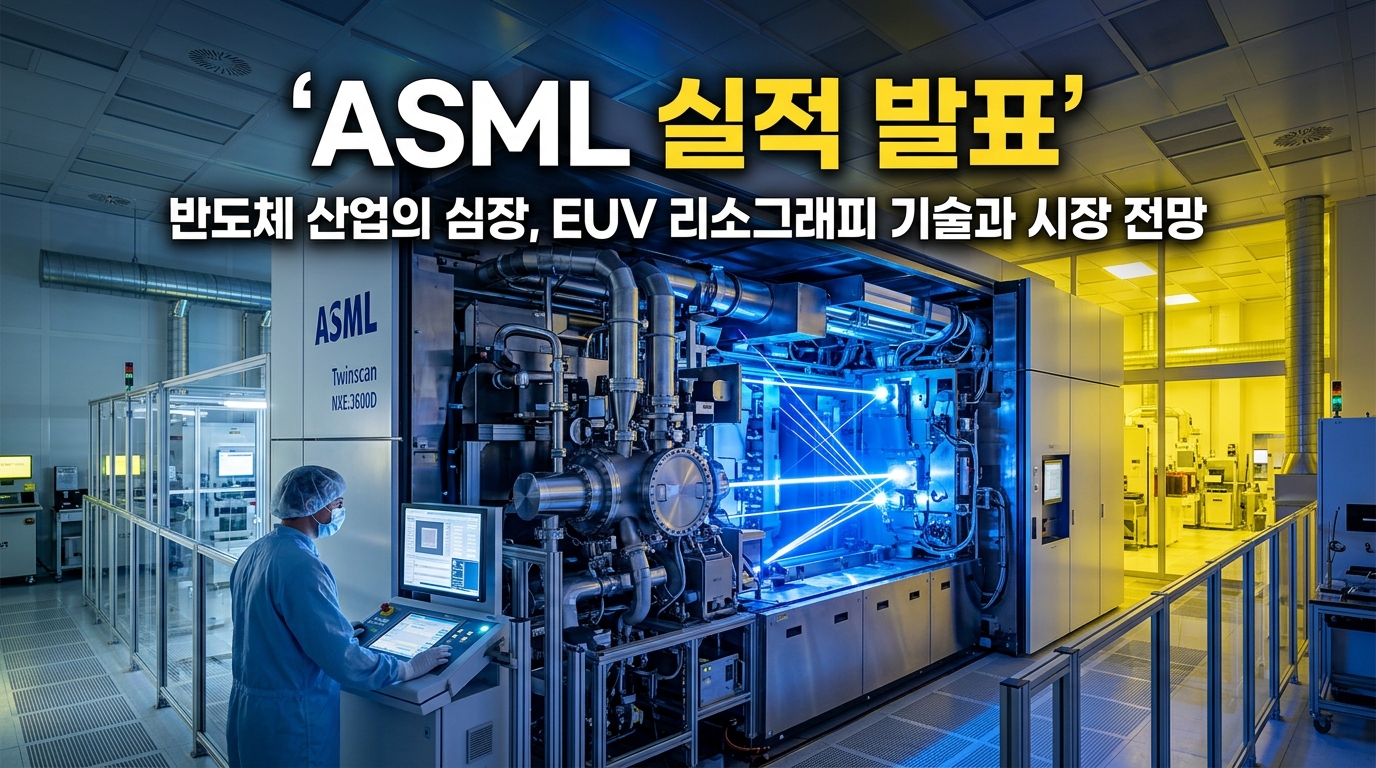
Netherlands-based ASML, the exclusive provider of Extreme Ultraviolet (EUV) lithography systems critical for advanced semiconductor nodes, has proven itself a direct beneficiary of the AI infrastructure investment boom.
According to the earnings released on July 15 (local time), Q2 net sales reached €9.3265 billion, exceeding the upper bound of the guidance, while gross margin remained robust at 54.0%.
In the global macroeconomic landscape, a fundamental decoupling among the US, Europe, and Asia is becoming more pronounced.
While the US Nasdaq continues its strength on the back of AI technology competitiveness, the Eurozone is stagnant—as shown by the PMI index hovering around the baseline—and Asian markets are grappling with the side effects of a weak Yen and sluggish growth in China.
As of the intraday trading on the day of reporting (tentative), the KOSPI is trading around 6,747.95, KOSDAQ at 753.34, and the USD/KRW exchange rate is at 1,481.60 KRW.
The Nasdaq Composite is also navigating global macroeconomic volatility, continuing its intraday movement around the 25,832.35 level.
According to Daily Stock's proprietary Fear & Greed Index, the KOSPI Fear & Greed Index is indicating extreme fear (13), which stands in stark contrast to extreme fear (12.6) one week ago, fear (28.8) one month ago, and greed (65) three months ago.
The Nasdaq Fear & Greed Index also remains in the fear (36.9) zone, showing that market participants have adopted a more defensive posture compared to neutral (41.1) one week ago, fear (37.3) one month ago, and greed (73.3) three months ago.
Financial Analysis
ASML's detailed financial performance in Q2 is underpinned by balanced growth in its flagship EUV segment and the "Installed Base Management" segment, which handles the maintenance and service of existing equipment.
Out of the €6.6 billion in net system sales, the EUV segment accounted for €3.8 billion, while the non-EUV segment recorded €2.8 billion.
Furthermore, net bookings demonstrated a robust recovery as major foundries resumed capital expenditures to meet the demand for high-performance AI processors.
In terms of financial health, the company set an interim dividend of €1.88 per share for 2026, scheduled for payment on August 5, and executed approximately €1.1 billion in share buybacks during the quarter.
| Key Financial Metrics (Q2 2026) | Reported (Actual) | Market Consensus | Analysis |
|---|---|---|---|
| **Net Sales** | €9.3265 Billion | Approx. €8.8 Billion | Earnings Surprise |
| **Net Income** | €2.9176 Billion | Approx. €2.6 Billion | Beat market expectations by ~12% |
| **Gross Margin** | 54.0% | Approx. 50.0%–51.0% | Driven by service and upgrade margins |
| **EPS (Basic)** | €7.59 | Approx. €6.88 | Driven by higher share of premium equipment |
| **Full-Year Revenue Guidance (FY2026)** | €43.0B–€45.0B | Prev. €36.0B–€40.0B | Significant upward revision |
[Image: /stdaily/uploads/202607/gen_6a5fca99f22d93.39209006.png]
Valuation
ASML's stock price has stably defended its valuation premium following the earnings surprise.
Based on the latest available intraday data (tentative as of July 21, 2026: Nasdaq ASML at $1,804.87, Amsterdam Euronext ASML at €1,585.60), the price-to-earnings (P/E) ratio maintains a level of approximately 55–56x.
This is evaluated as being in an attractive range compared to the US semiconductor industry average P/E of 62.6x and the major peer group average of 60.5x.
With demand in the memory sector (DRAM, HBM) surging over 75% year-over-year and competition in foundry node shrinking reigniting, an environment for maintaining a high return on equity (ROE) is being established.
Expert & Institutional Analysis
Global financial institution experts evaluate this earnings release as the clearest mirror reflecting the robust infrastructure expansion trend in the AI semiconductor market.
Following the earnings release, multiple analytical institutions raised their target prices, raising the 12-month average target price of analysts across 14 major firms from $2,061 to $2,156.57.
In particular, as the application of High-NA EUV systems to Intel's 18A process layers takes concrete shape, confidence in the long-term equipment adoption roadmap has strengthened.
Experts believe that as long as Big Tech's CAPEX competition in advanced semiconductors persists despite economic slowdown concerns, ASML's market dominance will solidify further.
[Image: /stdaily/uploads/202607/gen_6a5fcaa30b5b98.60075032.png]
Risk Factors
The most dominant threat is the potential tightening and prolonging of equipment export regulations to China due to US-China tensions.
Indeed, ASML management officially acknowledged that the revenue share from China could significantly shrink in 2026, factoring in the impact of regulatory stances.
In addition, fluctuations in oil (WTI) and raw material (copper) prices due to geopolitical tensions are potential negative factors that could increase logistics costs across the high-tech, ultra-precision component manufacturing supply chain.
If major foundry customers slow down their capital expenditures due to a global economic slowdown, temporary earnings volatility could occur due to deferred equipment deliveries.
Investment Perspective Summary
ASML is demonstrating superior defensive capabilities using its overwhelming "equipment monopoly" as leverage, even in a macroeconomic 3-pole decoupling environment.
This is because it guards the indispensable gateway for global technological progress, even as US interest rate pressures, Europe's moderate economic recovery, and Asia's currency fluctuations are mixed.
Therefore, rather than reacting oversensitively to short-term regulatory news or macro indicators, a dollar-cost averaging approach betting on the long-term AI facility build-out cycle could be a reasonable alternative.
However, investors should keep in mind a scenario where the actual intensity of future regulations and the easing of monetary tightening in major countries will serve as the ultimate turning point for valuation expansion.
Investor Checklist Q&A
Q1. What was the biggest growth engine behind ASML's Q2 earnings surprise?
A1. The decisive factors were the robust demand for EUV equipment required for AI processor manufacturing, and the high-margin contribution from the "Installed Base Management" segment, which exceeded guidance by more than €300 million.
Q2. By how much was the future guidance raised?
A2. The FY2026 annual revenue outlook was raised from the previous €36B–€40B to €43B–€45B, and the annual gross margin target was also raised to the 54%–56% range, securing market confidence.
Q3. How is the Chinese regulatory risk stemming from the US-China trade conflict being managed?
A3. Management stated that they are preemptively reflecting conservative scenarios within their guidance bands to flexibly respond to the results of export sanction discussions.
Q4. Is the next-generation High-NA EUV equipment actually being deployed in manufacturing?
A4. Yes, this quarter's revenue reflected the sales performance of one High-NA EUV system for Intel's process, proving mass-production viability starting with its integration into Intel 18A layers.
Q5. What is the current fear level in the Korean stock market (KOSPI) and the US stock market (Nasdaq), and what is its impact on tech stocks?
A5. Based on our proprietary indices, KOSPI is in "extreme fear" (13) and Nasdaq is in "fear" (36.9), indicating a stronger shift of funds toward safe-haven assets.
In highly volatile markets, a scenario is proposed where liquidity flows back to mega-cap stocks with irreplaceable core technology monopolies and superior cash flows, such as does ASML.