Hello. This is Daily Stock, delivering deep insights and analyzing key trends in the global financial markets.
Summary
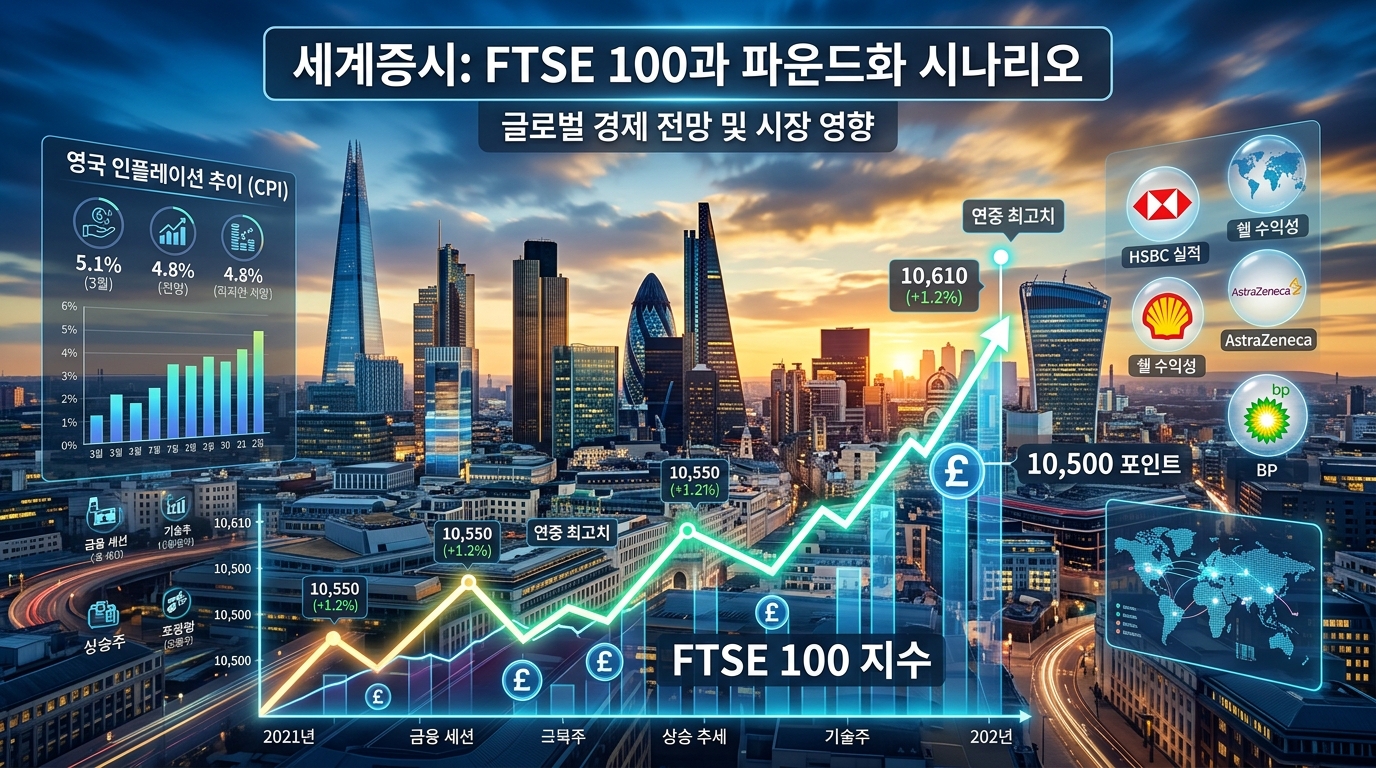
While the UK's FTSE 100 index shows resilient momentum, reaching the 10,529.39 level, the British pound (GBP/USD) continues to fluctuate around the $1.33 mark.
Amid the tri-polar fundamental decoupling of the US, Europe, and Asia, UK-based multinational corporations—which generate a significant portion of their revenue overseas—are expected to benefit from translation gains driven by GBP volatility.
As geopolitical tensions flare up and push up commodity prices, including crude oil, market attention is shifting toward a relative outperformance scenario for the FTSE 100, which has a heavy concentration of energy and value stocks.
[Image: /stdaily/uploads/202607/gen_6a5687a9693209.26748362.png]
Market Overview
Based on intraday (provisional) figures, the UK's benchmark FTSE 100 index maintained a stable trajectory, recently trading at 10,529.39.
This performance was supported by rising energy prices driven by instability in the Middle East, as well as robust earnings reports from major US banks.
In terms of global tri-polar decoupling, the US Nasdaq composite continues its high-valuation run (around the 25,873.18 level) led by technology stocks.
On the other hand, Asian markets showed relative weakness, with the KOSPI at 6,856.83 and the KOSDAQ at 783.98.
According to Daily Stock's proprietary Fear & Greed Index, the Nasdaq is currently in "Neutral" territory (43.7), whereas the KOSPI has plunged into "Extreme Fear" (9.1), reflecting severely depressed investor sentiment across Asian markets.
For context, the KOSPI Fear & Greed Index was at 12.5 (Extreme Fear) a week ago, 53.4 (Neutral) a month ago, and 56.9 (Neutral) three months ago.
The Nasdaq Fear & Greed Index stood at 43.7 (Neutral) a week ago, 35.5 (Fear) a month ago, and 76.1 (Greed) three months ago.
In stark contrast to the extreme risk-off sentiment in Asian markets, European markets, including the UK, are showing value-stock-driven resilience supported by the Bank of England's decision to hold interest rates steady (at 3.75%).
Financial Analysis
A key financial characteristic of the multinational corporations that make up the FTSE 100 is that over 70% of their revenues are generated outside the United Kingdom.
Consequently, the "currency translation effect" that occurs when converting overseas revenues into British pounds has a massive impact on corporate earnings.
With the GBP/USD exchange rate currently battling around the 1.3391 level, periods of relative weakness in the pound tend to trigger sharp book-value increases in the revenues and net profits of multinational exporters.
This serves as a crucial cushion for corporate earnings through translation effects, separate from organic improvements in fundamental performance.
In particular, commodity majors like Glencore and Rio Tinto, along with energy giants BP and Shell, are generating robust cash flows fueled by rising global commodity prices and GBP fluctuations.
With geopolitical instability intensifying in the Middle East, these energy and resource companies find their financial gains further maximized amid fears of crude supply disruptions.
[Image: /stdaily/uploads/202607/gen_6a5687b3b5a440.33806309.png]
Valuation
A comparison of global stock market valuations reveals a clear divergence between the US, Europe, and Asia.
While US equity markets are trading at high multiples driven by AI and Big Tech, the UK's FTSE 100 offers an attractive defensive profile with a relatively low price-to-earnings ratio and a high dividend yield of around 3%.
| Classification | Key Index / Indicator | Current Level (Intraday Provisional) | Fear & Greed Index (Daily Stock Base) | Key Characteristics & Valuation Attributes |
|---|---|---|---|---|
| **UK Market** | FTSE 100 Index | 10,529.39 | - | Heavy on energy & commodity value stocks; dividend yield of ~3.06% |
| **US Market** | Nasdaq Index | 25,873.18 | Neutral (43.7) | Led by global AI and Big Tech; high valuation pressures persist |
| **Korean Market** | KOSPI Index | 6,856.83 | Extreme Fear (9.1) | Focused on semiconductor & export stocks; pressured by global tightening & geopolitics |
| **FX Market** | USD/KRW | 1,489.70 KRW | - | Linked to safe-haven demand and a strong global US dollar |
| **UK FX Market** | GBP/USD | $1.3391 | - | Reflects BoE's rate pause and energy supply volatility |
The FTSE 100's 12-month forward price-to-earnings ratio trades at a deep discount compared to the US S&P 500 or the Nasdaq.
As a result, a scenario where global hedge funds use the UK index as a safe haven to avoid high valuation risks amid tri-polar decoupling is gaining traction.
Expert & Institutional Analysis
Global investment banks evaluate that the potential delay in UK rate cuts is supporting the pound's downside and bolstering the stability of multinational corporations.
With the UK inflation rate halting its descent at around 2.8% and facing upward risks from energy volatility, the Bank of England held its benchmark policy rate steady at 3.75% while maintaining a hawkish tone.
The International Monetary Fund recently upgraded its 2026 growth forecast for the UK to 1%, projecting it to be the third-fastest growing economy in the G7.
However, a divergence in views exists, as Fitch Ratings warned that high public debt and interest costs on inflation-linked bonds could constrain the UK's fiscal flexibility.
Risk Factors
The primary risk is the potential disruption to global supply chains and acute volatility in crude oil prices driven by escalating geopolitical conflicts in the Middle East.
If oil prices surge due to transit anxieties in the Strait of Hormuz, supply-side inflationary pressures could intensify, forcing the Bank of England to pursue additional rate hikes.
Domestic political transitions in the UK also pose a key variable.
Andy Burnham is scheduled to assume office as Prime Minister on July 20, and analysts point out that the Labour government's economic policy direction and strengthening of fiscal oversight could introduce temporary market uncertainty.
Investment Outlook
In a market defined by extreme decoupling among US, European, and Asian equities, monitoring GBP volatility and hedging scenarios with FTSE 100 multinationals could be crucial for asset allocation strategies.
As US tech valuations look stretched and the KOSPI remains suppressed in "Extreme Fear," the UK market has the potential to serve as a stable dividend pipeline.
However, a conservative, staggered approach is advised, keeping a close eye on commodity inflation driven by geopolitical issues and the potential for sharp GBP fluctuations due to domestic political developments. Navigating these interconnected FX and macroeconomic variables is key in this rapidly changing market.
Investor Checklist Q&A
Q1. Why does the FTSE 100 index tend to rise when the British pound weakens?
A1. Because FTSE 100 companies generate over 70% of their revenues overseas. When foreign earnings are translated back into a weakened pound, it boosts their reported revenues and net profits on paper.
Q2. What is the recent trend of the Bank of England's policy rate?
A2. The BoE recently held its policy interest rate steady at 3.75%. Due to fears of commodity supply disruptions from Middle East tensions that could trigger inflation, the bank is expected to maintain a cautious hold and a hawkish stance for the time being.
Q3. What makes the UK FTSE 100 stand out amidst global tri-polar decoupling?
A3. Its significantly lower valuation multiple compared to the US Nasdaq and its high dividend yield of approximately 3.06%. Additionally, its heavy exposure to old-economy value stocks like energy, financials, and mining makes it a strong defensive asset during geopolitical crises.
Q4. What domestic political factors will impact the UK stock market in July 2026?
A4. The upcoming inauguration of Andy Burnham as Prime Minister on July 20. Investors should monitor future fiscal and regulatory risks as the new Labour government is expected to directly strengthen economic policy oversight.
Q5. Which macroeconomic indicators should investors watch most closely?
A5. UK inflation metrics and global oil benchmarks like WTI. Geopolitical developments in the Middle East and the recovery of oil supply routes remain the core variables determining the path of UK monetary policy.