Hello. This is Daily Stock, bringing you precise analysis of key global financial market trends.
Key Summary
[Image: /stdaily/uploads/202607/gen_6a4e9f6b68eb55.22352405.png]
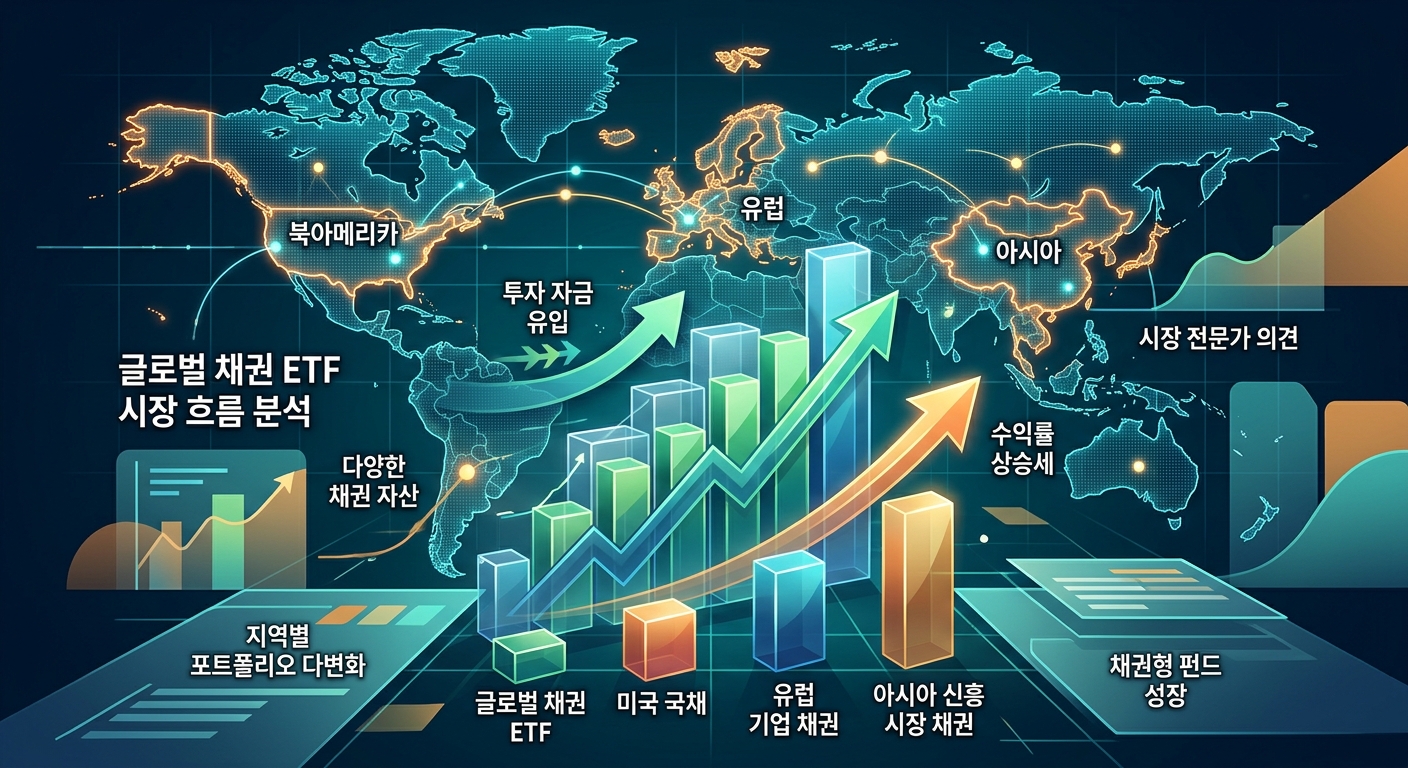
In the first half of 2026, the global bond ETF market witnessed an unprecedented surge of capital, recording a net inflow of $292 billion, up a whopping 65% year-on-year.
The core of this trend is "moving away from the aggregate index"—diverging from traditional aggregate bond index-tracking toward ultra-short term (cash alternatives), credit, and active bond ETFs.
Amid a "tri-polar decoupling" where the monetary policies and fundamentals of the US, Europe, and Asia are starkly diverging, global capital is seeking highly customized, independent paths.
Current Market Summary
As of intraday trading on July 9, 2026 (provisional), the domestic stock market is exhibiting high volatility, trading around the KOSPI 7,246.79 level.
According to Daily Stock's proprietary Fear & Greed Index, the KOSPI Fear & Greed Index is at 12.5, indicating an "Extreme Fear" stage, further deteriorating from 18.1 a week ago.
In contrast, the US Nasdaq index is hovering around 25,834.47, with the Nasdaq Fear & Greed Index at 43.5 in the "Neutral" zone, highlighting a clear psychological divergence between domestic and overseas markets.
With the USD/KRW exchange rate soaring to the 1,507.90 won level, investors are looking to the bond ETF market as an alternative to hedge against stock market volatility.
In particular, the pressure of Yen carry trade unwinding following the Bank of Japan's (BOJ) policy rate hike to 1.00% and the European Central Bank's (ECB) stagflation defense policies are reshaping the global liquidity landscape.
Financial Analysis
Analyzing the global bond ETF inflow data for the first half of 2026 highlights a focus on niche markets and precise duration allocation.
Out of the total $292 billion inflow, 7-to-10-year Treasury ETFs, representing the medium-term (Belly) segment, absorbed approximately $600 billion, becoming the most preferred maturity segment.
At the same time, cash-alternative ultra-short-term bond ETFs saw massive inflows, with SGOV, a leading ultra-short-term ETF, sweeping in about $13 billion in Q2 alone.
| Bond ETF Category | Key Characteristics & Inflow Trends in H1 2026 |
|---|---|
| **Total Global Bond ETFs** | Total H1 net inflow of $292 billion (up approx. 65% YoY) |
| **Medium-term Bonds (Belly)** | Led inflows with approx. $60 billion entering the 7-10 year maturity segment |
| **Ultra-short Treasuries (SGOV, etc.)** | Attracted $13 billion in Q2 alone, shining as cash substitutes amid prolonged high interest rates |
| **Active Bond ETFs** | Reached a record-high market share, attracting over $62 billion in H1 |
Experts analyze that rather than keeping funds parked in simple passive index funds, investors are actively focusing on active assets that can dynamically navigate interest rate volatility.
Valuation
The valuation appeal of the bond market is currently exhibiting relative strength compared to the equity market.
While the tech-heavy Nasdaq index has reached 25,834.47, raising valuation pressures, the bond market is offering attractive, guaranteed coupon rates (interest income).
In particular, unlike the simultaneous stock-bond sell-off in 2022–2023, the 52-week rolling correlation between stocks and bonds has recently returned to negative (-) territory.
This indicates that bonds are once again properly functioning as a reliable portfolio shield when the stock market falters.
Spreads between investment-grade corporate bonds and high-yield bonds remain near historic lows, prompting smart money to actively move to capture additional credit risk premiums.
Expert & Institutional Analysis
[Image: /stdaily/uploads/202607/gen_6a4e9f73d99e69.04906017.png]
Executives at global asset manager BlackRock recently noted regarding bond flows that "the market is sniffing something out."
This represents a structural shift as investors depart from traditional aggregate bond benchmarks to diversify their portfolios into credits, securitized assets, and high-yield bonds.
Daniel Sotiroff, senior analyst at Morningstar, projected that "bond ETFs will account for one-third (33%) of the entire bond fund market by the end of 2026."
Institutional investors are increasingly utilizing bond ETFs as core tools for arbitrage and currency diversification strategies, leveraging the interest rate gaps among the US, EU, and Asian regions.
Risk Factors
The most significant risks are concerns over the US Federal Reserve's prolonged high interest rates ("Higher for Longer") and the potential reignition of inflation.
If inflation surges back to uncontrollable levels due to higher trade barriers or global supply chain disruptions, bond prices could face another correction.
Liquidity tightening in Asian markets is another variable; if the Yen carry trade rapidly unwinds amid the BOJ's tightening bias, there is a risk of passive capital fleeing emerging market bond spaces.
With the KOSPI Fear & Greed Index lingering at an Extreme Fear level of 12.5, persistent Won weakness and forex market instability could compound currency exposure risks for domestic investors holding overseas bonds.
Investment Perspective Outlook
The global bond ETF market has evolved beyond a simple "safe-haven parking spot" into an arena for precise yield maximization.
Under the US-EU-Asia tri-polar decoupling environment, rather than blanket bond buying, a barbell strategy—securing cash flow via ultra-short Treasuries while allocating to active and medium-term bonds—may be highly effective.
To manage high stock market volatility and extreme fear sentiment, it is crucial to closely monitor the diversified trends in global bond ETFs from a portfolio diversification perspective.
Investor Checklist Q&A
Q1. Why are investors moving away from the traditional Aggregate Bond Index?
A1. Simply tracking the index makes it difficult to achieve optimal returns when high interest rates persist. Thus, investors are slicing and dicing their exposure toward ultra-short terms or specific credit bonds offering higher yields.
Q2. What is the significance of the $292 billion bond ETF inflow in H1 2026?
A2. It represents an explosive 65% year-on-year increase, showing that a structural migration of capital into the bond market is underway amid global market instability and deepening decoupling.
Q3. What is driving the rising popularity of active bond ETFs?
A3. As market volatility rises, active strategies—where fund managers flexibly adjust duration and credit risk—are better positioned to generate alpha than passive index-tracking alternatives.
Q4. Why is the US-EU-Asia tri-polar decoupling important in bond investing?
A4. As regional interest rate gaps widen—with the US cutting rates cautiously, Europe executing defensive rate policies, and Japan raising rates—the valuations and currency volatilities of country-specific bond ETFs are diverging dramatically.
Q5. Who are ultra-short Treasury ETFs (e.g., SGOV) suitable for?
A5. They are ideal for investors looking to park cash safely to avoid severe stock market volatility while securing short-term liquidity with the benefit of high yields.