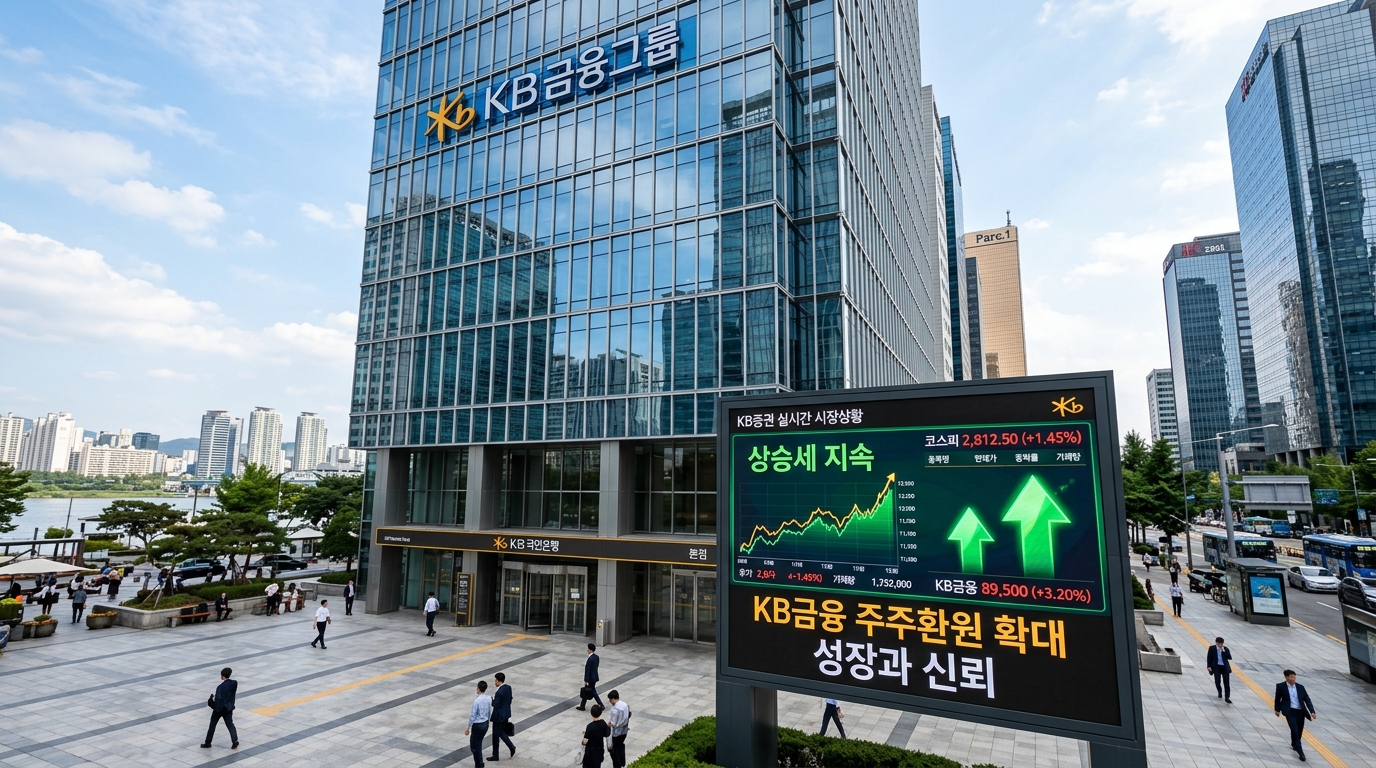
KB Financial Group is presenting an increasingly robust dividend and shareholder return blueprint as a leading player in the corporate value-up program, which is the biggest topic in the 2026 capital market.
[Image: /stdaily/uploads/202606/gen_6a4218bc5dcd24.53142761.png]
Executive Summary
KB Financial Group is raising its total shareholder return rate to approximately 56% by 2026, based on a predictable dividend policy linked to its Common Equity Tier 1 (CET1) ratio.
The recently announced first round of shareholder return execution, worth KRW 2.82 trillion, is evaluated as an unprecedented and bold value-up move in the history of domestic financial holding companies.
At the same time, it is necessary to examine the multi-faceted impact on future capital ratios of the KRW 6.9 trillion inclusive finance support policy announced on June 29 and its subsidiary KB Securities' KRW 1 trillion paid-in capital increase.
Market Overview
As of the close of the Korean stock market on June 29, 2026, KB Financial Group (105560) closed at KRW 153,700, up 2.95% from the previous trading day.
Although it adjusted to an intraday low of KRW 146,200, strong waiting buy orders flowed in, proving its solid downside support.
On the same day, the KOSPI index closed at 8394.65, the KOSDAQ index at 920.57, and the USD/KRW exchange rate was recorded at 1541.80 won.
In the global market, the Nasdaq index is fluctuating around the 25297.62 level.
According to Daily Stock's proprietary Fear & Greed Index, the KOSPI recorded 35.7 (Fear), showing weakened investor sentiment compared to Neutral (52.4) one week ago and Neutral (57.5) one month ago.
The Nasdaq Fear & Greed Index at the same point was also 24.8 (Fear), dropping significantly from the Greed (60.9) state of a month ago, indicating a stronger global risk-aversion trend.
Despite this sluggish flow, KB Financial Group fully demonstrated its public financial responsibilities by announcing the 'KB Kookmin Happy Hope Project' worth a total of KRW 6.9 trillion to support youth and small business owners.
Financial Analysis
KB Financial Group's net profit attributable to controlling interests for the second quarter of 2026 is projected to increase by 15.0% year-on-year to KRW 1.965 trillion, signaling record-high quarterly performance.
The group's core profitability indicator, net interest income, exceeded approximately KRW 3.4 trillion, and the bank's net interest margin (NIM) improved by about 2bp quarter-on-quarter, serving as the main driver of profit growth.
The CET1 ratio, a measure of capital health, is also managed at around 13.73%, boasting the industry's highest level of capital efficiency.
However, the plans for a KRW 999.9 billion shareholder-allocated paid-in capital increase by its subsidiary KB Securities, disclosed after the market close on the 26th, are considered temporary capital demands for the holding company and supply-demand burdens.
The table below summarizes KB Financial Group's recent major financial health and shareholder return indicators.
| Classification | End of 2025 (Confirmed) | Q2 2026 (Estimate) | Key Details & Remarks |
|---|---|---|---|
| **Net Profit (Controlling)** | KRW 5.843T | KRW 1.965T | Tailwind effect from both interest and non-interest income |
| **CET1 Ratio** | 13.79% | Around 13.73% | Capital exceeding 13% at year-end linked as shareholder return resources |
| **Quarterly DPS** | Q4: KRW 1,605 | Q1: KRW 1,143 | Steady quarterly equal and differential dividend stance maintained |
| **Cost-to-Income Ratio (CIR)** | 39.3% | - | Reached record low through company-wide cost efficiency |
[Image: /stdaily/uploads/202606/gen_6a4218c83fc585.45604420.png]
Valuation
Based on the closing price of the day, KB Financial Group's Price-to-Book Ratio (PBR) stands at approximately 0.87x, and its Price-to-Earnings Ratio (PER) remains at around 8.97x.
While it remains relatively undervalued compared to global financial holding peers, its Book Value Per Share (BPS) is continuously improving following treasury share cancellations.
With non-interest sector profitability enhanced by the surge in KOSPI transaction volume boosting brokerage commission income, the adjusted Return on Equity (ROE) for 2026 is expected to reach approximately 11%.
This represents the highest capital efficiency improvement since 2011, marking a 15-year record.
As the scale of additional treasury share buybacks in the second half is projected to reach between KRW 600 billion and KRW 850 billion, there is a possibility that the total number of outstanding shares could decrease by more than 5% during the year from the share cancellation effect alone.
Analyst & Institutional Perspectives
The financial investment industry generally gives high marks to the fact that KB Financial Group's shareholder return policy is highly systematized rather than being a simple one-off event.
Hanwha Investment & Securities raised its target price to KRW 226,000, stating that the adjusted Earnings Per Share (EPS) growth rate reflecting the treasury share buyback and cancellation effects will reach 22%, the highest among banking holding companies.
In the case of LS Securities, considering the positive trend of interest rate spreads and the stability of the foreign exchange market, it predicted a rapid recovery rate of the capital ratio and maintained its target price at KRW 205,000.
In particular, the fact that the Hong Kong H-index ELS penalty issue, which previously acted as a burden, could return as a write-back of non-operating losses from provisions worth approximately KRW 110 billion is cited as a strong catalyst for a surprise Q2 performance.
Experts added that if non-taxable capital reduction dividends through the reduction of capital reserves are fully introduced in the future, it could improve retail investors' after-tax dividend yield by approximately 18.2% or more.
Risk Factors
The first risk factor is the concern that the trend of improvement in Net Interest Spread (NIS) could slow down due to excessively fierce competition among banks to secure corporate loans under increasingly strict household loan regulations.
If the interest spread between deposits and loans stagnates compared to the rise in real market interest rates, it could act as a variable dragging down long-term profit growth.
The second concern is the likelihood that the KRW 6.9 trillion financial support for self-employed and small business owners announced today could lead to deteriorating asset health in the short term, accompanied by low-interest refinancing loan conversions and the write-off of delinquent bonds.
While securing the social value of supporting vulnerable groups, there is potential for an increased burden of establishing bad debt provisions in the future.
Lastly, as the holding company's own available capital is tied up in the short term due to its participation in the KRW 1 trillion paid-in capital increase of its subsidiary KB Securities, investors must keep in mind the scenario where this slightly impacts the acquisition of resources for shareholder returns.
Investment Perspective Summary
KB Financial Group is firmly establishing its position as a 'Value-up Leader' in the domestic financial sector by combining industry-leading capital strength and shareholder return commitment.
The clear principle of returning all capital exceeding the 13% CET1 ratio at year-end to shareholders is the best incentive to attract buying flow from institutional and foreign investors.
However, the burden of supporting the KRW 1 trillion subsidiary capital increase and the possibility of sacrificing profits due to shared-growth financial support for vulnerable groups under high interest rates are short-term noises that investors should continue to monitor.
Nevertheless, performance turnaround and meeting the requirements for separate dividend taxation are clearly strong core foundations driving mid-to-long-term dividend attractiveness.
Investor Checklist Q&A
Q1. When are KB Financial Group's next quarterly dividend record date and payment date for 2026?
A1. KB Financial Group sets the end of each quarter as the dividend record date, and the upcoming ex-dividend date for the second quarter is scheduled for July 1, 2026.
Generally, cash dividends are paid to shareholders who own shares on the dividend record date, usually between mid-to-late August after the board of directors' resolution.
Q2. How will the treasury share buybacks be conducted to achieve the annual shareholder return rate target of 56%?
A2. In connection with managing its CET1 ratio, KB Financial Group is executing treasury share buybacks of KRW 600 billion each in the first and second quarters of the first half, totaling KRW 1.2 trillion.
In the second half, depending on the level exceeding the capital adequacy standard, there is a high probability that it will additionally buy back and cancel treasury shares worth approximately KRW 600 billion to KRW 850 billion.
Q3. What benefits will retail investors receive if 'non-taxable capital reduction dividends' are actually implemented?
A3. When capital reserves are reduced and used as dividend resources, the corresponding dividends are treated as non-taxable under the Income Tax Act, and dividend income tax (15.4%) is not levied.
In particular, since it is excluded from the comprehensive financial income taxation, it brings a massive after-tax yield improvement effect to high-net-worth individuals and individual long-term investors with high tax burdens.
Q4. Will the announcement of the 'KB Kookmin Happy Hope Project' worth KRW 6.9 trillion reduce earnings per share?
A4. Decreasing loan interest rates for ordinary citizens and writing off delinquent bonds could slightly increase the cost-to-income ratio or bad debt expenses in the short term.
However, preemptive resolution of non-performing loans and the rehabilitation of vulnerable borrowers contribute to long-term asset health stability, so it is unlikely to lead to a rapid erosion of Earnings Per Share (EPS).
Q5. Is the holding company's participation in KB Securities' KRW 1 trillion paid-in capital increase bad news?
A5. Since KB Securities is a wholly-owned subsidiary 100% owned by KB Financial Group, it is unrelated to general market concerns about dilution of shareholder value.
However, as a large amount of the holding company's available cash is injected into the subsidiary's capital expansion, it could temporarily pressure the capital ratio limit for additional treasury share buybacks in the second half, requiring close tracking of the progress.