Hello, this is Daily Stock, delivering trendy and in-depth insights into the capital markets.
[Image: /stdaily/uploads/202606/gen_6a40d4df624e51.79152364.png]
Key Takeaways
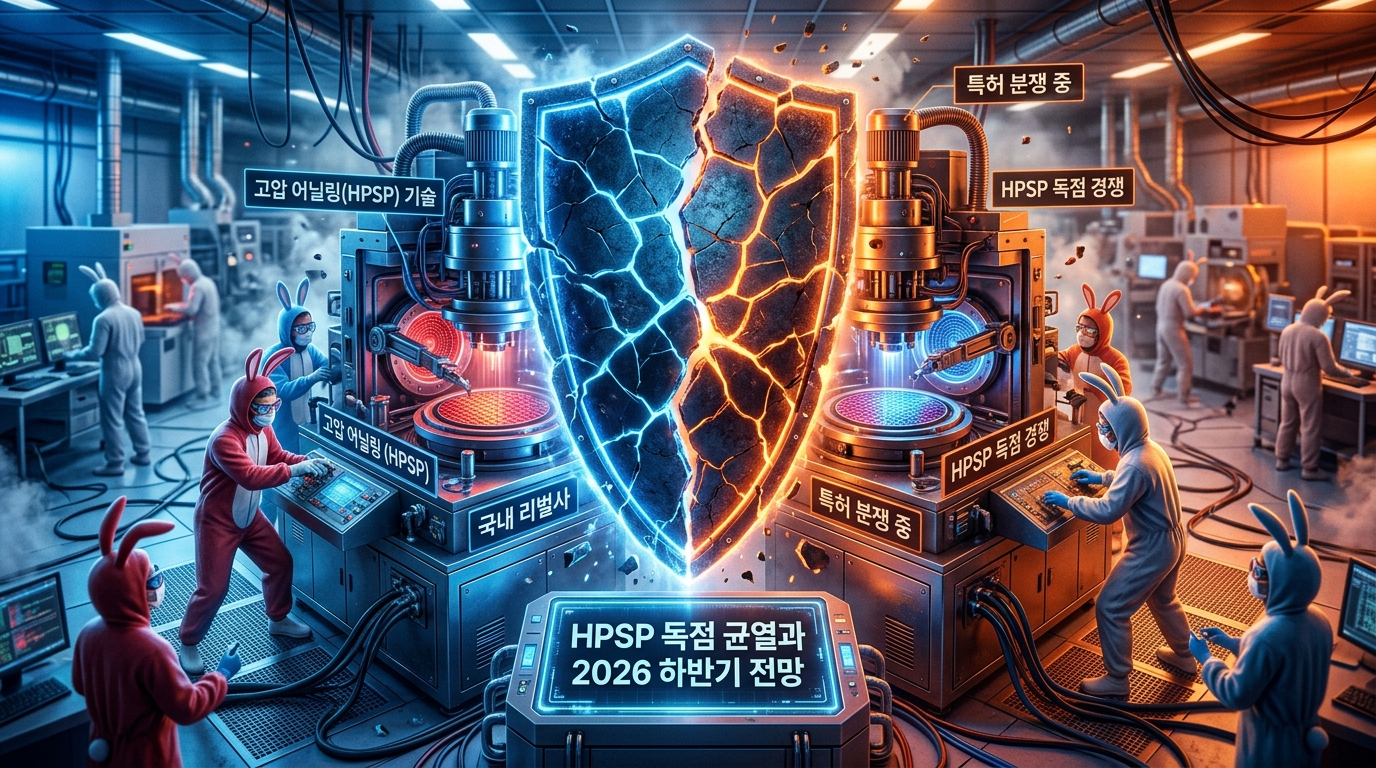
HPSP has run into unexpected patent litigation hurdles, threatening its long-standing monopoly in the high-pressure hydrogen annealing (HPA) equipment market.
Following the Patent Court's second-instance ruling in favor of a latecomer's claim of non-infringement, minor cracks are beginning to appear in the "100% monopoly system" that the market had taken for granted.
However, the major shareholder's commitment to responsible management and expectations of a resumption in capital expenditure on advanced nodes by global foundry customers in the second half are supporting a solid earnings recovery.
This article examines the reality of the litigation issues, the earnings outlook for the second half of 2026, and the potential fluctuations in valuation from multiple angles.
Current Situation Summary
On June 18, 2026, the Patent Court ruled in favor of YESTI in a trial to revoke a trial decision—essentially the second instance—regarding HPSP's core patent, the "Chamber Opening and Closing Apparatus for Semiconductor Substrate Processing" ('027 patent).
While the court acknowledged that HPSP's patent remains valid, it dismissed HPSP's lawsuit, stating that YESTI's equipment technology does not fall within the scope of the patent's claims.
As a result, YESTI has announced plans to deliver its first mass-production equipment in August 2026, triggering concerns over a weakening monopoly and driving significant stock price volatility.
However, HPSP maintains that the ruling was based on technical drawings rather than actual mass-production equipment, and plans to respond with full force at the main patent infringement lawsuit hearing scheduled for August 13, 2026.
Meanwhile, through an extraordinary general meeting of shareholders on June 25, 2026, Lee Ki-doo, CEO of Crescent Equity Partners (the largest shareholder), was newly appointed as an inside director.
This move has partially eased market concerns regarding an overhang risk from potential block deals by the major shareholder and management vacuum, replacing them with a declaration of strengthened responsible management.
[Image: /stdaily/uploads/202606/gen_6a40d4eb713d88.88740496.png]
Financial Analysis
HPSP recorded somewhat sluggish earnings in Q1 2026, impacted by temporary CAPEX adjustments in downstream industries.
Its separate Q1 revenue stood at KRW 31.9 billion with an operating profit of KRW 16.1 billion, still maintaining an overwhelming operating profit margin of 50.52%.
In the second half of the year, a clear trend of stronger performance is anticipated as global foundries accelerate investments in 2nm and 3nm advanced nodes and equipment shipments sequentially resume.
The 2026 annual market consensus targets a major turnaround, projecting revenue between KRW 234.1 billion and 245.0 billion, and operating profit between KRW 124.5 billion and 130.0 billion.
| Classification | 2024 (Actual) | 2025 (Preliminary/Est.) | 2026 (Market Consensus) | Q1 2026 (Actual) |
|---|---|---|---|---|
| **Revenue (KRW 100M)** | 1,791 | 1,760 | 2,341 ~ 2,450 | 319 |
| **Operating Profit (KRW 100M)** | 933 | 910 | 1,245 ~ 1,300 | 161 |
| **OP Margin (%)** | 52.1 | 51.7 | 53.0 | 50.52 |
Valuation
As of the market close on June 26, 2026, HPSP's stock price stood at KRW 52,700, representing a market capitalization of approximately KRW 4.3372 trillion.
The current 12-month forward price-to-earnings (P/E) ratio is trading in the range of 50x to 60x, slightly lower and stabilized compared to the peak multiples enjoyed during its absolute monopoly era.
While the potential crack in its monopoly exerts downward pressure on the valuation multiple, the expansion of high-pressure hydrogen process applications (such as advanced memory nodes and high-performance HBM) is acting as a strong buffer.
Depending on the outcome of the main lawsuit and the speed of shifts in actual market share, scenarios for a valuation re-rating or further de-rating are expected to diverge.
Expert & Institutional Analysis
Market analysts note that although supply and demand volatility has increased due to short-term litigation noise, the underlying demand for the equipment driven by process scaling remains intact.
Domestic and foreign institutional investment opinions mostly maintain a "Buy" or "Strong Buy," with an average target price distributed around KRW 69,714.
However, some cautious voices advise that if YESTI's mass-production equipment is delivered to lines in the second half and its operational stability is proven, downward adjustments to the market share assumptions underpinning target prices will be unavoidable.
Ultimately, key litigation milestones in August and actual shipment developments will serve as critical indicators for institutional investors' buying directions.
Risk Factors
The most significant risk is the realization of unit price cuts and market share dilution resulting from a weakened monopoly.
If HPSP fails to secure a favorable ruling in the main civil infringement lawsuit after August, and competitors smoothly settle mass-production supplies, HPSP's target of maintaining a 50% profit margin could face threats.
Secondly, global foundry giants could slow down their capital expenditure due to macroeconomic headwinds, which could defer order cycles for high-priced front-end equipment.
Lastly, potential overhang concerns regarding Crescent Equity Partners' remaining stake (approx. 20.11%) have not been entirely resolved, remaining a long-term supply and demand risk.
Investment Perspective Summary
HPSP has demonstrated irreplaceable leadership in front-end processes amidst a Kosdaq growth stock rally, but is currently in a transition period where growth and uncertainty coexist.
Supported by synchronization with the Nasdaq index and the CAPEX cycles of global semiconductor giants, the probability of a second-half earnings rebound remains very high.
However, since volatility may expand significantly depending on the August lawsuit outcomes and the verification of YESTI's mass-production equipment deliveries, a split-entry approach seems prudent.
Investors should avoid emotional trading in the short term and build scenario-based responses thoroughly grounded in factual checks on equipment shipments and legal developments.
For reference, as of June 28, 2026, the proprietary Fear and Greed Index shows the KOSPI in the "Fear (39)" stage and the Nasdaq in the "Fear (24.8)" stage, reflecting a generally conservative sentiment across the macro environment.
Investor Checklist Q&A
Q1. Did the Patent Court's second-instance ruling invalidate HPSP's patent?
- No. The Patent Court ruled that HPSP's core patent is "valid." However, it interpreted that competitor YESTI's equipment design does not infringe on that patent (non-infringement).
Q2. What is the most critical upcoming litigation schedule?
- The first hearing for the main civil lawsuit seeking a "patent infringement injunction" (which holds actual civil enforcement power) is scheduled to take place at the Seoul Central District Court on August 13, 2026. This ruling will be a watershed moment determining the future status of both companies.
Q3. Is there a possibility that the largest shareholder, PEF Crescent, will sell additional shares via block deals?
- Following the extraordinary shareholders' meeting, the CEO of Crescent was appointed as an inside director and pledged long-term responsible management. The company stated that the likelihood of further block deals is extremely low, but potential risks remain.
Q4. What is the basis for expecting stronger earnings momentum in the second half of 2026 compared to the first half?
- Capital expenditures for next-generation advanced nodes (2nm/3nm) by major global foundry and memory players, which were delayed in the first half, are expected to resume, concentrating high-pressure hydrogen equipment shipments in the second half.
Q5. Will HPSP's profit margins plunge if competitors enter the market?
- In the short term, downward pressure on equipment prices may emerge, leading to concerns about moderating profit margins. However, many experts believe a rapid drop is unlikely, given HPSP's accumulated high-pressure process know-how and its next-generation portfolio, such as high-pressure oxide (HPO) equipment.