Hello, this is Daily Stock, delivering the vivid pulse of the Korean financial market.
Core Summary
![Image: /stdaily/uploads/202606/gen_6a3397c8a6efa0.21030905.png]
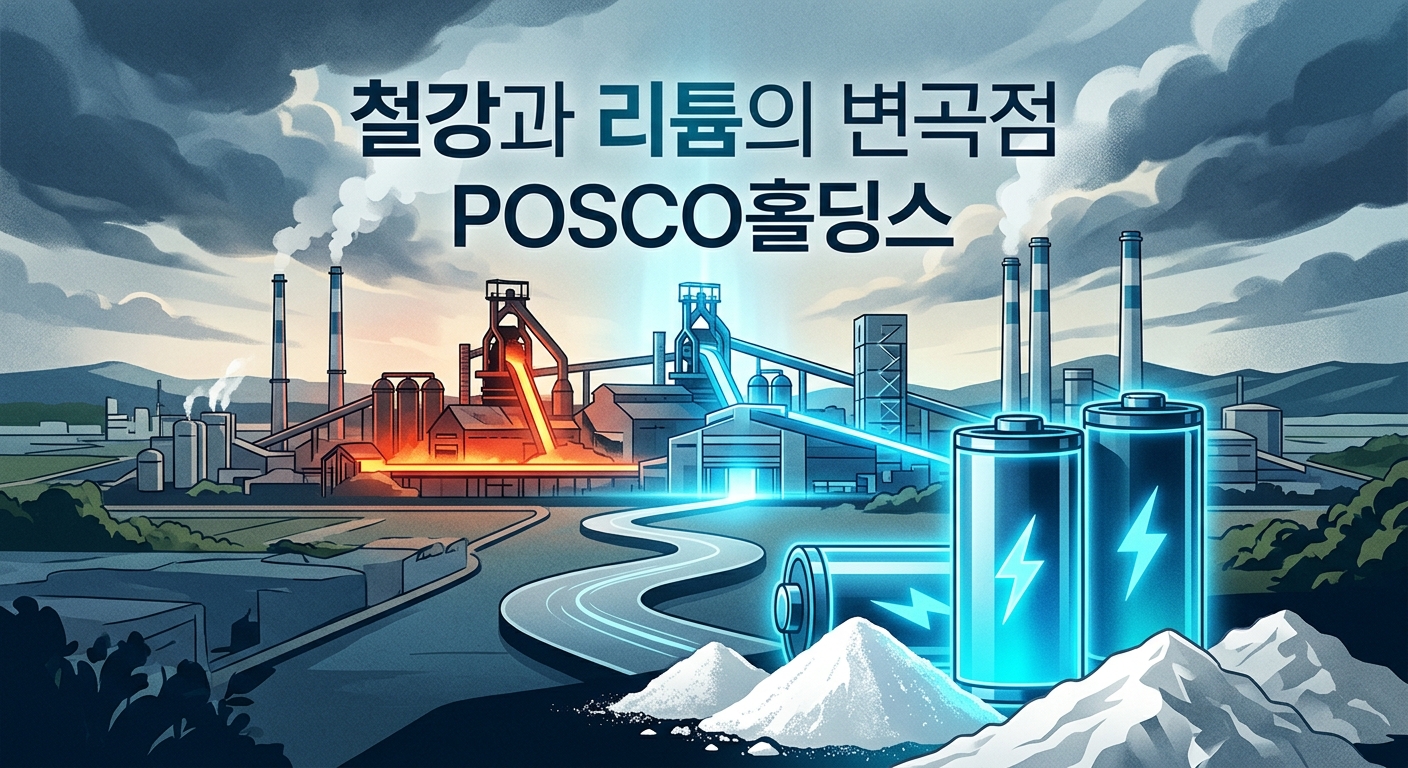
Amid a global economic slowdown and structural oversupply in the steel industry, POSCO Holdings (005490) is passing through an inflection point where sluggish performance in its core steel business is being offset by strong performances in its secondary battery and energy subsidiaries.
As of June 18, 2026, while the KOSPI index recorded the 9063.84 level, the KRW/USD exchange rate remained high at 1527.40 won, compounding the cost burden for steel raw material imports.
Nonetheless, as the commercial production of its Argentina lithium production corporation begins in earnest and subsidiaries like POSCO Future M and POSCO HY Clean Metal gear up for a turnaround, the non-steel new business division is emerging as a new pillar for the stock price.
Current Situation Summary
Currently, the domestic steel industry is facing a triple whammy due to oversupply from China, a sluggish domestic construction sector (a key downstream industry), and strengthening trade barriers such as the US and European Union (EU) Carbon Border Adjustment Mechanism (CBAM).
According to the World Steel Association (WSA), global steel demand in 2026 is expected to show a moderate recovery. However, because excess capacity has not been structurally resolved, the rebound potential for commodity grade steel prices remains limited.
Amid this industry slowdown, POSCO Holdings' stock price has been fluctuating recently under pressure from target price adjustments by brokerages.
As of June 18, 2026, the stock price of POSCO Holdings saw intraday corrections with current quotes unconfirmed (the latest confirmed value was in the 369,000 won range), but its long-term fundamental improvement trend continues.
According to the Daily Stock Fear & Greed Index, which represents investor sentiment, KOSPI currently maintains a neutral (54.5) level, indicating that a wait-and-see attitude is dominant across the overall market.
Financial Analysis
POSCO Holdings' preliminary consolidated earnings for the first quarter of 2026 recorded revenue of 17.876 trillion won and operating profit of 707 billion won.
This represents a 2.5% increase in revenue and a 24.3% increase in operating profit year-on-year, showing that new business divisions like lithium offset the squeezed margins in the steel division caused by the high exchange rate and rising raw material costs.
| Classification | Q1 2026 Earnings (Consolidated) | Year-on-Year (YoY) | Quarter-on-Quarter (QoQ) |
|---|---|---|---|
| **Revenue** | KRW 17.876 Trillion | +2.5% | +6.1% |
| **Operating Profit** | KRW 707 Billion | +24.3% | +5,472.8% |
| **Net Income** | KRW 543 Billion | +57.9% | Turn to Profit |
In particular, as POSCO Argentina entered commercial production, the deficit in the lithium business narrowed significantly. POSCO Future M and POSCO HY Clean Metal also recorded operating profits driven by higher utilization rates and cost reduction, leading overall profitability improvement.
Furthermore, as part of its mid-term (2026-2028) shareholder return policy, the company announced a performance-linked dividend plan targeting 35-40% of adjusted controlling net income and plans for treasury stock cancellation, underscoring its commitment to enhancing shareholder value.
Valuation
Due to the prolonged slump in the steel sector, securities firms are conservatively lowering the target Price-to-Book Ratio (PBR) applied to the core steel business.
However, as the prices of core battery materials such as lithium carbonate bottom out and rebound, mainly in the Chinese market, the valuation weight of the non-steel business division is gradually being adjusted upward.
Recently, the average 12-month target price for POSCO Holdings suggested by brokerages stands at around 521,950 won, though estimates vary widely from a low of 415,000 won to a high of 620,000 won depending on institutional perspectives.
Volatility in appropriate valuation is likely to continue depending on whether the core business's profit fundamentals are damaged and how fast secondary battery material subsidiaries can ramp up their operation rates.
Expert & Institutional Analysis
![Image: /stdaily/uploads/202606/gen_6a3397d67a7eb9.44836062.png]
While major financial investment experts are adjusting their targets for POSCO Holdings' steel division downward, they expect the strong performance of subsidiaries to firmly support the stock price's downside.
iM Securities lowered its target price from 540,000 won to 480,000 won, reflecting the structural oversupply in the steel sector and sluggish export profitability due to global trade regulations.
Conversely, Shinhan Securities and others evaluate the capital allocation away from steel cycle dependency and into non-steel areas like lithium as encouraging, maintaining their 'Buy' rating and previous target price.
Experts assess that under strengthening global resource nationalism and limited lithium supply chain conditions, POSCO Holdings' supply chain dominance—secured through independent mine stakes and concentrate sourcing rights—enhances its long-term appeal as an alternative stock.
Risk Factors
The most immediate risk is the delayed recovery in demand for raw materials and basic materials due to global high interest rates and inflation.
If Chinese steelmakers continue their low-priced export push despite razor-thin margins, defending hot-rolled and heavy plate prices in the Asian region could become highly challenging.
Furthermore, if the super-high exchange rate exceeding the 1,520 won level persists, the import unit prices of raw materials such as iron ore and coking coal will surge, intensifying the manufacturing cost burden for domestic plants.
In addition, changes in trade regulations after the US presidential election and the full-scale application of the EU CBAM, leading to increased costs for low-carbon steel production, could serve as short-term margin pressures.
Investment Perspective Summary
Overall, POSCO Holdings is in a transitional phase where it is carving out a breakthrough through new businesses amid an unfavorable macroeconomic environment characterized by slowing demand in its core steel sector.
While short-term volatility is inevitable depending on rapid exchange rate fluctuations and steel price trends, the profit contribution from the lithium and secondary battery value chain is expected to gradually rise over the medium to long term.
Therefore, rather than aggressive chasing, a strategy of taking a split-purchase approach while monitoring the conclusion of steel inventory adjustments and the quarterly profit scale of the Argentina and Pilbara lithium corporations is gaining traction.
Investor Checklist Q&A
![Image: /stdaily/uploads/202606/gen_6a3397e4329b80.79036477.png]
Q1. What are the main causes of the recent slump in the steel industry?
A1. It is a combination of structural oversupply, where surplus steel products from China's slowing domestic economy are exported to Asian markets at low prices, and the downturn in the domestic construction industry.
Q2. How does the KRW/USD exchange rate around the 1,527 won level affect the steel business?
A2. Since core raw materials like iron ore and coal must be fully imported, a high exchange rate raises import unit prices, adding to the cost burden and worsening profitability.
Q3. What is the key point of the new shareholder return policy announced in 2026?
A3. It is a policy to return 35-40% of adjusted controlling net income to shareholders from 2026 to 2028, aiming to increase dividend predictability while combining treasury stock buybacks and cancellations.
Q4. What is the status of the turnaround for the secondary battery materials and lithium subsidiaries?
A4. POSCO Argentina started commercial production and achieved its first monthly surplus in March 2026, and recycling subsidiaries like POSCO HY Clean Metal are also establishing profitability as utilization rates rise.
Q5. What are the key indicators for investors to watch moving forward?
A5. Whether Chinese domestic steel distribution prices rebound, the price trends of lithium carbonate, and the status of tariff responses to US and EU trade regulations.