Welcome to Daily Stock, providing deep investment insights by analyzing key trends in the global financial markets.
Summary
Recently, the French CAC 40 index has shown signs of recovery, driven by easing geopolitical tensions and a rebound in the stock prices of major luxury companies.
However, as the European Central Bank (ECB) maintains its tight interest rate policy, the global luxury market has moved away from its past rapid growth phase and entered a period of gradual stabilization and deceleration.
In this report, we analyze eurozone luxury consumption trends—including LVMH and Hermès—and their macroeconomic impact under the three-way decoupling scenario of the US, Europe, and Asia.
Market Overview
[Image: /stdaily/uploads/202606/gen_6a319d921f6f66.63367319.png]
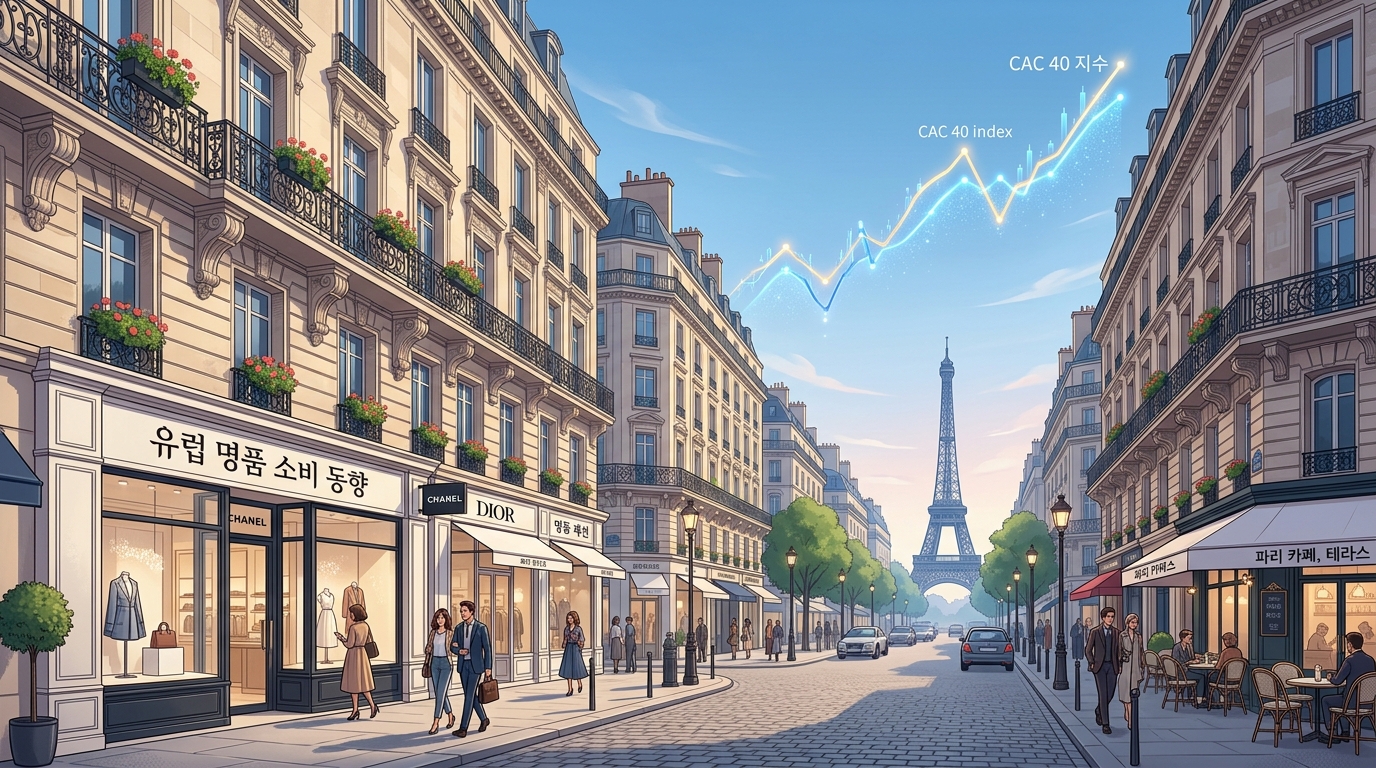
The French CAC 40 index has maintained a solid recovery trend around the 8,400 level during intraday trading, following reports of a potential agreement between the US and Iran to ease geopolitical tensions.
The decline in international oil prices due to reduced geopolitical risk is easing energy-driven inflationary pressures, creating positive momentum across the consumer goods sector.
Benefiting from this, large luxury brands with significant market capitalization in the index, such as LVMH, Hermès, and Kering, have advanced during intraday trading, driving the rebound of the French stock market.
However, on June 11, the European Central Bank (ECB) raised interest rates by an additional 25 basis points (raising the deposit rate to 2.25% per annum) to counter inflationary pressures from Middle East tensions, meaning monetary tightening continues to constrain the real economy.
Looking at domestic and international markets during intraday trading today, June 17, 2026, the KOSPI index stands at 8,726.60, the KOSDAQ index at 1,018.68, and the USD/KRW exchange rate remains elevated at 1,509.20.
Meanwhile, the US Nasdaq index is showing a flat-to-positive trend at 26,584.05, reflecting investor caution.
According to Daily Stock's proprietary Fear & Greed Index (0-100), the KOSPI Fear & Greed Index is currently Neutral (52.7), showing steady improvement compared to Fear (31.4) a week ago, Neutral (58.9) a month ago, and Fear (36.1) three months ago.
Conversely, the Nasdaq Fear & Greed Index is currently Neutral (41.3), indicating that investor sentiment has become more cautious due to tech valuation pressures, compared to Fear (32.4) a week ago, Greed (63) a month ago, and Greed (61.1) three months ago.
Financial Analysis
The global luxury industry is in a transitional phase, moving from the abnormal post-pandemic revenge-spending boom back toward a normalized organic growth trajectory.
According to Bain & Company, the global personal luxury goods market growth is expected to converge to around 3% to 5% in 2026, with performance diverging significantly based on each brand's pricing power.
In particular, foreign exchange headwinds from a strong Euro and cumulative inflation cost increases are likely to exert downward pressure on operating margins.
The table below summarizes the 2026 performance outlook and financial characteristics of major luxury retail companies in the CAC 40.
| Company | Expected Organic Growth Rate | Key Financial Indicators & Margin Trends | Core Competencies & Characteristics |
|---|---|---|---|
| **Hermès** | Projected at 7–9% | Margin erosion minimized due to ultra-high-end focus | Exclusive brand value and robust backlog demand |
| **LVMH** | Projected at 5–6% | Resilient due to a balanced portfolio across fashion, spirits, and watches | Overwhelming liquidity and marketing dominance |
| **Kering** | Projected at 2–4% | Conservative outlook due to delayed turnaround of major brands like Gucci | Brand reorganization phase following creative director changes |
Hermès has demonstrated a resilient financial structure by targeting ultra-high-net-worth individuals, while Kering, which relies more on aspirational consumers, is feeling the impact of weakening domestic demand first.
Valuation
[Image: /stdaily/uploads/202606/gen_6a319d9b7aec24.28135699.png]
Price-to-earnings (P/E) valuations in the European luxury sector have undergone a rerating adjustment, returning to long-term historical averages after overshooting during the low-interest-rate liquidity cycle.
Unlike the US stock market, which maintains high valuation premiums driven by big tech earnings momentum, the Eurozone market is showing a contrasting trend due to the cumulative impact of ECB tightening and economic slowdown concerns.
Hermès continues to command a premium with a forward P/E of over 40x based on its brand defense, while LVMH is trading near the bottom of its historical valuation band at around 22–25x.
A moderate domestic stimulus in China and whether the Eurozone’s rate hike cycle peaks early remain the key variables that could trigger a meaningful rebound in valuation multiples.
Expert & Institutional Analysis
Morgan Stanley noted at its annual European Luxury Conference in Paris that luxury consumption has reached a phase of "prudent recalibration" rather than a "recession."
However, it suggested that selective portfolio management is essential for the time being, as geopolitical and macroeconomic uncertainties must be resolved before consumer sentiment can fully recover.
BNP Paribas Equity Research warned that even for companies attempting to break through organic growth limits, currency headwinds could make reported book performance look slightly weaker.
Meanwhile, according to Deloitte's 2026 Global Powers of Luxury Goods report, while 66.9% of executives expect sales growth and stability, brand pricing power—rather than sales volume—will be the key determinant of survival.
Risk Factors
First, the risk of prolonged consumer weakness due to the global three-way economic decoupling.
In a stagflation scenario where the Eurozone Composite PMI remains sluggish and the ECB preemptively raises rates to defend inflation, there are concerns that middle-class consumer attrition could accelerate.
Second, the fallout from protectionist tariff disputes between the US and the EU.
If the US government maintains or expands high tariffs on European luxury and finished goods, margins in North America—the largest market for Eurozone companies—could be compromised.
Third, the risk of renewed volatility in raw material and energy prices linked to geopolitical tensions in the Middle East.
Surging global logistics costs and rising raw material costs remain key factors threatening the high operating margins of luxury manufacturers.
Investment Outlook
At this juncture, the Eurozone luxury sector must be evaluated within the context of fundamental decoupling: the US (resilient economy and strong consumption), Europe (high interest rates and inflationary pressure), and Asia (delayed domestic demand recovery due to China's cautious policy approach).
Therefore, rather than expecting a broad upward trend across the luxury sector, investors should focus on companies like Hermès that possess irreplaceable, high-end product lines and strong pricing power.
A prudent strategy would involve monitoring the ECB’s interest rate decision in July and companies' Q2 earnings guidance to gradually adjust portfolio safety.
Investor Checklist Q&A
Q1. Are the European Central Bank’s (ECB) recent interest rate hikes negative for luxury consumption?
Yes, rate hikes reduce consumers' real purchasing power and asset values, directly lowering the spending capacity of aspirational buyers who consume entry-level and mid-tier luxury goods.
Q2. What is the specific reason for the performance decoupling between Hermès and other luxury brands?
Hermès has a significantly higher proportion of ultra-high-net-worth clients compared to other brands, and its supply control and waiting lists provide strong protection against economic cycles.
Q3. Which overseas market are Eurozone companies focusing on most under the three-way decoupling?
Experts point to the US market, which has resilient employment data and consumer spending, as the preferred target. The Chinese market is expected to show a more gradual and cautious recovery due to household debt and weak domestic demand.
Q4. How do exchange rate fluctuations affect the margins of CAC 40 luxury companies?
Luxury groups with high shares of international sales face currency headwinds when the Euro strengthens against the USD or Asian currencies, as overseas sales translate into fewer Euros on their financial statements.
Q5. What are the key trends or alternative drivers to watch in the luxury market?
In addition to price increases, companies are focusing on next-generation survival strategies such as AI-driven VIP concierge services and preserved residual value through certified pre-owned (CPO) and refurbished markets.