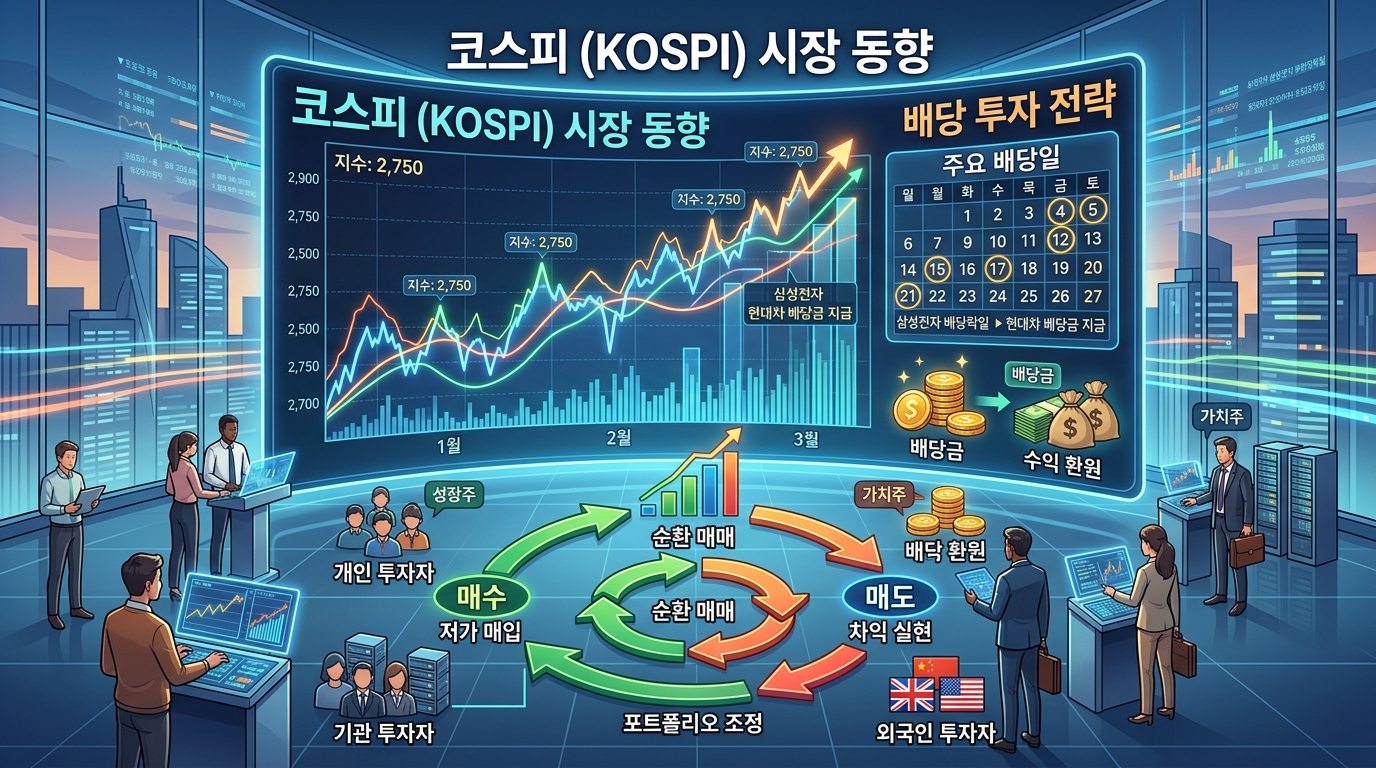
This is an analysis from Daily Stock on KOSPI supply-demand information and the market impact of the dividend system reform.
Key Summary
- As the June 2026 semi-annual and second-quarter dividend season approaches, structural changes are being captured in the supply-demand patterns before and after the ex-dividend date in the KOSPI market.
- With the amendment of the Capital Markets Act, the "determine dividend amount first, designate record date later" structure has taken root for quarterly and semi-annual dividends, significantly mitigating the traditional end-of-June uniform ex-dividend shock.
- Consequently, the program arbitrage supply-demand of financial investment (securities firms), which previously triggered a sharp reversal to selling after driving a one-sided buying trend before the ex-dividend date, is now dispersed over time, acting as a factor to lower market volatility.
- Amid high exchange rate conditions, we proactively examine potential arbitrage selling scenarios driven by fluctuations in foreign futures supply-demand and the spot-futures basis.
[Image: /stdaily/uploads/202606/gen_6a251791f0d7c5.20248024.png]
Current Status Summary
As of June 7, 2026, the KOSPI index is attempting to settle around the 8,160.59 level, while the KOSDAQ index maintains a solid flow at 1,002.44.
With the NASDAQ index recording 25,709.43, the KRW/USD exchange rate maintains high volatility pressure at 1,559.70 KRW.
According to the Daily Stock Fear & Greed Index, the KOSPI Fear & Greed Index is in the 'Neutral' phase at 51.8 (compared to 57.5 a week ago, 66.5 a month ago, and 32.9 three months ago).
The NASDAQ Fear & Greed Index also stands at a 'Neutral' level of 42.1 (compared to 59.5 a week ago, 67.3 a month ago, and 58.0 three months ago), indicating a continuing wait-and-see attitude toward domestic and international macro indicators.
With the end-of-June semi-annual closing approaching, the market is focusing on the traditional ex-dividend effect and the associated spot-futures supply-demand trends of financial investment and foreign investors.
Financial Analysis
In the past, the domestic stock market closed its shareholder register at specific times, such as the end of June and December, to first finalize eligible shareholders.
This "blind dividend" structure, where investors had to buy shares without knowing the dividend amount, was a chronic factor that increased market uncertainty.
However, through the revision of the Capital Markets Act, the system was improved so that for quarterly and semi-annual dividends—following year-end dividends—the board of directors can first resolve the dividend amount and designate the record date afterward.
These institutional changes have fundamentally altered the unique program arbitrage patterns of financial investment (securities) accounts.
Previously, financial investors introduced large-scale spot buying just before the ex-dividend date to chase risk-free dividend arbitrage, and then consistently sold on the ex-dividend day itself, repeating a "supply-demand U-turn."
[Image: /stdaily/uploads/202606/gen_6a25179dbae0c0.27509835.png]
| Category | Before Reform (Blind Dividend Era) | After Reform (Confirmed Dividend Amount First System) |
|---|---|---|
| **Designation of Record Date** | Uniformly designated at the end of December and June | Independently designated by individual companies after board/shareholder meetings |
| **Ex-Dividend Timing** | Concentrated on specific days, leading to heavy selling pressure | Dispersed across March–April (annual), July–August (quarterly/semi-annual), etc. |
| **Financial Investment Flow** | Concentrated buying before ex-dividend, explosive selling on the ex-dividend day | Transitioned to dispersed trading flows as concentration of supply-demand eases |
| **Market Volatility** | Sharp drops in the index on ex-dividend days and heavy program selling pressure | Shock absorbed, leading to more stable stock price trends |
| **Investment Incentive** | Short-term trading dominated without knowing the dividend amount | Rational long-term investment inflows based on confirmed dividend amounts |
Since the reform, record dates are dispersed after board resolutions for each company, splitting the buying and selling timings for financial investments and easing short-term index distortions.
Valuation
The dispersion of supply-demand around ex-dividend dates plays a positive role in enhancing the valuation attractiveness of the overall KOSPI market.
By preventing short-term arbitrage flows aimed solely at dividends from rushing in all at once, the market avoids temporary overheating followed by sharp declines on the ex-dividend date.
In particular, high-dividend large-cap stocks in financial and telecommunication sectors, which maintain high shareholder return rates based on stable cash flows, are showing stronger resilience in recovering their stock prices after going ex-dividend.
Because investors enter the market with clear knowledge of the dividend amount, it has also become easier to utilize strategies exploiting cases where the stock price adjustment on the ex-dividend day is smaller than the actual dividend yield.
The "Korea Discount" phenomenon, where domestic markets were undervalued globally due to the previous blind dividend structure, now has greater room for gradual improvement through enhanced transparency in dividend information.
Expert & Institutional Analysis
Securities analysts point out that to understand the supply-demand during the June quarterly/semi-annual ex-dividend season, investors must monitor the "market basis"—the price difference between spot and futures—and foreign futures trends.
Generally, a "contango" state, where futures prices are higher than spot prices, creates a favorable environment for program arbitrage buying by financial investors.
Conversely, as the high exchange rate of 1,559.70 KRW persists, the basis could drop if foreign investors sell futures to avoid volatility.
If the market shifts to "backwardation," where futures prices fall below spot prices, the likelihood of program selling to liquidate buy-arbitrage balances held by financial investors increases.
However, since the selling pressure is no longer concentrated at a single moment due to the dividend system reform, the prevailing analysis is that even if arbitrage liquidation occurs, the market shock will be more limited compared to the single-day disruptions of the past.
Risk Factors
The current macro environment, with the KRW/USD exchange rate showing extreme strength in the 1,559.70 KRW range, is the biggest risk factor for market supply and demand.
A surging exchange rate increases the pressure for foreign capital outflows, encouraging domestic stock and futures selling, which can trigger program liquidations.
Additionally, for some companies that still adhere to the old method of keeping their dividend record dates at the end of June, short-term selling concentration may occur around those specific stocks, making it necessary to check individual regulatory filings.
If corporate Q2 profit outlooks are downgraded due to global economic slowdown concerns, the expected quarterly dividend scale itself could shrink, posing a risk of diminishing their value as dividend stocks.
Investment Perspective Summary
The June ex-dividend pattern after the system reform demands a long-term investment perspective that confirms "earnings and dividend sustainability" rather than short-term arbitrage opportunities.
Amit high exchange rate volatility, high-dividend large-cap value stocks that offer stable cash flows can serve as an excellent defensive shield for portfolios.
In terms of supply and demand, rather than being swept up in the temporary U-turn selling forces of financial investments, a rational strategy would involve weighing buying opportunities by tracking spot-futures basis trends and the direction of foreign investor flows.
Investors should look beyond simple dividend yield figures and comprehensively consider individual companies' quarterly earnings forecasts and whether they have autonomously designated their dividend record dates.
Investor Checklist Q&A
Q1. Does the "determine dividend amount first, designate record date later" system apply to all companies?
A1. No. It only applies to companies that have amended their articles of incorporation to adopt the new dividend process. Investors should check regulatory filings to see if a company has adopted the improved system before investing.
Q2. If I hold shares at the end of June, am I guaranteed to receive the Q2 dividend?
A2. For companies that have amended their articles of incorporation, you must hold the stock on the specific record date designated after the board resolution, which may not be the end of June, to qualify for the dividend.
Q3. How does the dispersion of financial investment "U-turn supply-demand" benefit individual investors?
A3. Since large-scale program selling pressure that used to concentrate on specific trading days is now dispersed over time, the sharp index declines on ex-dividend days and distortions in large-cap stock prices are mitigated, enabling more stable trading.
Q4. How exactly is the spot-futures basis linked to ex-dividend supply-demand?
A4. If the basis deteriorates (futures undervalued), financial investors will sell spot stocks to liquidate their arbitrage positions, which can increase selling pressure around the ex-dividend date.
Q5. Is investing in dividend stocks viable in a high exchange rate environment in the mid-1,550 KRW range?
A5. Although a high exchange rate triggers instability in foreign supply-demand and increases overall index volatility, large-cap stocks with solid domestic foundations and strong commitment to shareholder returns are likely to show relative downside rigidity.