Hello, this is Daily Stock, always bringing you a calm perspective on the hidden sides of the global market.
Core Summary
As of intraday April 21, 2026 (provisional), the Nasdaq index recorded 24,404.39, maintaining a strong trend. However, we are entering a phase where the valuation burden regarding the limits of multiple expansion is growing.
As the estimated 2026 AI CAPEX (capital expenditure) of major hyperscalers approaches $700 billion, concerns about delays in short-term monetization relative to investments are emerging.
Furthermore, with the US 10-year Treasury yield (US10Y) showing support at the 4.26% level, possibilities are being raised that this will act as downward pressure on the growth stock premium.
Current Situation Summary
[Image: /stdaily/uploads/202604/gen_69e6be59a50c02.37505758.png]
The current global stock market is in a phase where infinite expectations for AI infrastructure expansion are tightly clashing with controversies over utility versus astronomical costs.
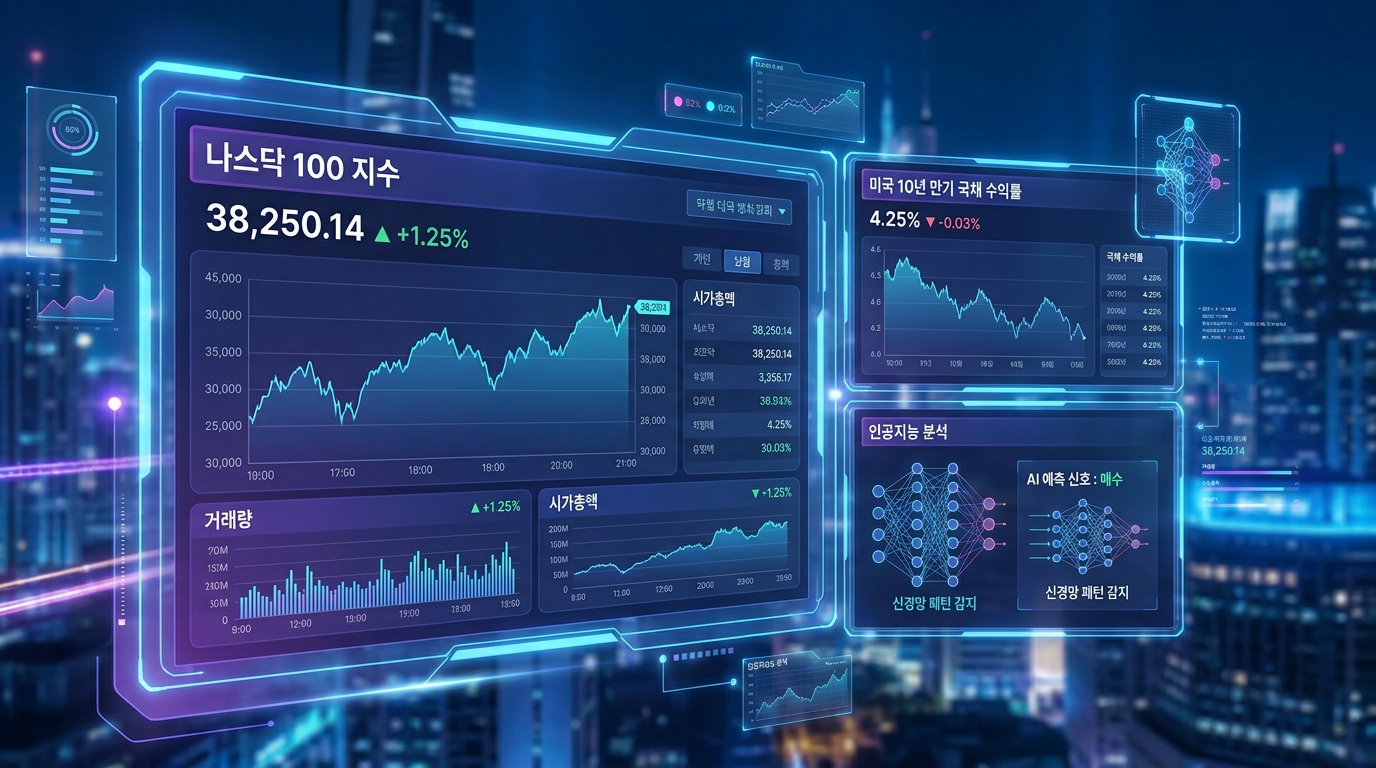
As of intraday April 21, 2026 (provisional), the Nasdaq index remains at a high level of 24,404.39, while the KOSPI index is recording 6,307.68, and the USD/KRW exchange rate is at 1,472.00 won.
Looking at Daily Stock's proprietary Fear & Greed Index, the Nasdaq is currently in the Greed (69.9) stage.
This is a sharp rebound from Extreme Fear (15.6) a month ago and Extreme Fear (16.1) three months ago, suggesting that investor sentiment has quickly skewed toward a buying advantage.
On the other hand, the KOSPI Fear & Greed Index is currently Neutral (59.3), coming down from Extreme Greed (87.4) three months ago, showing a relatively stable wait-and-see attitude.
In terms of macro indicators, the US 10-year Treasury yield (US10Y) is recording around 4.26%, putting a burden on Big Tech's multiple expansion.
Additionally, the Dollar Index (DXY) is fluctuating around the 98 level, acting as a sensitive variable that could impact global liquidity flows.
Financial Analysis
Big Tech's aggressive AI infrastructure buildup is directly impacting individual companies' free cash flows (FCF) and financial structures.
This year, the combined AI CAPEX of major tech companies such as Amazon, Microsoft, Alphabet, and Meta is estimated to exceed a staggering $700 billion.
Such astronomical spending inevitably entails increased depreciation expenses, which is bound to lead to a short-term contraction in profit margins.
Particularly, as massive budgets are concentrated on expanding hardware like hyperscale data centers and custom silicon (ASICs), defending the return on investment (ROI) has emerged as a core financial task.
| Company Category | Estimated 2026 AI CAPEX | Key Investment Areas | Profitability Defense Risks |
|---|---|---|---|
| Cloud Infrastructure (AWS, Azure, GCP) | Over $150B - $200B | Hyperscale data centers, in-house AI chips | High depreciation costs, short-term margin contraction |
| Social & Platforms (Meta, etc.) | $115B - $135B | Open-source AI models, inference infrastructure | Potential delays in linking to ad revenue |
| Enterprise AI (Oracle, etc.) | Around $50B | Building specialized cloud servers | Burden of transition costs compared to legacy business |
As shown in the table above, there are mixed, uncertain scenarios regarding whether massive cash expenditures will lead to immediate EPS (Earnings Per Share) growth.
Valuation
[Image: /stdaily/uploads/202604/gen_69e6be6e9dbf29.30526336.png]
The valuation of the Nasdaq 100 commands a significant premium compared to S&P 500 value stocks or traditional growth stocks.
To justify such high multiples and massive CAPEX, monetization at the AI agent and software levels must continuously exceed market consensus.
If the US10Y rises toward the mid-4% range or becomes entrenched at its current high level, the discount rate applied to future earnings will increase, potentially exacerbating multiple pressure.
Historically, the US 10-year yield and the Nasdaq 100 multiple have shown an inverse correlation; therefore, if rate cut expectations recede, the possibility of steep valuation corrections cannot be ruled out.
Expert & Institutional Analysis
Wall Street analysts point out that the current index level of the Nasdaq 100 could be attributed to short-term short covering and a concentration of AI momentum.
Some institutions are divided on whether the explosion in CAPEX, reaching $700 billion annually, will lead to a true 'productivity revolution' or end up as 'excessive overlapping investments.'
Additionally, the VIX (Volatility Index) fluctuating around the 18 mark, showing signs of emerging risk aversion, is a closely watched point.
Scenarios are also being raised where, if the Federal Reserve's monetary policy flexibility decreases due to inflation rebound concerns, technical resistance selling may emerge in the short term, centered around large-cap Nasdaq stocks.
Risk Factors
The most fundamental risk is the issue of 'delayed monetization,' where astronomical AI infrastructure investments do not directly translate into meaningful software and service revenues.
If end-user enterprise companies scale back their AI adoption budgets or slow down the pace, the cloud revenue growth of Big Tech could sharply falter.
Moreover, the possibility of intensifying regulatory pressure from global authorities regarding AI antitrust laws or copyright issues is another factor that could compound costs.
On the macro side, if inflationary pressures are reignited by rising energy prices, prolonging a high-interest-rate environment, a strong valuation contraction could occur across tech stocks.
Investment Perspective Summary
[Image: /stdaily/uploads/202604/gen_69e6be8412ccc9.44463035.png]
Currently, the Nasdaq 100 is walking a tightrope between the massive mega-trend of AI infrastructure building and heightened macro uncertainties (interest rates, exchange rates).
As the Fear & Greed Index has reached the Greed level (69.9), investor sentiment may react sensitively to even small earnings misses or deteriorating indicators, demanding a cautious approach rather than blind chase-buying.
A strategy of thoroughly differentiating between highly indebted companies with high interest-rate sensitivity and companies where AI monetization is visibly reflected in the numbers to review your portfolio could be advantageous.
In phases of expanding volatility (VIX), maintaining a certain proportion of cash and exploring split-buying opportunities during periods when the valuation bubble dissipates would be a rational scenario.
Investor Checkpoint Q&A
Q1. What is the market significance of Big Tech's 2026 CAPEX scale reaching $700 billion?
While it has a strong nature of an essential defensive investment to secure next-generation AI leadership, in the short term, it deteriorates free cash flow and could trigger debates over valuation overpricing.
Q2. What is the impact on the Nasdaq of the US10Y (US 10-Year Treasury Yield) being in the 4.2% range?
As the risk-free rate increases, the discount rate applied to the distant future value of growth stocks rises, which acts as downward pressure on high-multiple tech stocks like the Nasdaq 100.
Q3. What does it mean that the Daily Stock Nasdaq Fear & Greed Index is at 69.9 (Greed)?
It indicates that market sentiment has significantly transformed into optimism compared to Extreme Fear (16.1) three months ago. However, it also implies a cautionary zone in the short term where the desire for profit-taking may grow due to favorable factors being priced in.
Q4. Is there a risk that AI infrastructure investments will fail?
Rather than a technical failure, there is an ever-present possibility that disappointing sell-offs will pour in if the investments are not translated into B2B/B2C software revenues as quickly as the market's high expectations demand.
Q5. What strategy should individual investors take in the current macroeconomic environment?
Rather than getting swept up in FOMO (Fear of Missing Out), it is advisable to closely monitor interest rate directions (US10Y) and volatility (VIX) trends, building a defensive position focused on stocks with solid cash flows.