Hello, this is Daily Stock, where we highlight global macro trends and supply and demand dynamics in the domestic stock market.
[Image: /stdaily/uploads/202604/gen_69dfe0ad4b66b4.79071231.png]
Key Summary
Today, the KOSPI is exploring new index levels, fueled by a dual buying spree from both foreign and institutional investors.
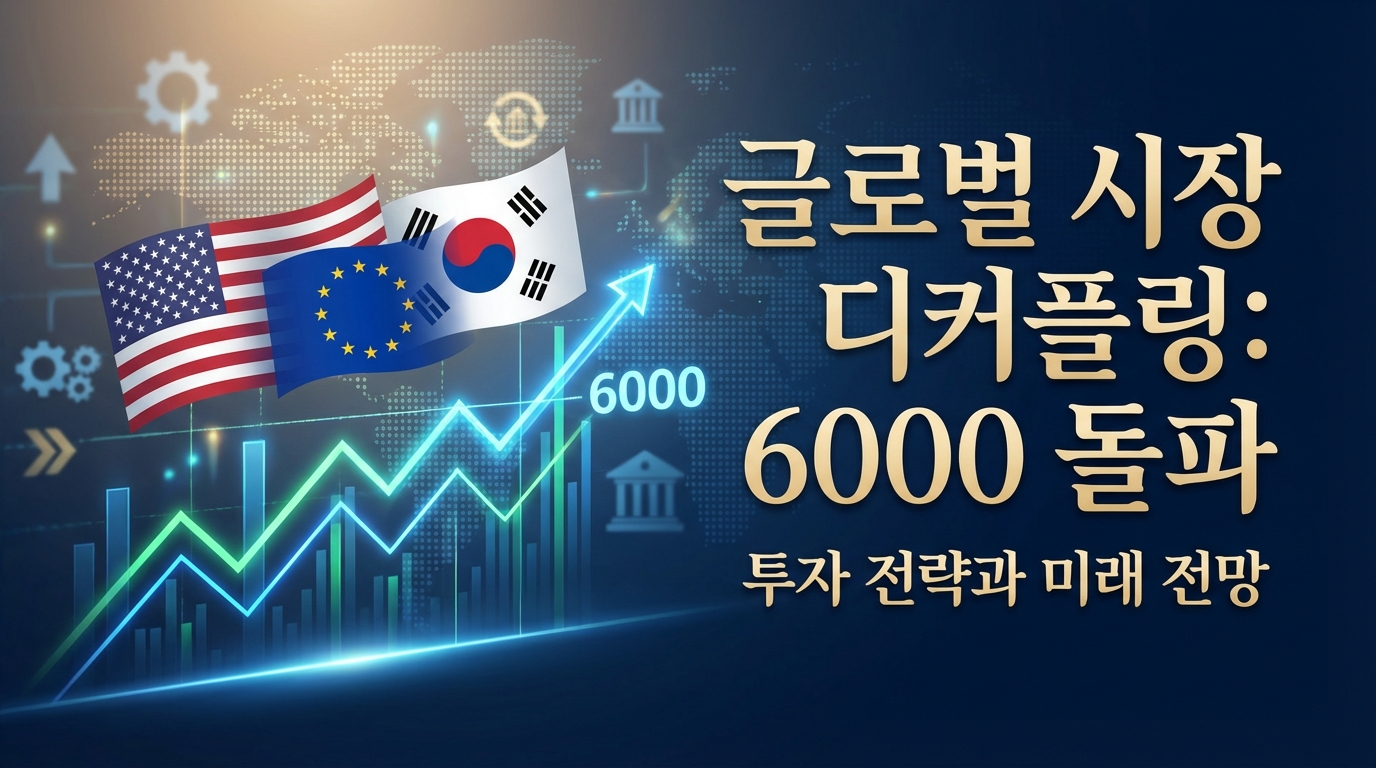
Amid the deepening fundamental decoupling between the US, European, and Asian stock markets, global liquidity appears to be concentrating on undervalued Korean export stocks.
In particular, sectors with traditional cash-generating capabilities, such as automobiles and shipbuilding, dominated the top of today's supply and demand.
This is interpreted not simply as a domestic issue, but as the result of a massive capital movement created by the differentiation of monetary policies in major countries.
Current Situation Summary
As of intraday (provisional) on April 16, 2026, the KOSPI index recorded 6,091.39, showing strong upward support.
At the same time, the KOSDAQ stands at 1,152.43 and the NASDAQ at 23,793.08, while the KRW/USD exchange rate is fluctuating around 1,476.10 won.
According to Daily Stock's proprietary Fear & Greed Index, the KOSPI is currently at a 'Neutral (56.2)' level.
This indicates a gradual recovery in investor sentiment from Neutral (50.2) a week ago and Fear (36.1) a month ago, but it also shows that overheating has significantly cooled off compared to the Extreme Greed (89.4) level three months ago.
The NASDAQ Fear & Greed Index is also currently recorded as 'Neutral (49)'.
Compared to just one week ago at Fear (34.4), one month ago at Fear (21.4), and three months ago at Extreme Fear (13.1), investor sentiment is clearly stabilizing.
The global financial market is currently seeing a distinct fundamental decoupling across three major regions.
While Europe continues to face the European Central Bank's (ECB) monetary policy dilemma due to sluggish manufacturing PMI, Asia is benefiting from policy measures amid the People's Bank of China's (PBOC) liquidity injection and the Bank of Japan's (BOJ) cautious moves.
Financial Analysis
The top sectors in the KOSPI market that saw strong foreign inflows today are heavy industries such as shipbuilding and automobiles.
These companies are enjoying the financial advantage of maximized KRW-converted margins under the high exchange rate environment of 1,476.10 won per dollar.
In particular, major shipbuilding stocks positioned at the top of the inflow list are significantly improving their operating margins by smoothly passing on raw material price hikes to ship prices.
Despite major raw materials like oil and copper maintaining strong price trends, it is positive that they have turned their free cash flow (FCF) into a surplus based on solid order backlogs.
| Rank | Sector | Primary Buyer | Financial Characteristics & Momentum |
|---|---|---|---|
| 1 | Automobiles | Foreigners | Beneficiaries of high exchange rate, structural ROE increase driven by global market share expansion |
| 2 | Shipbuilding | Foreigners/Institutions | Arrival of eco-friendly ship replacement cycle, expansion of high-margin, high-value-added vessels |
| 3 | Power Equipment | Institutions | North American power grid replacement demand, double-digit operating margin based on long-term supply contracts |
| 4 | Financial Holdings | Foreigners | Strengthened shareholder return policies, unparalleled valuation attractiveness with PBR below 1x |
[Image: /stdaily/uploads/202604/gen_69dfe0c2cc4474.13374439.png]
Valuation
Comparing the relative strength of the US, European, and Asian stock markets, the downside rigidity of the Korean stock market stands out strongly in terms of valuation.
While the NASDAQ index has crossed the 23,000 mark, increasing the price-to-earnings (PER) burden again, large-cap KOSPI stocks remain discounted compared to major countries despite achieving record-high earnings.
There is a growing possibility that abundant US liquidity will gradually shift away from overvalued big tech towards Asian value stocks, which are cheaper in valuation relative to their earnings.
On the other hand, the European stock market is constrained by recession fears, making the global capital tilt towards Asia an effective strategy for the time being.
Expert and Institutional Analysis
Major global investment banks (IBs) analyze that the difference in balance sheet policies among major central banks has created the current supply-demand concentration in emerging markets.
While the US Federal Reserve (Fed) and the ECB take a cautious stance on liquidity management, the PBOC's gradual easing and the BOJ's moderate pace of normalization are evaluated as increasing the relative asset attractiveness of the Asian region.
Furthermore, global macro analysts diagnose that the price trends of key industrial metals like copper confirm the rebound of the Asian manufacturing cycle.
The blue-chip KOSPI export stocks, which have attracted concentrated inflows, are expected to demonstrate the most remarkable earnings stamina in this global manufacturing restocking cycle.
Risk Factors
The biggest potential risk is the possibility of prolonged geopolitical tensions centered around the Middle East and Eastern Europe.
This could lead to wild fluctuations in international oil prices, delaying the slowdown of global inflation, and consequently entangling the monetary easing steps of major countries.
In addition, concerns over global supply chain disruptions, such as logistics bottlenecks on major shipping routes, are variables that require continuous monitoring.
If supply chain freight costs surge steeper than expected, it could act as a short-term margin pressure factor for export-oriented Korean companies.
Investment Perspective Summary
The current concentration of foreign inflows is interpreted as part of a structural asset allocation based on global fundamental decoupling, rather than simple short-term trading.
Therefore, it is suggested to consider focusing on value stocks with clear cash flows and earnings visibility, rather than aggressively chasing high-valuation leading stocks.
As macro indicator volatility persists, a strategy of cross-verifying global PMI trends and raw material price movements to enhance portfolio defensiveness is considered notable.
Frequently Asked Questions
Q1. Why are foreigners heavily buying automobile and shipbuilding stocks today?
This is because the current high KRW/USD exchange rate environment around 1,476 won enhances the price competitiveness and KRW-converted profit margins of these export companies.
Additionally, the absolutely cheaper valuation compared to the US or European stock markets is attracting long-term investment funds.
Q2. The KOSPI Fear & Greed Index is neutral; is it appropriate to expand new investments now?
An index reading of 'Neutral (56.2)' means that past extremes of overheating or fear-driven biases have been resolved.
However, rather than an unconditional all-out buy signal, it suggests an environment suitable for selective, fractional purchases focusing on stocks with strong fundamentals.
Q3. What are the specific causes of the decoupling among US, European, and Asian stock markets?
The US is hindered by accumulated valuation burdens, while Europe is held back by structural consumption slumps and worsening PMI.
Conversely, Asia is showing an independent bullish trend, combining China's accommodative liquidity policy with expectations of an earnings turnaround in export manufacturing.
Q4. What is the impact of a stable copper price trend on the domestic stock market?
The robustness of copper prices, often called 'Dr. Copper,' is a representative leading indicator of demand recovery in the global manufacturing sector.
This is a positive signal suggesting that corporate earnings estimates for export-driven countries like South Korea could be revised upwards.
Q5. What are the key global macro indicators to watch closely?
The key indicators are the monthly manufacturing and services PMI trends in the US and Europe, along with major raw material (oil price) movements.
In particular, the contrasting changes in monetary policy stances of the ECB, BOJ, and PBOC can serve as core triggers for global capital movements, making the outcomes of monetary policy meetings important to monitor.