Welcome to Daily Stock, delivering in-depth analysis of structural changes in the global tech market and the fundamentals of key companies.
[이미지: /stdaily/uploads/202609/gen_6aac7f25ba9d84.16784737.png]
Key Takeaways
Synopsys (SNPS) has successfully closed its $35 billion acquisition of Ansys, establishing an unmatched full-stack platform that spans from semiconductor logic design to thermal, structural, and electromagnetic physics simulations.
As chiplets and 2.5D/3D advanced packaging become critical components in AI accelerators, the convergence of legacy Electronic Design Automation (EDA) and physics analysis tools creates an insurmountable barrier to entry.
While Big Tech's push into custom AI chip (ASIC) development and expanding R&D expenditure serve as long-term tailwinds, 10-year U.S. Treasury yield volatility and high valuation multiples represent key tests for its stock price.
Current Market Context
As the world's leading semiconductor design software provider, Synopsys is actively targeting an expanded Total Addressable Market (TAM) of roughly $31 billion following the close of its Ansys merger.
As AI chips grow more sophisticated, multi-die architectures have become essential to circumvent the physical limits of micro-processing nodes. Consequently, physics simulations that resolve thermal and power-integrity bottlenecks have seen their importance skyrocket.
In a duopoly with its primary rival Cadence (CDNS), Synopsys has solidified its dominant position by embedding Ansys's fluid and thermal analysis capabilities directly into its "Synopsys.ai" suite.
Cloud service providers (CSPs) like Google, Amazon, and Meta—who design custom in-house AI silicon—find it increasingly difficult to reduce their structural dependence on Synopsys's toolchain.
Looking at intraday market benchmarks as of September 18, 2026 (preliminary), the KOSPI sits at 6,715.41, the KOSDAQ at 822.18, and the USD/KRW exchange rate is at 1,381.00.
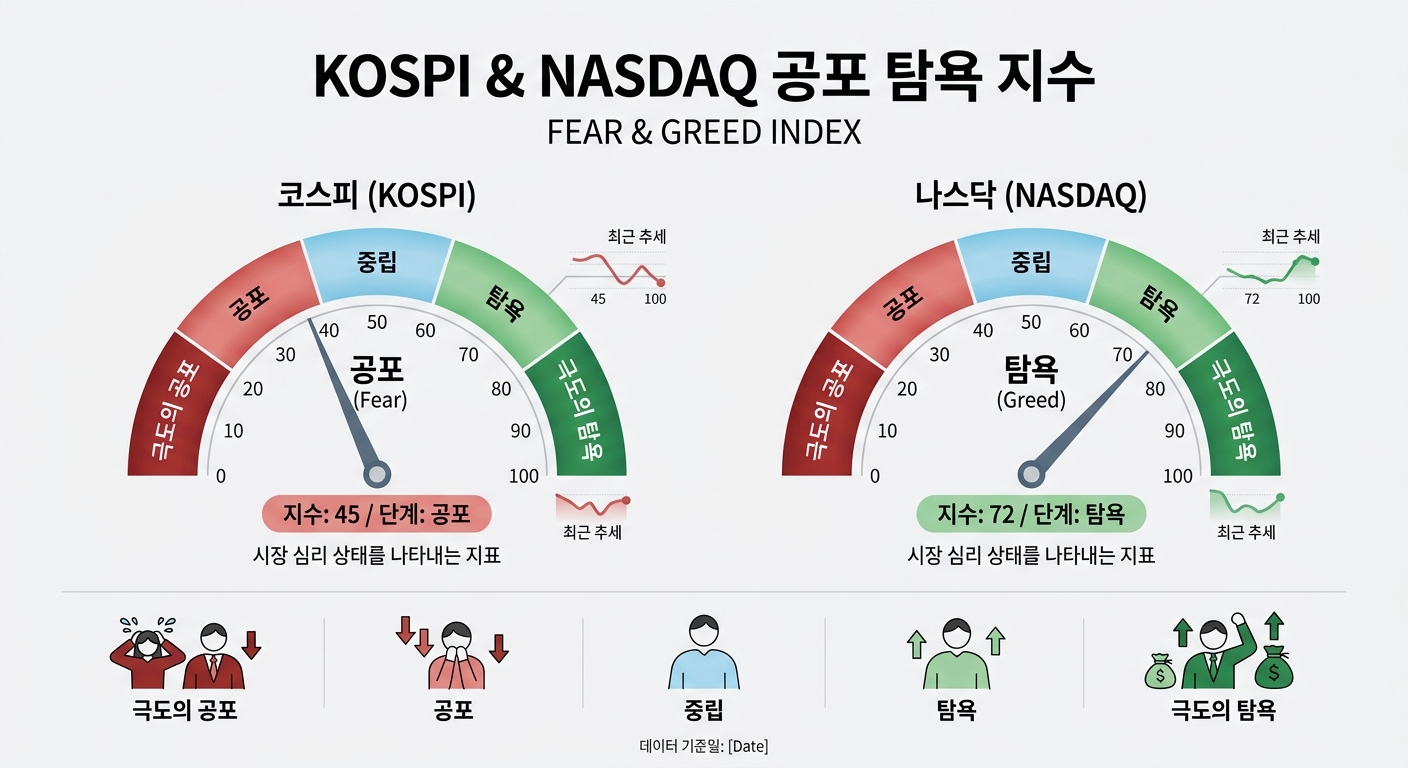
While Nasdaq indices show mixed signals, Daily Stock's proprietary Fear & Greed Index indicates Nasdaq sentiment is currently in "Fear" at 28.7—weakening substantially from "Fear" (32.2) one week ago, "Neutral" (59.1) one month ago, and "Greed" (63.8) three months ago.
The KOSPI Fear & Greed Index similarly stands in "Fear" (30.6), down from "Neutral" (42.5) a week ago, "Neutral" (52.1) a month ago, and "Neutral" (40.2) three months ago, pointing to clear risk aversion.
Synopsys (SNPS) intraday price data is unconfirmed for the day (based on latest verified prints), but the stock reflects ongoing volatility tied to broader Philadelphia Semiconductor Index (SOX) macro sensitivity.
Financial Analysis
Synopsys's financial structure has entered a phase of accelerated top-line expansion driven by the Ansys integration.
The combined entity's annual revenue has leaped past $9 billion, with more than 80% generated through recurring revenue under multi-year contract structures, offering superior defensive resilience across economic cycles.
Although the company incurs financial expenses tied to new shares issued and debt taken on for the Ansys acquisition, it demonstrates robust cash-generation capabilities by sustaining non-GAAP operating margins near 40%.
A steady order backlog acts as the primary foundation supporting earnings visibility over the next 2 to 3 years.
| Financial Metric | Synopsys (SNPS) Key Figure | Notes & Analytical View |
|---|---|---|
| Combined Annual Revenue | Approx. $9.5B – $9.8B | Reflects post-Ansys acquisition consolidation |
| Non-GAAP Operating Margin | Approx. 39% – 41% | Driven by high-margin software licenses |
| Backlog | $8B+ | Highly stable recurring revenue on multi-year deals |
| Core Growth Drivers | AI Semiconductor EDA & System Simulation | Growing orders across chiplets & advanced 3D packaging |
| Current Share Price | Unconfirmed intraday (based on latest verified print) | As of September 18, 2026 intraday (preliminary) |
So long as Big Tech maintains monumental AI CapEx budgets, demand for software R&D licenses should remain solid.
Over the short term, however, investors should monitor the drag that intangible asset amortization and organizational integration costs associated with the M&A deal will place on GAAP net income.
[이미지: /stdaily/uploads/202609/gen_6aac7f2f966e82.76244638.png]
Valuation
Unlike traditional fabless designers or foundry hardware plays, Synopsys has historically commanded elevated forward P/E multiples ranging from the high 30s to low 40s.
This premium is supported by an asset-light operational model with minimal CapEx overhead alongside a commanding software moat.
Nonetheless, in an environment of elevated 10-year Treasury yields (US10Y) and a strong U.S. Dollar Index (DXY), high-multiple tech equities face persistent discount-rate headwinds.
The valuation gap between Synopsys and Cadence (CDNS) is likely to re-rate depending on the quality of portfolio integration and subsequent cross-selling execution.
Because Synopsys trades at a premium to the Nasdaq 100, its quarterly EPS growth must consistently exceed 15% to validate its current multiple.
During macro shock episodes marked by a surging Volatility Index (VIX), investors must remain mindful of short-term multiple de-rating risks.
Expert & Institutional Perspectives
Major Wall Street institutions believe that closing the Ansys transaction cements Synopsys's role as the quintessential "super-supplier" across the semiconductor ecosystem.
Global investment banks such as Benchmark emphasize that neither Nvidia nor cloud hyperscalers engineering custom accelerators can manufacture a single chip without EDA software.
Semiconductor research firm SemiAnalysis similarly noted that Synopsys's toolchain lock-in effect has grown far more entrenched in sub-7nm advanced nodes and 3D ICs.
For engineers who have honed their skills within a specific environment for decades, switching tool suites incurs hundreds of billions of won in friction costs.
Conversely, certain credit rating agencies point to debt paydown velocity and talent retention during the integration phase as key monitoring checkpoints.
Some observers also argue that synergy figures should be evaluated conservatively on a quarter-by-quarter basis until both product lines are seamlessly fused into a unified environment.
Risk Factors
The foremost risk is the potential moderation of hyperscaler AI infrastructure CapEx.
If Big Tech's AI monetization lags market expectations, new chip tape-out timelines could be pushed out or R&D allocations could face belt-tightening.
Geopolitical friction between the U.S. and China, paired with tighter semiconductor export curbs, represents another headwind.
While Synopsys secured Chinese regulatory clearance to finalize the merger, heightened restrictions on next-generation, high-performance EDA suites could directly impair licensing revenues across the Greater China market.
Additionally, prolonged elevated interest rates present multiple compression risks, and aggressive pricing battles with Cadence could dent operating margins.
Given the sheer scale of the combination, the potential for software compatibility snags or reduced productivity due to delayed cultural integration cannot be ruled out.
Investment Takeaway
Regardless of who emerges victorious in the AI race, Synopsys stands as an indispensable infrastructure toll-collector across the chip design phase.
Its "Silicon to Systems" roadmap, finalized through the Ansys acquisition, represents a unique, turnkey solution to the physical bottlenecks plaguing advanced AI hardware.
However, with the macro environment weighed down by a Nasdaq Fear & Greed Index reading of 28.7, high-P/E growth stocks remain vulnerable to heightened short-term volatility.
Rather than pursuing short-term momentum bets, a dollar-cost-averaging approach that tracks the custom ASIC development cycle and quarterly free cash flow (FCF) progression appears to be the most prudent playbook.
Q&A with Daily Stock
Q1. What was the strategic rationale behind Synopsys acquiring Ansys?
A1. As AI chips advance, silicon can only function reliably if physical variables like heat dissipation, structural stress, and electromagnetic interference are simulated alongside logic signals. The deal combines traditional EDA with Ansys's multi-physics simulation suite to deliver a one-stop design platform.
Q2. What sets Synopsys (SNPS) apart from Cadence (CDNS)?
A2. Synopsys maintains dominant market share in logic synthesis and timing verification, and this acquisition secures an unmatched structural lead in multi-physics simulation.
Q3. How does Big Tech's in-house AI chip development (ASIC) impact Synopsys?
A3. Projects like Google's TPU, Amazon's Trainium, and Meta's MTIA broaden the customer base for software licenses beyond classic foundries and fabless firms to hyperscalers at large, acting as a secular tailwind.
Q4. Are there lingering concerns from the conditional approval by Chinese regulators?
A4. Although China's State Administration for Market Regulation (SAMR) greenlit the deal, overlapping U.S. Department of Commerce export controls restrict certain advanced capabilities, leading to ongoing geopolitical compliance overhead.
Q5. Which metrics deserve the closest attention when evaluating Synopsys in today's market?
A5. Key barometers include the trajectory of the 10-year Treasury yield, quarterly CapEx guidance across the big four cloud providers (Microsoft, Google, Meta, Amazon), and the steady expansion of the company's contracted backlog.