Welcome to Daily Stock, where we closely track the US stock market and Tesla's AI pivot roadmap.
[Image: /stdaily/uploads/202609/gen_6aa88aa81545e8.90123015.png]
Key Takeaways
- The foundation of Tesla's (TSLA) corporate valuation is rapidly shifting from simple electric vehicle (EV) delivery figures to full self-driving (FSD) software subscriptions and autonomous Cybercab network revenue models.
- With aggressive annual capital expenditure (CapEx) plans exceeding $25 billion as of 2026 and ongoing expansions in AI compute infrastructure, near-term free cash flow (FCF) and operating margins remain under pressure.
- Amid macroeconomic volatility in the 10-year US Treasury yield (US10Y) and the US Dollar Index (DXY), justifying Tesla's premium software multiple hinges on the adoption pace of active FSD users and the timing of meaningful earnings per share (EPS) contributions.
Current Situation Overview
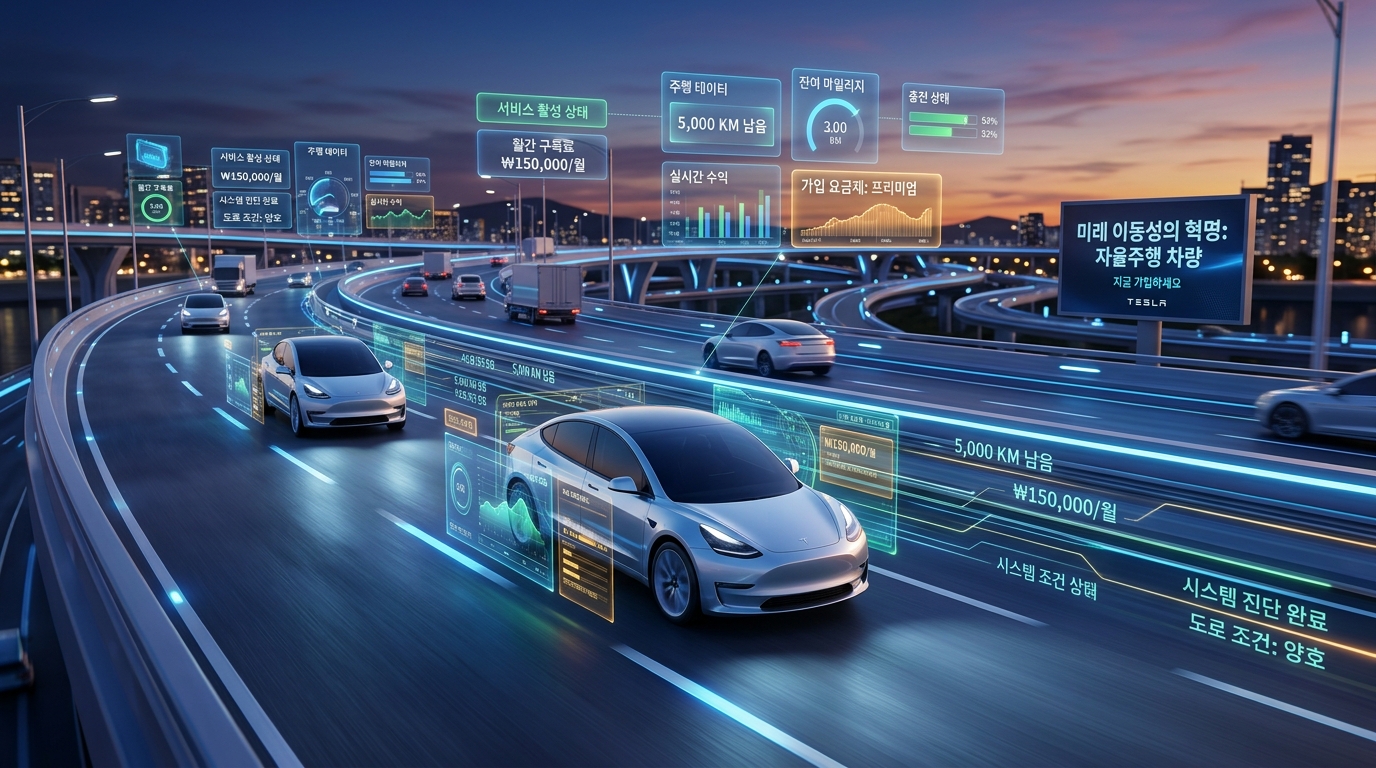
Following the unveiling of its autonomous Cybercab concept, Tesla overhauled its autonomous driving commercial strategy, pivoting from upfront hardware/software package sales to a full subscription-based model priced at $99 per month.
This strategy lowered entry barriers and drove cumulative active FSD subscribers past 1.4 million accounts.
However, quarterly AI computing CapEx for Hardware 4 (AI4) and next-generation clusters has surpassed $5 billion, causing a sharp retreat in near-term operating margin defense.
As of intraday September 15, 2026 (tentative), with no active Nasdaq Composite cash session trading, the Daily Stock Fear & Greed Index places Nasdaq in 'Fear (31.1)', down significantly from 'Greed (64.3)' one month ago, reflecting souring sentiment across tech growth stocks.
Domestic markets also reflect risk-off positioning: the KOSPI sits at 6,631.02 and KOSDAQ at 806.44, with the KOSPI Fear & Greed Index sliding into 'Fear (27.8)'.
With the USD/KRW exchange rate moving sideways at 1,347.50 KRW, while Tesla's latest trading prices remain unconfirmed intraday, pressure to justify its tech valuation multiple—trading above a forward P/E of 100x—is intensifying.
| Metric | Key Figures & Indicators (As of 2026-09-15 Intraday, Tentative) | Previous / Comparative Period |
|---|---|---|
| **KOSPI / KOSDAQ** | 6,631.02 pt / 806.44 pt | KOSPI Fear Index: 27.8 (50.9 Neutral 1 week ago) |
| **Nasdaq Fear & Greed** | 31.1 (Fear) | 45.2 (Neutral) 1 week ago / 64.3 (Greed) 1 month ago |
| **USD/KRW Rate** | 1,347.50 KRW | Limited volatility; wait-and-see FX stance |
| **Annual CapEx Guidance** | Exceeding $25 Billion | Ramping investments in AI compute clusters & dedicated lines |
| **Active FSD Subscribers** | Approx. 1.48 Million (Latest confirmed quarter) | +56.0% YoY growth |
| **Operating Margin Trend** | 1.4% (Latest confirmed quarter) | Pressured by rising AI R&D and depreciation costs |
[Image: /stdaily/uploads/202609/gen_6aa88ab26e4741.77326774.png]
Financial Analysis
Tesla's revenue in the most recent quarter exceeded $28 billion on the back of record vehicle deliveries; however, its operating margin dropped to around 1.4%.
This figure trails the automotive industry average, impacted directly by lower average selling prices (ASPs) from price cuts alongside surging AI R&D expenses.
The most notable balance-sheet shift is the turn to negative free cash flow (FCF).
With quarterly CapEx reaching $5.8 billion, net cash outflows emerged for the period, and management affirmed that full-year CapEx will surpass $25 billion, with heavy expenditures set to continue over several years.
Conversely, encouraging signals are surfacing in the software division.
With monthly $99 recurring FSD active accounts reaching 1.48 million, an annual recurring revenue (ARR) run rate of roughly $1.7 billion has formed.
As accumulated deferred revenue is sequentially recognized, it—along with the higher-margin Energy Storage System (ESS) division—is beginning to serve as a buffer against automotive hardware margin compression.
Valuation
On the Nasdaq, Tesla is traded under the valuation framework of a high-growth software platform rather than a traditional automaker.
With the Philadelphia Semiconductor Index (SOX) and the Nasdaq 100 transitioning toward a phase demanding tangible AI monetizability, maintaining rich multiples on long-term vision alone has become increasingly difficult.
If the 10-year US Treasury yield (US10Y) exhibits downward stickiness, structural vulnerabilities requiring substantial discounting of long-dated cash flows become pronounced.
To justify its heavy premium over S&P 500 mega-cap growth peers, Tesla must prove that commercial robotaxi service costs can settle around $0.30 to $0.35 per mile while establishing steady platform take-rate collections.
Tesla retains more than $40 billion in cash and equivalents, keeping balance-sheet liquidity risk well-managed despite additional debt financing plans.
However, amidst near-term cash flow drawdowns, any spikes in the Volatility Index (VIX) or strength in the US Dollar Index (DXY) leave the door open for multiple de-rating volatility.
Wall Street & Institutional Views
Major Wall Street investment banks maintain diverging stances on Tesla's AI and mobility pivot.
Bullish firms, including Benchmark, emphasize that Tesla remains the only enterprise capable of leveraging manufacturing cash flows to construct in-house AI silicon and proprietary supercomputing clusters.
They argue that FSD adoption surpassing 50% on newly delivered North American vehicles represents an unmistakable tipping point for autonomous driving mass adoption.
In contrast, conservative institutional investors highlight that CapEx exceeding $25 billion severely impairs near-term earnings per share (EPS).
They caution that if regulatory approvals for fully driverless commercial fleets are delayed, depreciation burdens from massive computing infrastructure could weigh on operating margins through 2027.
[Image: /stdaily/uploads/202609/gen_6aa88abca3e592.21608269.png]
Risk Factors
The primary fundamental risk lies in the temporal mismatch between AI infrastructure investments and actual monetization.
Amid escalating CapEx competition among Big Tech peers, should fully autonomous robotaxi commercialization lag despite heavy capital deployments, free cash flow deficits could widen.
A second headwind is the regulatory hurdle across jurisdictions.
Legal liability frameworks for driverless, unsupervised autonomous transit remain fragmented across municipal and state lines, threatening to slow nationwide rollout schedules.
Lastly, macroeconomic interest rate dynamics pose clear valuation risks.
If the pace of monetary easing falls short of market expectations or rebounding inflation pushes 10-year Treasury yields back upward, compression of Tesla's multiple—heavily tethered to distant terminal value—remains inevitable.
Investment Perspective
Tesla is navigating a transitional phase from a pure hardware assembly business to a 'Physical AI' infrastructure and software network ecosystem.
Consequently, primary investment criteria must shift away from quarterly vehicle unit deliveries toward active FSD subscription trajectories and AI compute efficiency milestones.
With Fear & Greed indicators across domestic and US markets entrenched in 'Fear', investors should focus on confirming an operating margin trough rather than expecting aggressive multiple expansion.
As the $25 billion annual CapEx fully ripples through Cost of Goods Sold (COGS) and SG&A, whether high-margin software revenues can create a golden cross to offset these capital costs will be the decisive inflection point for medium- to long-term re-rating.
Investor Checkpoint Q&A
Q1. What is the financial significance of Tesla eliminating upfront FSD purchases in favor of an all-subscription model?
By replacing upfront packages that previously cost up to $15,000 with a $99/month recurring plan, Tesla dramatically lowered initial consumer adoption barriers. The strategy replaces lump-sum, irregular cash inflows with a predictable, high-margin Annual Recurring Revenue (ARR) stream.
Q2. What is driving the 2026 CapEx guidance past $25 billion?
The capital ramp stems from deploying dedicated AI supercomputing clusters (e.g., Cortex), outfitting production lines for the next-generation Cybercab, and accelerating Optimus humanoid robotics development—matching the infrastructure intensity of leading hyperscalers to realize Physical AI.
Q3. Why did the operating margin contract into the 1% range in the latest quarter?
It resulted from a confluence of automotive price cuts implemented to protect volume, compounded by heavy depreciation on AI computing clusters, elevated R&D spending, and pre-production tooling costs.
Q4. Which macroeconomic indicators exhibit the strongest correlation with Tesla's equity pricing?
The 10-year US Treasury yield (US10Y) and the Volatility Index (VIX). Because cash flows from robotaxis and unsupervised autonomous networks sit further out on the horizon, the equity multiple is sensitive to the long-term discount rates (WACC) applied to future earnings.
Q5. Which FSD metric should investors monitor most closely?
The FSD attach rate on newly delivered units and the expansion curve of cumulative active subscribers. For Tesla to absorb $25 billion in annual CapEx and re-accelerate margins, its current subscriber base of ~1.48 million must continue compounding at sustained double-digit percentage rates.