Hello, this is Daily Stock, delivering in-depth analysis of the global macroeconomy and the Big Tech infrastructure ecosystem.
[Image: /stdaily/uploads/202609/gen_6aa8445e74c2f6.25353462.png]
Key Takeaways
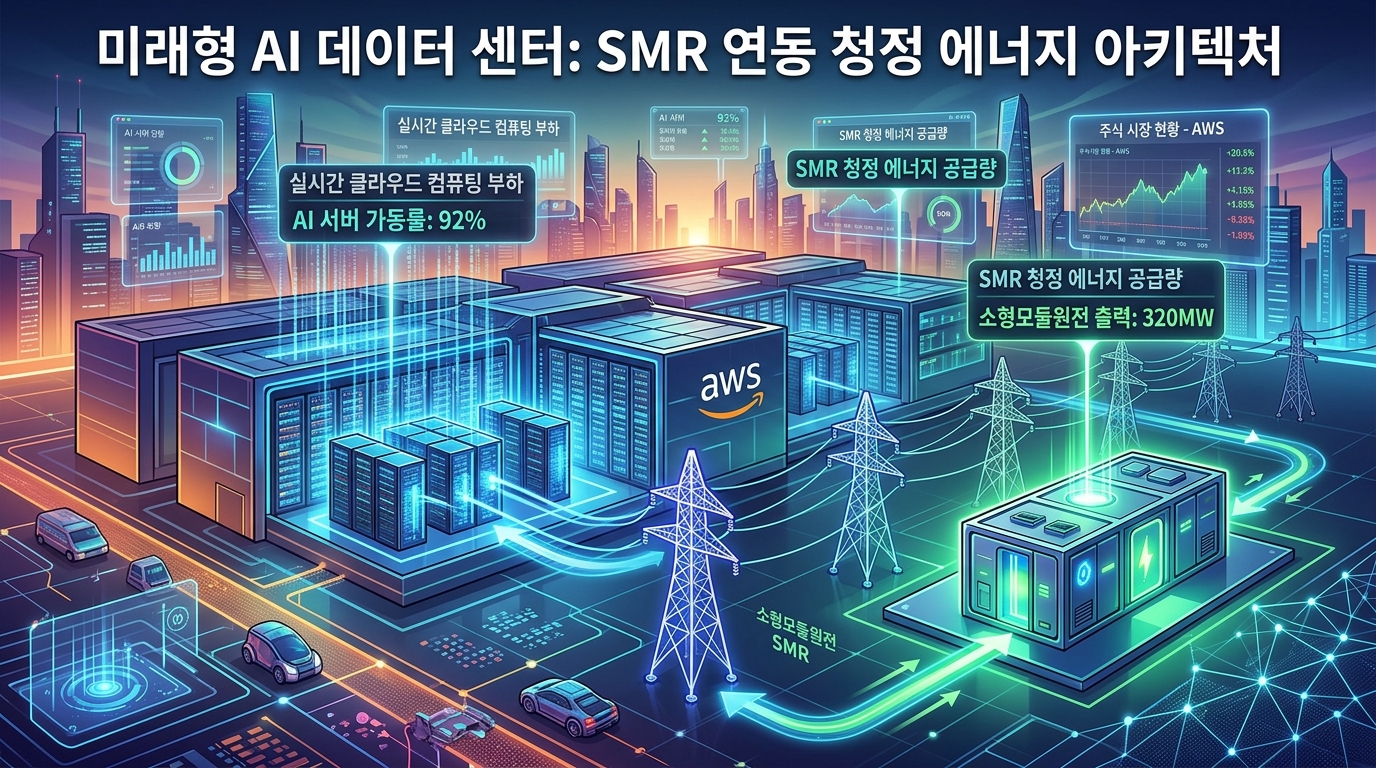
Amazon (AWS) is aggressively accelerating long-term power purchase agreements (PPAs) and investments in small modular reactor (SMR) development to cope with explosive computing demand from artificial intelligence.
Key milestones include expanding a 1,920 MW nuclear PPA with Talen Energy and advancing diversified SMR deployments with partners like X-energy and Energy Northwest.
Global financial markets are witnessing deeper fundamental decoupling across three major economic blocs—the US, Europe, and Asia—driven by differences in AI power grid buildout speeds.
The race to secure reliable baseload power is driving strong demand for core commodities such as copper and uranium, triggering a broad macroeconomic valuation reset.
According to Daily Stock's proprietary Fear & Greed Index, as of intraday September 15, 2026 (provisional), the KOSPI sits in Fear (27.8) and the Nasdaq in Fear (33.3).
This marks a coordinated deterioration from Neutral one week prior (KOSPI 50.9, Nasdaq 45.2), pointing to a transitional scenario as markets absorb heavy infrastructure spending commitments and macroeconomic tightening pressures.
Current Market Environment
Big Tech's expansion of generative AI data centers has permanently evolved from a short-term scramble for graphic processing units (GPUs) into a long-term race to lock down 24/7 carbon-free baseload power.
After acquiring a data center campus adjacent to Talen Energy's Susquehanna nuclear power plant, Amazon secured a PPA ensuring up to 1,920 MW of clean power through 2042.
Concurrently, Amazon made an equity investment in advanced nuclear startup X-energy and outlined plans with Washington state's Energy Northwest consortium to deploy up to 12 SMRs under the Cascade Advanced Energy Project.
In Virginia, Amazon is partnering with Dominion Energy to study the feasibility of installing at least 300 MW of SMR capacity near existing nuclear stations.
| Category | Key Partnerships & Projects | Power / Facility Scale | Key Features & Expected Impact |
|---|---|---|---|
| Long-term Existing Nuclear PPA | Talen Energy | Up to 1,920 MW (through 2042) | Tied to Susquehanna plant; locks in stable baseload power at long-term fixed rates |
| Next-Gen SMR Deployment | Energy Northwest & X-energy | Initial 320 MW to max 960 MW (12 modules) | Cascade project in Washington; commercialization targeted for early 2030s |
| Utility Joint Study | Dominion Energy | 300 MW+ under review | Addresses power grid expansion across data center clusters in Virginia |
| Core Equipment Supply Chain | US-ROK Nuclear Alliance (Doosan Enerbility, etc.) | Multi-module main equipment manufacturing partnerships | Integrates SMR forgings and primary components into the global supply chain |
Global macro divergence is growing more pronounced across regions.
The US maintains robust economic resilience, supported by an ongoing capital expenditure boom across utilities and independent power producers (IPPs) despite power supply-demand friction.
Conversely, Europe faces sluggish manufacturing PMI recoveries and widening industrial electricity price gaps—exacerbated by nuclear phase-outs across key members outside France—which limits overall economic momentum.
This explains why industrial competitiveness continues to lag despite European Central Bank (ECB) monetary easing.
In Asia, nuclear component and power equipment manufacturers in South Korea and Japan stand out as beneficiaries absorbing North American procurement orders.
However, market volatility is amplified by a confluence of Bank of Japan (BOJ) rate hike vigilance and People's Bank of China (PBOC) stimulus efforts.
As of intraday trading on September 15, 2026 (provisional), the KOSPI stood at 6,684.37, the KOSDAQ at 806.79, and the USD/KRW exchange rate fluctuated near 1,346.70. The Nasdaq index remains unconfirmed for the day (based on latest verified prints).
[Image: /stdaily/uploads/202609/gen_6aa844686ceb24.76743816.png]
Financial Analysis
Backed by massive free cash flow (FCF), Amazon's cloud unit (AWS) is aggressively lifting CapEx for renewables and advanced nuclear energy.
By pivoting from spot power purchases to 15-plus-year long-term PPAs, Amazon preemptively mitigates operational cost volatility tied to fluctuating fuel prices.
These mega-commitments from Big Tech drastically improve cash flow visibility for IPP partners.
Traditional operators such as Talen Energy are lowering reliance on federal nuclear Production Tax Credits (PTC) through fixed-price PPAs, demonstrating durable EBITDA generation.
Capital flowing into the SMR ecosystem is also shifting from early-stage public subsidies toward direct equity injections and advance purchase commitments from Big Tech balance sheets.
This cushions commercial demonstration funding risks for unlisted developers like X-energy and translates into advance deposits and backlog expansion across global component suppliers.
Valuation
With power supply emerging as the defining bottleneck for AI infrastructure scale, utility operators with nuclear assets are rerating toward historical multiple peaks.
Forward P/E multiples for traditional utilities, historically anchored at 12x to 15x, are breaking above 20x as tech infrastructure growth premiums get priced in.
Valuation dispersion across the three macro regions is stark.
US equities sustain relative valuation premiums (higher P/E and EV/EBITDA multiples) centered on AI and infrastructure beneficiaries, while the European STOXX 600 faces capped multiple expansion due to energy transition costs and regulatory burdens.
Asian equities present appealing valuations across hardware supply chains producing grid transformers, power transmission cables, and heavy nuclear forgings.
Nevertheless, regional discount factors are unlikely to dissolve quickly given divergent monetary policies and lingering geopolitical uncertainties.
Expert & Institutional Insights
Wall Street investment banks and energy think tanks view Big Tech's nuclear PPAs as the convergence of energy security and AI dominance.
Morgan Stanley and Goldman Sachs note that extending the life of existing nuclear units and building SMRs are essential steps to provide the 24/7 carbon-free baseload required to offset renewable intermittency.
The International Energy Agency (IEA) has cautioned that surging data center power demands could create structural supply shocks across copper and uranium markets.
While structural demand for copper climbs to support transmission modernizations and new substations, competition to secure high-assay low-enriched uranium (HALEU) required for SMR deployment is expected to intensify.
Industry analysts also emphasize the structural efficiency of "behind-the-meter" projects co-locating data centers directly at generation sites, citing it as an effective approach to reduce transmission losses and bypass lengthy grid interconnection queues.
[Image: /stdaily/uploads/202609/gen_6aa844737a2813.73289186.png]
Risk Factors
The most structural risks stem from regulatory licensing delays and grid interconnection disputes.
Strict standard design approval reviews by the US Nuclear Regulatory Commission (NRC) and contentious debates at the Federal Energy Regulatory Commission (FERC) over fair power grid allocation could delay targeted commercialization timelines.
Geopolitical vulnerabilities in the nuclear fuel supply chain also loom large.
Global enrichment capacity for HALEU, the primary fuel for next-generation SMRs, remains heavily concentrated in limited geographies, posing operational risks if Western supply chain self-reliance lags.
Furthermore, extreme raw material price volatility and sustained high borrowing costs could inflate initial project financing (PF) expenses, heightening construction-phase CapEx overrun risks.
Investment Perspective
Amazon's multi-gigawatt nuclear PPAs and SMR bets show that Big Tech views power availability not merely as support infrastructure, but as a core strategic survival asset.
From an investment perspective, key areas of interest include US IPPs with operating nuclear capacity, pioneering SMR technology vendors, and ROK-US supply chain partners providing critical reactor components.
In the near term, however, macro liquidity concerns and profit-taking impulses dominate market psychology, as indicated by Daily Stock's Fear & Greed Index placing both the KOSPI (27.8) and the Nasdaq (33.3) in Fear territory.
Utility and nuclear theme stocks that have priced in substantial optimism may experience elevated near-term volatility driven by regulatory headlines and earnings updates.
Consequently, phased accumulation tied to verified project licensing milestones and actual PPA delivery timelines is preferable to chasing rallies.
Investors should manage risk by cross-referencing monetary policy paths against grid equipment order momentum within this tri-polar decoupling backdrop.
Investor Checkpoint Q&A
Q1. Why is Amazon focusing on nuclear PPAs and SMRs over solar and wind?
Generative AI data centers demand round-the-clock, continuous high-volume power.
Because wind and solar suffer from weather-related intermittency and high battery energy storage system (BESS) costs, nuclear power has emerged as an optimal choice to supply clean, uninterrupted baseload electricity.
Q2. How do Small Modular Reactors (SMRs) differ from conventional large-scale reactors?
SMRs typically generate 300 MW or less per module and are manufactured in factories for on-site assembly.
This approach substantially lowers initial capital costs and construction schedules while offering modular placement near data centers or edge grids to circumvent transmission bottlenecks.
Q3. How are Korean companies connected to the Amazon and X-energy partnership?
South Korean players like Doosan Enerbility participate as core manufacturing partners supplying heavy forgings and major components for X-energy's Generation IV gas-cooled reactor (Xe-100).
Increased Big Tech capital expenditure directly expands the global contract pipeline for Korean nuclear equipment fabricators.
Q4. Why are regulatory decisions from US FERC and the NRC critical?
FERC reviews assess whether directly interconnecting data centers to operating nuclear facilities compromises grid stability or elevates utility rate burdens for the public.
Additionally, SMR designs require NRC standard design approvals and construction permits before achieving commercial operation, making regulatory progress the definitive metric for commercial deployment.
Q5. How should investors navigate the power infrastructure sector under current Fear sentiment?
With sentiment depressed across both the KOSPI (27.8) and the Nasdaq (33.3), short-term multiple pressure may continue to play out.
A defensive portfolio strategy involves screening for utilities backed by contracted long-term supply agreements or hardware manufacturers with transparent order backlogs to buffer macro volatility.