Hello, this is Daily Stock, delivering in-depth insights into the key flows across global tech and Nasdaq semiconductor supply chains.
[이미지: /stdaily/uploads/202609/gen_6aa7392339aba4.91118405.png]
Key Summary
Qualcomm's ambitiously launched Copilot+ PC lineup powered by Snapdragon X Elite spearheaded the on-device AI PC era. However, it faces a sobering reality as its initial global PC market penetration hovers around just 1%.
Nevertheless, the lineup achieved a double-digit market share (approx. 10%) in the US retail market for premium Windows laptops priced above $800. With its next-generation processor lineup (X2 Elite) planned for 2026 and more than 100 OEM design wins secured, the company is laying the groundwork for structural business transformation.
As the Nasdaq Fear & Greed Index slips into the "Fear (33.3)" territory amid ongoing macro volatility in the 10-year US Treasury yield (US10Y) and the US Dollar Index (DXY), the revenue visibility of Qualcomm's PC chips stands as a critical litmus test to reduce mobile dependency and unlock valuation multiple re-ratings.
---
Current Market Status
According to market research firm Canalys, initial quarterly shipments of laptops equipped with Snapdragon X series processors stood at approximately 720,000 units, accounting for only about 0.8% of total global PC shipments.
Considering the broader AI-enabled laptop market surpassed 13 million quarterly shipments with over a 20% market share, the incumbent x86 camp—led by Intel's Lunar Lake and AMD's Ryzen AI—has largely defended its initial territory.
However, Qualcomm's partnership with Microsoft rapidly expanded into flagship models for Surface devices and major OEMs such as Dell, HP, and Lenovo.
Notably, in the US retail high-end Windows laptop segment priced above $800, Qualcomm secured approximately a 10% share, validating its power efficiency and NPU (Neural Processing Unit) competitiveness in the premium tier.
In the domestic FX market, the USD/KRW exchange rate currently stands at 1,343.80 KRW, while the KOSPI index trades at 6,909.91 intraday as of 09:00 on September 14, 2026 (provisional).
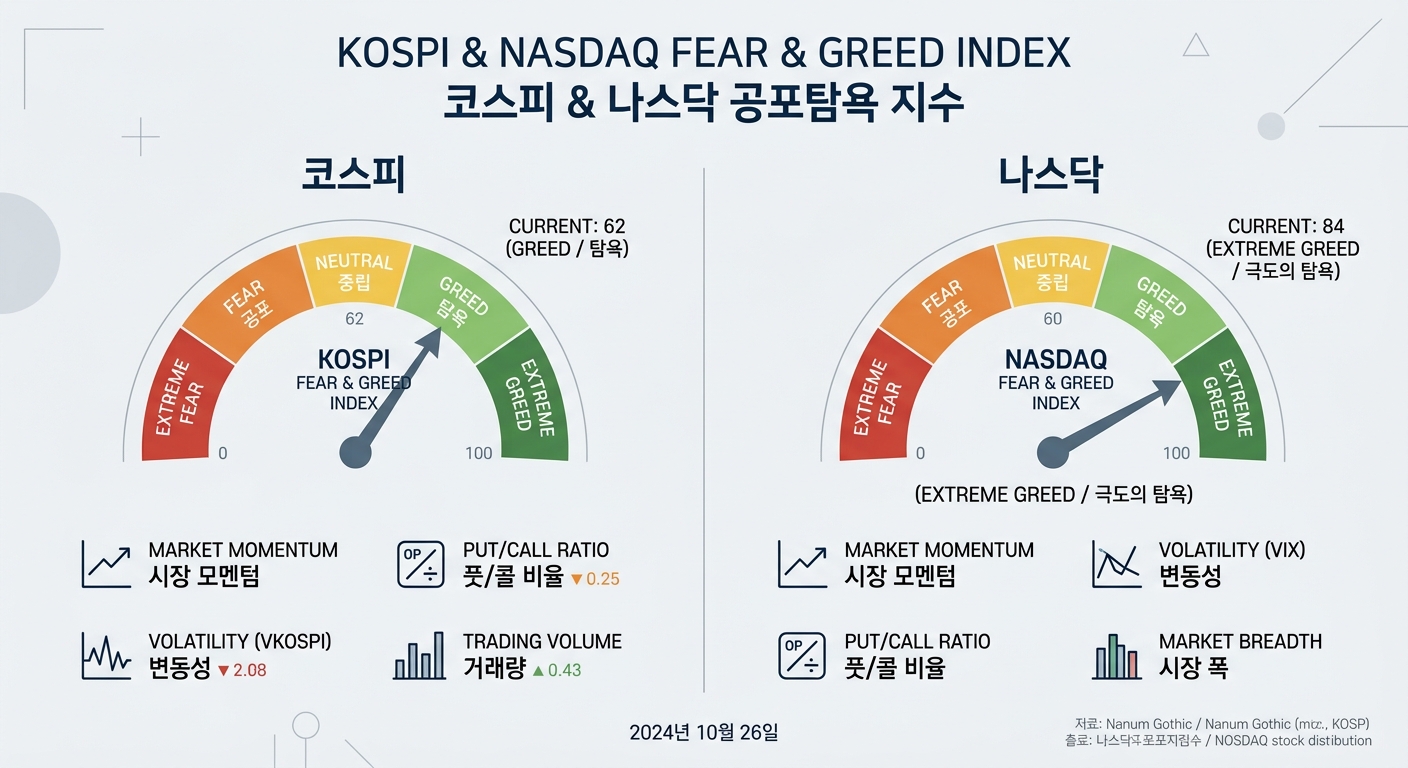
The Nasdaq Fear & Greed Index is currently at the Fear (33.3) level, showing a steep contraction in investor sentiment compared to Neutral (45.2) one week ago, Greed (60.1) one month ago, and Greed (60.3) three months ago.
In contrast, the KOSPI Fear & Greed Index is currently Neutral (42.1), maintaining a moderate correction trend compared to one week ago (49.8), one month ago (50.9), and three months ago (54.5).
---
Financial Analysis
Within Qualcomm's business segments, PC processors are categorized under the IoT (Internet of Things) division, serving as a primary engine to diversify revenue beyond mobile handsets.
Driven by expanding shipments of the Snapdragon X series and the growth of the Automotive division, the share of non-smartphone revenue within the QCT segment is charting a steady upward trajectory.
| Business Segment / Key Metric | Earnings Contribution & Status | Key Growth Drivers & Commentary |
|---|---|---|
| **QCT Mobile (Handset)** | Over 60% of total QCT revenue | Driven by demand for flagship smartphone APs (Snapdragon 8 Series) |
| **QCT IoT (including PC)** | Double-digit YoY growth (20–30% range) | Driven by Snapdragon X Elite/Plus adoption and expansion in enterprise devices |
| **QCT Automotive** | Surged over 50% YoY | Expanded adoption of digital cockpits and autonomous driving stacks |
| **PC Segment Medium-term Target** | $4 billion annual revenue goal by 2029 | Backed by over 100 global OEM designs and B2B enterprise adoption |
Qualcomm has officially set an annual revenue target of $4 billion in the PC processor segment by 2029.
With combined revenues from Automotive and IoT growing more than 27% year-over-year, the company is building a buffer to cushion the historical earnings volatility tied to smartphone upgrade cycles.
---
Valuation
Qualcomm (QCOM)'s valuation multiple as of September 14, 2026, reflects a forward P/E historically trading in the 15–18x range (based on the latest confirmed data), which is relatively discounted compared to mega-cap fabless tech peers such as Nvidia and Broadcom.
This discount stems from the fact that a significant portion of its revenue remains tied to cyclical smartphone replacement demand, preventing it from commanding a full AI premium.
[이미지: /stdaily/uploads/202609/gen_6aa7392cecef77.59607281.png]
However, if Snapdragon X Elite pushes PC market penetration structurally above 5% and B2B enterprise deployments accelerate, the resulting EPS growth improvement could trigger a meaningful valuation multiple re-rating.
Amid trends in the Philadelphia Semiconductor Index (SOX) and the Nasdaq 100, scenarios focused on narrowing the valuation gap between pure hyperscaler AI accelerator beneficiaries and edge on-device semiconductor players are gaining traction.
---
Expert & Institutional Analysis
Global market research firms like Canalys and IDC cite high first-generation price points and concerns regarding x86 legacy application emulation compatibility as primary reasons for the sluggish early adoption of the Snapdragon X series.
The fact that over 30% of enterprise IT channel partners adopted a wait-and-see stance toward deploying Copilot+ PCs also contributed to slower B2B penetration.
Conversely, Counterpoint Research highlights that the power-to-performance ratio delivered by the Oryon core—developed on Nuvia architecture—and its 45+ TOPS NPU computing capacity served as a potent technological catalyst, putting competitive pressure on Intel and AMD.
Wall Street investment banks, including Morgan Stanley and Goldman Sachs, note that Qualcomm's introduction of the budget-friendly 8-core X Plus processor, lowering entry price points to the $600–$800 range, could act as a catalyst for a market share rebound.
---
Risk Factors
The primary risk is the delay in consumer replacement demand caused by the lack of "killer" on-device AI applications.
If Microsoft's Copilot features fail to demonstrate decisive superiority over standard x86 PCs, consumers will have less incentive to accept the compatibility risks associated with Arm-based PCs.
A secondary risk is the macroeconomic environment.
Elevated 10-year US Treasury yields (US10Y), a strong US Dollar Index (DXY), and an elevated Cboe Volatility Index (VIX) put pressure on valuation multiples across valuation-sensitive tech stocks.
Furthermore, market skepticism regarding short-term monetization relative to Big Tech's massive AI capital expenditures (CAPEX) has pushed the Nasdaq Fear & Greed Index down to 33.3, creating supply-demand headwinds.
Next-generation architectures from Intel, AMD's persistent catch-up efforts, and the potential entry of an Nvidia-MediaTek alliance into Arm-based PC processors also represent competitive threats to Qualcomm's current positioning.
---
Investment Perspective Summary
Qualcomm's Snapdragon X Elite should be evaluated not merely by short-term shipment volumes, but by whether it establishes a viable, sustainable alternative that breaks x86's monopoly within the "Windows on Arm" ecosystem.
The initial sub-1% global market share represents an unavoidable transition cost. The upcoming launch of the 2nd generation X2 Elite and more than 80 OEM design references provide tangible groundwork for a market share rebound post-2026.
Investors should closely track quarterly IoT revenue trends to verify Qualcomm's structural transformation from a cyclical smartphone chip supplier into an edge AI platform company spanning PCs and automotive.
---
FAQ
Q1. What was the main reason for the sluggish initial sales of Snapdragon X Elite laptops?
Early product lineups were concentrated in the premium price bracket of $999 and above, while enterprise and retail consumers accustomed to traditional x86 Windows environments took a wait-and-see approach regarding legacy office software and gaming compatibility.
Q2. Is Qualcomm's $4 billion PC revenue target by 2029 achievable?
It is viewed as mathematically attainable if the share of Arm-based laptops reaches 10–15% of total annual global PC shipments (approx. 250 million units) and Qualcomm captures roughly half of that volume.
Q3. What are Qualcomm's key advantages compared to the latest AI PC chips from Intel and AMD?
Superior battery life (power efficiency) derived from its extensive mobile AP design expertise and leading NPU compute performance that proactively met early Copilot+ requirements (40+ TOPS).
Q4. How do macroeconomic indicators (interest rates, the US dollar) impact Qualcomm's stock price?
A rising 10-year US Treasury yield (US10Y) places downward pressure on growth stock multiples, while a strong dollar (DXY) dampens global consumer sentiment for finished PCs and smartphones, weighing on Qualcomm's upstream shipment demand.
Q5. What key financial metrics should investors monitor?
Investors should track quarterly revenue growth in Qualcomm's QCT IoT division, the number of new PC design wins secured with OEM partners, and retail market share trends outside the United States.
---