Hello, this is Daily Stock.
[이미지: /stdaily/uploads/202609/gen_6aa64a1425c151.17764541.png]
Executive Summary
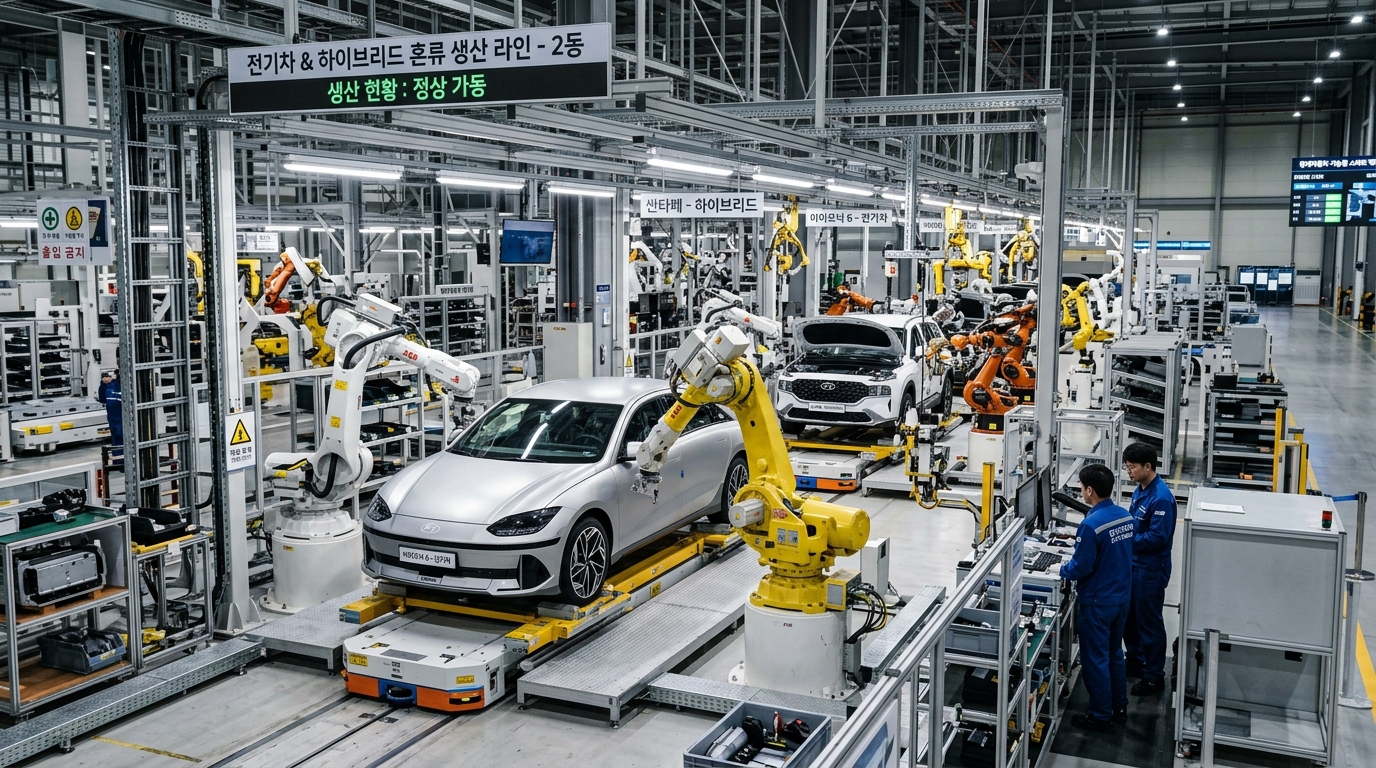
Hyundai Motor (005380) has made a strategic move to dominate the North American market as operations hit full stride at the Hyundai Motor Group Metaplant America (HMGMA) in Georgia.
By flexibly converting its production lines—originally designed exclusively for electric vehicles (EVs)—into a mixed production system for hybrid electric vehicles (HEVs), the automaker is adroitly navigating the global EV chasm (temporary demand plateau) and tariff pressures.
Plans are underway to phase in a capacity expansion at HMGMA from the initial 300,000 units to over 500,000 units. This expansion is poised to serve as a critical bridgehead to boost local US production from the 40% range up to roughly 80%.
As of September 13, 2026, the KOSPI index stands at 6,909.91, with the USD/KRW exchange rate at 1,343.80 won.
The Daily Stock Fear & Greed Index shows the KOSPI at 42.1 (Neutral), while the Nasdaq Fear & Greed Index has entered Fear territory at 33.3, signaling a need to manage macroeconomic volatility.
Current Situation Overview
Pivoting from an early EV-centric posture, HMGMA is deploying Hyundai's primary hybrid SUV lineup in rotation, starting with the Kia Sportage Hybrid.
While capacity utilization languished in the 30% range in the first half of the year due to softening EV demand, a rapid ramp-up is underway for the second half, driven by the rollout of two-shift rotations and active hybrid assembly.
Amid lingering uncertainties regarding US import tariffs and eco-friendly vehicle tax policies, localized production at the Georgia Metaplant serves as an essential defensive buffer to minimize tariff overhead.
Adding HMGMA (up to 500,000+ units) to the existing Alabama plant (360,000 units/year) and Kia Georgia plant (340,000 units/year) builds out a combined group manufacturing footprint of 1.2 million vehicles annually.
Across the broader Korean stock market, the resilient earnings power of the automotive sector—which anchors the upper tier of KOSPI market capitalization alongside semiconductors—remains a pivotal factor driving foreign capital flows.
Financial Analysis
Hyundai Motor is counterbalancing elevated dealer incentive burdens across North America by improving its product mix centered on hybrids and high-margin SUVs.
While temporary profitability headwinds emerged in Q1 due to increased tariffs and marketing expenditures, the rising share of local production has put cost-of-goods-sold (COGS) ratios and logistics cost controls on a normalized path.
| Category | Current Status & Targets | Notes & Details |
|---|---|---|
| Hyundai Motor Share Price | Intraday unverified (Based on latest confirmed data) | As of 2026-09-13 market close |
| HMGMA Production Capacity | 300,000 units/year → 500,000 units (up to 800,000 under review) | Hybrid mixed production facilities equipped |
| North American Localization Target | Low 40% range → Up to 80% | Phased completion planned for 2028–2030 |
| USD/KRW Exchange Rate | 1,343.80 KRW | Export margins and foreign sub translation gains |
| KOSPI Index / Sentiment | 6,909.91 / Neutral (42.1) | Moderated compared to 49.8 one week prior |
| Nasdaq Sentiment | Fear (33.3) | Widening global tech stock volatility |
Hyundai Motor's global hybrid sales continue to shatter historical records, supported by resilient order backlogs for the Tucson and Santa Fe Hybrids in North America.
With the exchange rate finding steady support around the 1,340 won mark, the positive currency-translation effect continues to bolster KRW-denominated revenues and operating profits generated from North American finished vehicle sales.
[이미지: /stdaily/uploads/202609/gen_6aa64a1fac3259.38308678.png]
Valuation
Within the global automotive landscape, Hyundai Motor's valuation continues to trade at a historical discount relative to Japanese peers such as Toyota and Honda.
Despite boasting competitive advantages in its dedicated EV platform (E-GMP) and possessing next-generation powertrains like the 2.5 Turbo Hybrid system, its price-to-earnings ratio (P/E) remains comparatively depressed.
Within the KOSPI 200 large-cap segment, foreign ownership shifts correlate closely with FX trajectories. Meanwhile, Hyundai Motor is steadily raising its total shareholder return (TSR) through expanded dividend payout ratios and treasury stock cancellations.
Analysts highlight that as tariff risks dilute through localized US production, historical discount factors may subside, opening the door for valuation rerating.
Backed by robust trade data reflecting solid Korean auto export volumes, the stock is demonstrating resilient, earnings-supported downside protection.
Expert & Institutional Analysis
Securities firms and industry research institutions view HMGMA's mixed production strategy as the most agile manufacturing strategy available to head off the EV chasm.
Remaining locked into a dedicated EV-only setup would have triggered substantial depreciation burdens; pivoting swiftly to supply surging hybrid demand has successfully defended plant operating rates.
Amid Nasdaq's Fear conditions (33.3), foreign institutional investors have shown an inclination to rebalance away from volatile growth names into Korean large-cap value and dividend plays with transparent earnings visibility.
Domestic institutional players are likewise tracking the Bank of Korea's policy rate path and broader monetary trends, focusing on the resilient free cash flow (FCF) generated by the auto sector.
However, initial ramp-up expenses and the time required to build workforce proficiency during the transition to a two-shift system in Georgia represent short-term watch points.
[이미지: /stdaily/uploads/202609/gen_6aa64a2b1dc0a2.60092998.png]
Risk Factors
The primary external headwind remains tariff volatility stemming from upcoming US trade regulations and heightened protectionism.
Until local production hits the 80% mark, the roughly 1 million vehicles exported annually from South Korea remain exposed to potential tariff barriers.
A secondary risk is consumer sentiment contraction linked to a broader economic slowdown, alongside upward pressure on North American dealer incentives.
A sharp appreciation of the Korean won could diminish foreign translation earnings, while erratic FX swings could trigger foreign capital outflows from KOSPI 200 spot and futures markets.
Finally, the potential circumvention entry of Chinese-manufactured vehicles into North America and intensifying price wars across the global hybrid market require sustained monitoring.
Investment Perspective
Hyundai Motor's (005380) hybrid mixed production setup at the Georgia Metaplant represents its most effective lever to adapt to a shifting global trade climate and dynamic market demand.
The operational agility to produce both EVs and HEVs interchangeably grants the company a powerful structural moat to maintain plant utilization well ahead of rivals.
With the KOSPI Fear & Greed Index holding at a Neutral 42.1, phased positioning into large-cap exporters with sturdy fundamentals remains an attractive narrative despite macro volatility.
Rather than reacting to short-term market noise, a prudent strategy involves monitoring monthly utilization curves at the Georgia facility alongside quarterly tracking of North American hybrid market share metrics.
This article is an analysis based on market data; all final investment decisions and responsibilities rest solely with the investor.
Investment Checklist
- [ ] **Georgia HMGMA Utilization Normalization**: Monitor monthly shipment volumes following the two-shift rollout and confirm operating rates cross the 70% threshold.
- [ ] **North American Hybrid Mix**: Track the expanding proportion of HEVs in total US sales alongside incentive management discipline.
- [ ] **Macro FX Monitoring**: Track whether USD/KRW holds around 1,340 won and observe foreign net buying trends across KOSPI spot and futures.
- [ ] **Trade Policy & Tariff Risks**: Evaluate ongoing tariff actions on US-bound exports and progress toward local content milestones.
- [ ] **Market Sentiment Volatility**: Monitor Daily Stock KOSPI Fear & Greed Index (currently 42.1) and watch for trend shifts in Nasdaq Fear conditions (33.3).