Hello, this is Daily Stock, delivering in-depth tracking of the global tech value chain and the core profitability of Big Tech cloud businesses.
[이미지: /stdaily/uploads/202609/gen_6a9f50426ac684.44654538.png]
Executive Summary
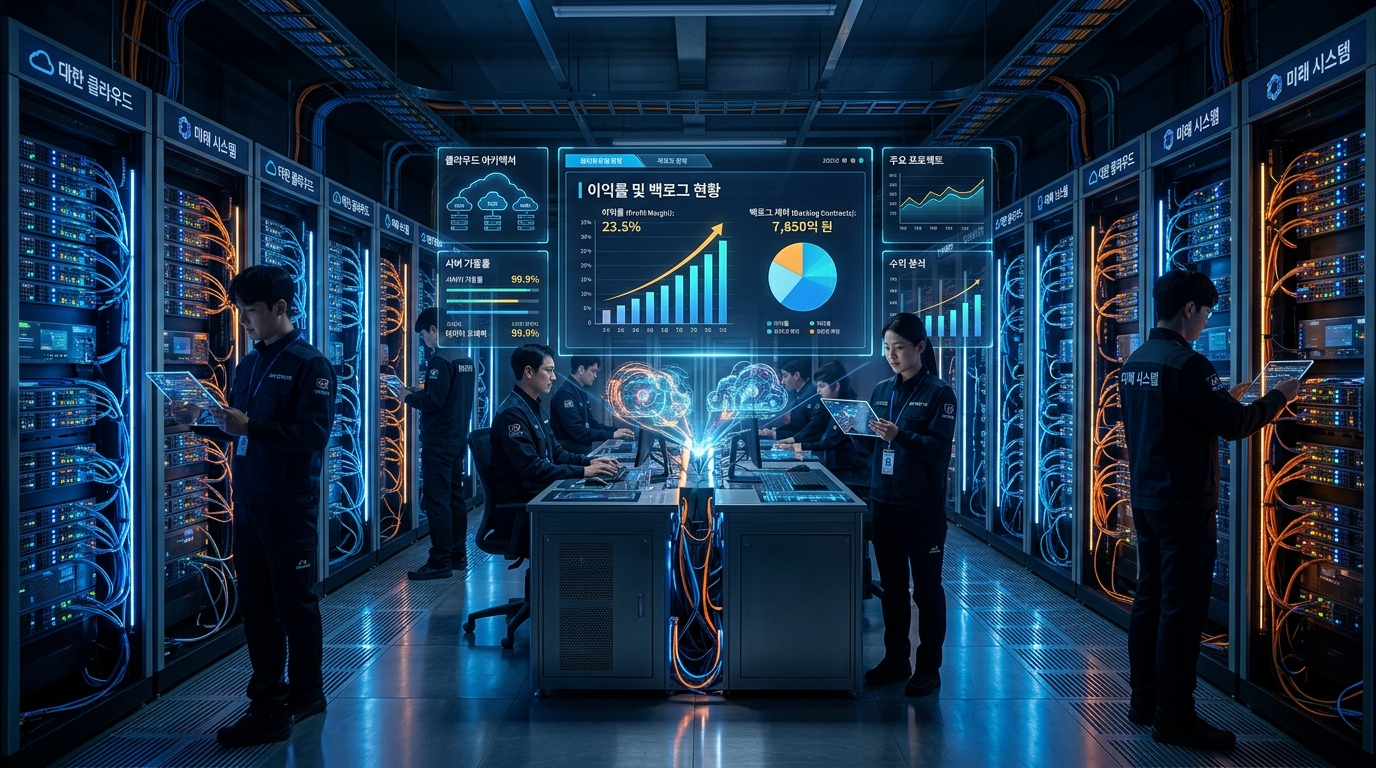
- **AWS Performance & Order Pipeline**: Amazon's (AMZN) cloud division, AWS, continues to post robust growth in its order backlog, driven by enterprise demand transitioning to generative AI workloads. Long-term contract commitments provide strong revenue visibility for the cloud segment over the coming years.
- **Cloud Operating Margin Resilience**: Despite an aggressive ramp-up in infrastructure CapEx, AWS is dispelling margin compression concerns by defending operating margins (OPM) in the mid-to-high 30% range through the expanded deployment of custom silicon (Trainium, Graviton) and enhanced server utilization efficiency.
- **Macro & Market Sentiment Assessment**: As of intraday September 8, 2026 (tentative), the Nasdaq Composite sits at 26,506.99, with the USD/KRW exchange rate at 1,344.00. Amid fluctuations in the 10-year US Treasury yield (US10Y), Daily Stock's proprietary Nasdaq Fear & Greed Index stands at 41.9 (Neutral), maintaining a cautious wait-and-see tone compared to 52.3 (Neutral) one week ago, 60.0 (Neutral) one month ago, and 61.2 (Greed) three months ago.
Current Market Environment
The central debate surrounding Big Tech earnings centers on whether astronomical AI capital expenditures (CapEx) can be recovered without eroding underlying cloud profit margins.
While Amazon's real-time share price on September 8, 2026, remains unconfirmed (based on the latest verified data), market focus has decisively shifted from the steady cash generation of its core e-commerce business toward AWS's margin defense.
The broader Nasdaq-100 index has entered a short-term consolidation phase, influenced by heightened volatility in the Philadelphia Semiconductor Index (SOX).
With the US Dollar Index (DXY) trading in a mild range-bound band and localized reactions across the CBOE Volatility Index (VIX), institutional scrutiny regarding the payback period on massive hyperscaler capital outlays has intensified significantly.
[이미지: /stdaily/uploads/202609/gen_6a9f5050d46f12.12824851.png]
Financial Analysis
AWS revenue has re-entered an acceleration phase following the conclusion of enterprise cloud optimization cycles and a surge in demand for enterprise AI model training and inference.
In particular, the expansion of software contract backlogs and multi-year Remaining Performance Obligations (RPO) serves as a buffer absorbing rising infrastructure depreciation costs.
| Segment & Financial Metric | Key Performance & Estimates Trend | YoY & Highlights |
|---|---|---|
| **AWS Quarterly Revenue** | Tracking toward mid-$30B to low-$40B range | Accelerated growth of 20–30% driven by AI infrastructure demand |
| **AWS Operating Margin (OPM)** | Mid-to-high 30% range (converging around 35%–39%) | Server efficiency gains realized through internal chip adoption |
| **Enterprise Order Backlog** | Hundreds of billions of dollars in remaining commitments | Long-term cloud contract portfolio spanning 3+ years |
| **Annual Company-wide CapEx** | Elevated spending centered on data centers and custom chips | Reflects power procurement and high-performance hardware buildouts |
| **Free Cash Flow (FCF)** | Subject to quarterly volatility due to upfront infrastructure investments | Near-term pressure managed against core operating cash generation |
The linchpin of Amazon's cloud profitability defense lies in the higher penetration of its proprietary custom silicon (Trainium, Inferentia), which gradually diversifies reliance away from Nvidia, alongside customer adoption of Graviton.
This dynamic lowers procurement costs per accelerator unit while deepening customer lock-in, creating a virtuous cycle leading to higher-margin SaaS and managed model services.
Valuation
Amazon's valuation is evaluated through a hybrid model blending traditional retail metrics (EV/EBITDA, PSR) with high-growth multiples (Forward P/E) applied to its high-margin cloud and advertising segments.
Historically, Amazon traded at a relative valuation discount compared to rival hyperscalers due to its heavy retail exposure. However, with AWS accounting for approximately 60% of total operating income, a qualitative re-rating is underway.
While fluctuations in the 10-year US Treasury yield (US10Y) can introduce discount rate pressures on high-P/E growth stocks, AWS's sustained 30%+ operating margin provides a critical floor for its valuation band.
A sum-of-the-parts (SOTP) framework—arguing that AWS's standalone equity value accounts for a substantial portion of Amazon's total market capitalization—continues to gain traction among institutional investors relative to the broader S&P 500 large-cap growth peer group.
Expert & Institutional Perspectives
Major Wall Street investment banks are viewing Amazon's upward CapEx revisions through a noticeably different lens compared to previous cycles.
Historically, hyperscaler CapEx increases were interpreted as near-term free cash flow impairment, triggering stock pullbacks. However, Amazon has demonstrated that its capital outlays are backed by contracted multi-year order backlogs.
Firms such as Morgan Stanley and Goldman Sachs have noted that AWS's margin resilience is not driven merely by price hikes, but by hardware architectural efficiency and high-margin software value delivered via enterprise AI platforms such as Amazon Bedrock.
Conversely, some analysts caution that inter-hyperscaler competition over AI data center power allocations and memory semiconductor pricing pressures could translate into medium-to-long-term depreciation headwinds.
[이미지: /stdaily/uploads/202609/gen_6a9f505c226996.13664709.png]
Risk Factors
The primary risk to monitor is delayed Return on Investment (ROI) realization among enterprise customers deploying generative AI.
If corporate clients struggle to transition from Proof of Concept (PoC) phases to full-scale enterprise production, cloud API call growth could slow, weakening the conversion velocity of backlogs into realized revenue.
A second risk is CapEx inflation resulting from structural increases in infrastructure construction costs and power grid bottlenecks.
Delays in data center construction or rising expenses for liquid cooling and substation interconnections expand fixed capital commitments, weighing on AWS margins once asset depreciation commences.
Lastly, scrutiny from global antitrust regulators targeting Big Tech and tighter data privacy regulations across AI platforms could extend enterprise adoption timelines.
Investment Perspective
Approaching Amazon requires balancing two key anchors: cloud margin resilience and macroeconomic conditions.
As of intraday September 8, 2026 (tentative), the KOSPI sits at 7,061.01 and the KOSDAQ at 825.01. Daily Stock's proprietary KOSPI Fear & Greed Index reads 52.7 (Neutral), reflecting a recovery from 47.9 (Neutral) one week ago, 17.5 (Extreme Fear) one month ago, and 44.6 (Neutral) three months ago.
In contrast, the Nasdaq Fear & Greed Index stands at 41.9 (Neutral), down from 61.2 (Greed) three months ago, indicating that appetite for risk assets has become more disciplined.
Rather than interpreting market uptrends as unvetted greed, investors should evaluate underlying fundamentals at the neutral equilibrium suggested by volatility indicators and RSI levels.
While AWS's deep backlog and mid-to-high 30% operating margin resilience remain clear positives, managing exposure through phased accumulation provides a balanced posture to navigate free cash flow volatility during an intensive CapEx investment phase.
Daily Stock Q&A
Q1. How does AWS's order backlog impact future financial performance?
The backlog represents committed contractual revenue from customers agreeing to consume AWS cloud infrastructure over designated durations. It provides a reliable revenue floor over multi-year horizons, shielding the segment from abrupt top-line contractions during macroeconomic slowdowns.
Q2. How can AWS defend operating margins amid soaring AI CapEx?
AWS scales internally designed custom AI accelerators (Trainium) and server CPUs (Graviton), reducing the capital required to purchase expensive commercial GPUs. Additionally, server life cycle optimizations and growth in high-margin managed AI software services offset rising fixed depreciation costs.
Q3. What is the current competitive dynamic with Microsoft Azure and Google Cloud?
While Azure has aggressively expanded market share through its partnership with OpenAI, AWS maintains the top spot in absolute revenue scale by leveraging Amazon Bedrock—which supports a broad spectrum of foundation models—alongside its extensive enterprise installed base.
Q4. How sensitive is Amazon's equity valuation to the 10-year US Treasury yield (US10Y)?
Higher Treasury yields elevate discount rates applied to long-duration cash flows, compressing valuation multiples. However, Amazon's high-margin cash generation across AWS and digital advertising provides greater insulation against rate volatility compared to pure-play unprofitable software peers.
Q5. What are the key metrics investors should track going forward?
Crucial monitoring checkpoints include AWS's quarterly operating margin (specifically holding above the 30% threshold), YoY backlog growth rates, full-year consolidated CapEx guidance revisions, and inflection points in Free Cash Flow (FCF) trajectory.