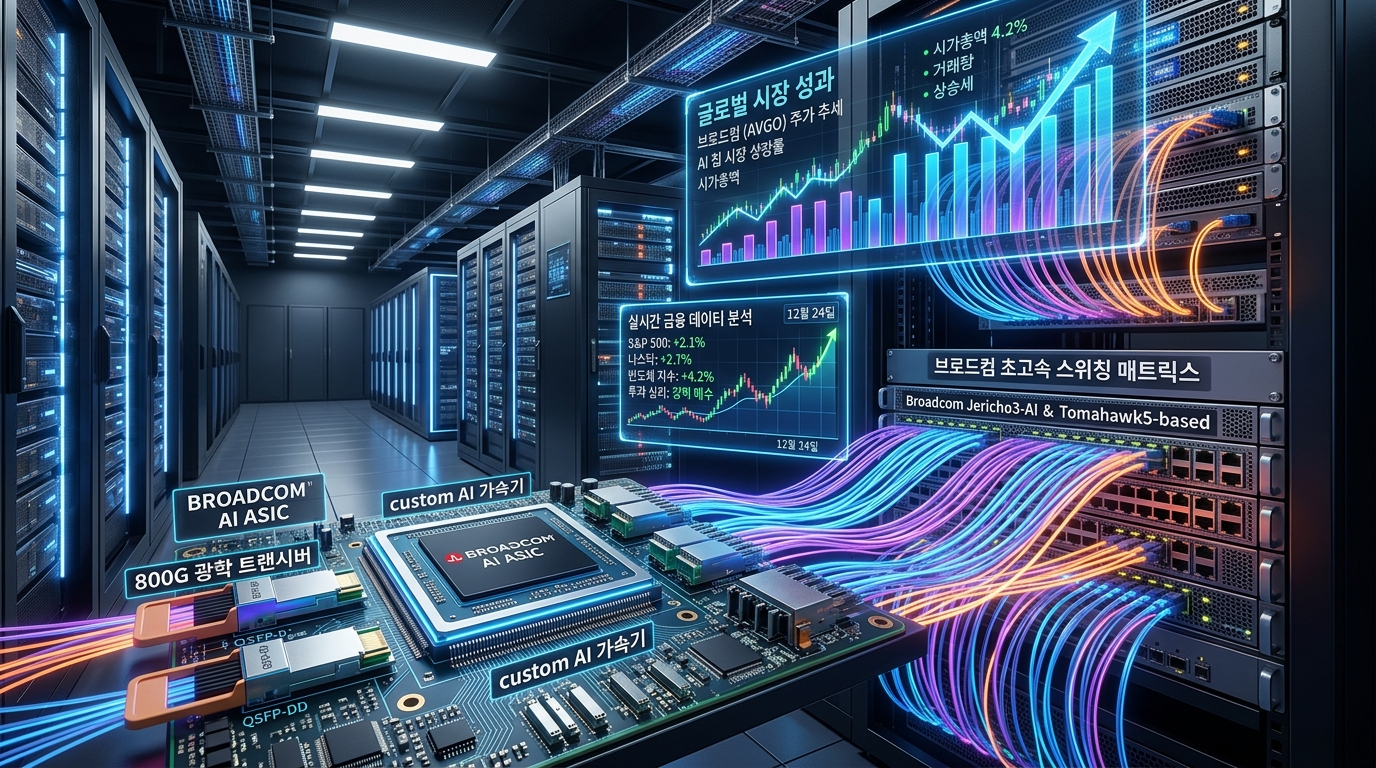
Hello, this is Daily Stock, delivering key insights into the global stock market and semiconductor supply chain.
[이미지: /stdaily/uploads/202609/gen_6a9f09da456378.27183811.png]
Key Takeaways
Broadcom is securing unprecedented order visibility on the back of massive custom ASIC (Application-Specific Integrated Circuit) supply contracts with global Big Tech firms, including Google, Meta, and OpenAI.
Fiscal Q3 AI semiconductor revenue surged 221% year-over-year to $16.7 billion, proving a fundamental transformation in the company's overall performance.
As of intraday trading on September 8, 2026 (provisional), global financial markets have entered a tri-polar decoupling phase characterized by expanding AI infrastructure capital expenditures (CapEx) by US Big Tech alongside a manufacturing slowdown in Europe and Asia.
Big Tech's accelerating push to internalize proprietary silicon—aiming to reduce reliance on Nvidia's general-purpose GPUs—has become the primary catalyst driving robust demand for Broadcom's custom accelerators (XPUs) and next-generation Ethernet networking.
Market Overview
Broadcom (AVGO) reaffirmed overwhelming demand for its custom AI accelerators and high-speed Ethernet switching hardware in its recent quarterly earnings release.
With mass production shipments of Google's 7th- and next-generation 8th-generation TPUs (Tensor Processing Units) and the ramp-up of OpenAI's 1st-generation custom accelerator silicon, AI chip revenue now accounts for well over half of the company's total revenue.
Looking at market indicators as of intraday trading on September 8, 2026 (provisional), the Nasdaq Composite stands at 26,506.99, while the KOSPI is at 6,995.39, the KOSDAQ at 822.19, and the USD/KRW exchange rate at 1,345.90 KRW.
On Daily Stock's proprietary Fear & Greed Index, the Nasdaq is currently at Neutral (41.9), moderating from Neutral (52.3) one week ago, Neutral (60) one month ago, and Greed (61.2) three months ago.
In contrast, the KOSPI Fear & Greed Index sits at Neutral (52.7), reflecting a gradual sentiment recovery after climbing out of Extreme Fear (17.5) a month ago and Neutral (47.9) a week ago.
Regional fundamentals reveal a clear tri-polar divergence.
In the United States, massive AI data center infrastructure investments by mega-cap hyperscalers continue to support services and advanced tech equities.
In Europe, lingering monetary tightening impacts, manufacturing PMI contraction, and energy transition costs are capping the Euro Stoxx 50's upside momentum.
In Asia, balancing between the People's Bank of China's (PBOC) liquidity injections and the Bank of Japan's (BOJ) measured pace of rate normalization, South Korea and Taiwan are seeking selective rebounds centered around advanced packaging supply chains.
[이미지: /stdaily/uploads/202609/gen_6a9f09e600da66.74640880.png]
Financial Analysis
Broadcom's fiscal Q3 2026 results were propelled by explosive growth in its AI Semiconductor Solutions division.
Net revenue rose 86% YoY to $29.59 billion, with AI semiconductor revenue alone reaching $16.7 billion, a 3.2-fold expansion from the prior-year period.
Custom accelerator (XPU) shipments grew more than 3.5-fold YoY, while the AI networking division—comprising high-speed Ethernet switches and SerDes technology—expanded over 2.5 times.
However, driven by higher pass-through costs associated with the surge in custom AI chips and bundled High Bandwidth Memory (HBM), gross margin contracted 210 basis points quarter-over-quarter to 75.0%.
| Key Financial Metric | FY2026 Q3 (Actual) | FY2025 Q3 (Actual) | YoY Change (%) |
|---|---|---|---|
| **Total Net Revenue** | $29.59B | $15.91B | +85.9% |
| **Semiconductor Solutions Revenue** | $20.84B | $9.17B | +127.3% |
| **- AI Semiconductors (ASIC & Networking)** | $16.70B | $5.20B | +221.2% |
| **Infrastructure Software Revenue** | $8.75B | $6.79B | +28.9% |
| **Adjusted Operating Income (Non-GAAP)** | $20.10B | $10.46B | +92.2% |
| **Adjusted Operating Margin** | 67.9% | 65.5% | +2.4%p |
| **Adjusted Diluted EPS (Non-GAAP)** | $3.32 | $1.69 | +96.4% |
| **Free Cash Flow (FCF)** | $13.70B | $7.10B | +93.0% |
Robust margins in Infrastructure Software (VMware) operating at an 84% operating margin helped cushion hardware cost pressures.
Cash flow from operations reached $14.2 billion, maintaining an excellent free cash flow (FCF) margin of 46% relative to revenue.
Broadcom management guided fiscal Q4 total net revenue to $34.8 billion and AI semiconductor revenue to $21.7 billion (up 236% YoY).
Based on its secured order pipeline, the company noted that an annualized AI semiconductor run-rate of $110 billion to $115 billion by fiscal 2027 is now well within sight.
Valuation
While Broadcom's real-time intraday quote is unconfirmed (based on latest verified figures), its forward price-to-earnings (P/E) ratio is trading in the range of approximately 28x to 32x.
This represents a meaningful re-rating as an AI infrastructure platform player, far exceeding the 15x to 18x multiple historically assigned when the business was centered on legacy networking and mobile communication chips.
Relative to Nvidia's forward P/E (around 35x to 40x), Broadcom trades at a valuation discount.
This reflects market concerns over potential margin compression stemming from long-term pricing negotiations with individual hyperscaler clients typical of custom ASIC contracts.
From a global asset perspective, Broadcom's strong FCF generation provides downside support against high S&P 500 valuation burdens.
Although an absolute valuation gap persists compared to European equities (Forward P/E of 13x–14x) and Asian equities (11x–15x), superior earnings growth momentum continues to offset this difference.
[이미지: /stdaily/uploads/202609/gen_6a9f09f3d1d435.29043055.png]
Analyst & Institutional Perspectives
Major Wall Street institutions view Broadcom's dominant position in the custom AI silicon market favorably, while keeping a close eye on near-term gross margin dilution.
Firms like Exane BNP Paribas have issued aggressive price targets around $675, projecting that hyperscalers' shift toward proprietary silicon will deliver structural benefits to Broadcom.
Conversely, some investment banks caution that Marvell Technology could emerge as a secondary source after fiscal 2029 by expanding its long-term partnership with Google.
Additionally, they point to Q4 revenue guidance ($34.8 billion) slightly missing extreme bull-case market estimates (over $35.0 billion) as a potential trigger for short-term price consolidation.
Asia-focused institutions are closely tracking Broadcom's collaboration on next-generation 3.5D packaging and 2nm foundry nodes.
Beyond TSMC's CoWoS capacity, analysts are watching how potential foundry partnerships with Samsung Electronics aimed at supply chain diversification could ripple across the broader Asian semiconductor supply chain.
Risk Factors
The primary fundamental risk is high revenue concentration among top hyperscaler customers.
Shifts in capital expenditure plans by Broadcom's top 4 to 6 clients—including Google, Meta, ByteDance, and OpenAI—could trigger sharp revisions in its custom accelerator order backlog.
A second risk involves bottlenecks in advanced packaging and component supply chains.
Capacity allocation bottlenecks in TSMC's advanced packaging (SoIC, CoWoS) and imbalances in next-gen HBM supply could delay product delivery schedules.
Third are macroeconomic conditions and raw material price volatility.
Rising costs for critical non-ferrous metals like copper—essential for high-speed transmission and large-scale AI data center expansions—along with soaring global grid buildout costs, could weigh on cloud service providers' total cost of ownership (TCO).
Investment Outlook
Broadcom is effectively capturing Big Tech's demand to internalize custom ASICs as they seek alternatives to Nvidia's GPU hegemony.
By offering a full-stack solution spanning IP licensing, advanced packaging, and ultra-high-speed Ethernet switching to cloud clients lacking end-to-end chip design capabilities, Broadcom has built high competitive moats.
Nevertheless, the moderating gross margin trend driven by HBM pass-through costs and intensifying customer diversification dynamics remain critical metrics to monitor in upcoming earnings prints.
Amid the tri-polar US-EU-Asia decoupling, investors should adopt a scenario-based approach that scrutinizes not only top-line growth, but also cash flow durability and the qualitative backlog composition.
FAQ
Q1. What is Broadcom's core competitive advantage in custom ASICs?
It offers a one-stop-shop solution covering vital SerDes IP, architecture design capabilities, and ultra-high-speed Ethernet networking required to cluster custom compute chips optimized for proprietary deep learning models.
Q2. What is the biggest difference between Nvidia GPUs and Broadcom custom ASICs?
While Nvidia GPUs excel in general versatility and software ecosystem (CUDA), Broadcom's ASICs provide tailored solutions capable of cutting power consumption and costs by up to 40% to 60% in specific, large-scale inference workloads.
Q3. Why did gross margin decline slightly in the latest earnings?
Because costly High Bandwidth Memory (HBM) and outsourced advanced packaging costs are passed directly through into finished chip selling prices, top-line revenue expanded significantly, but percentage-based margins experienced dilution.
Q4. How is the competitive landscape evolving against Marvell?
Broadcom and Marvell currently share more than 90% of the global AI custom silicon design market. Broadcom holds the lead in high-volume deployments, while Marvell continues to pursue customer diversification strategies.
Q5. How do divergent global monetary policies affect Broadcom's stock?
The Fed's interest rate trajectory and global liquidity conditions directly influence hyperscalers' financing costs for massive AI CapEx, making them key variables dictating the deployment pace of multi-year custom silicon orders.