Hello, this is Daily Stock, delivering key insights into structural shifts across global stock markets and asset classes.
[이미지: /stdaily/uploads/202609/gen_6a9db8603fcab1.12636642.png]
Executive Summary
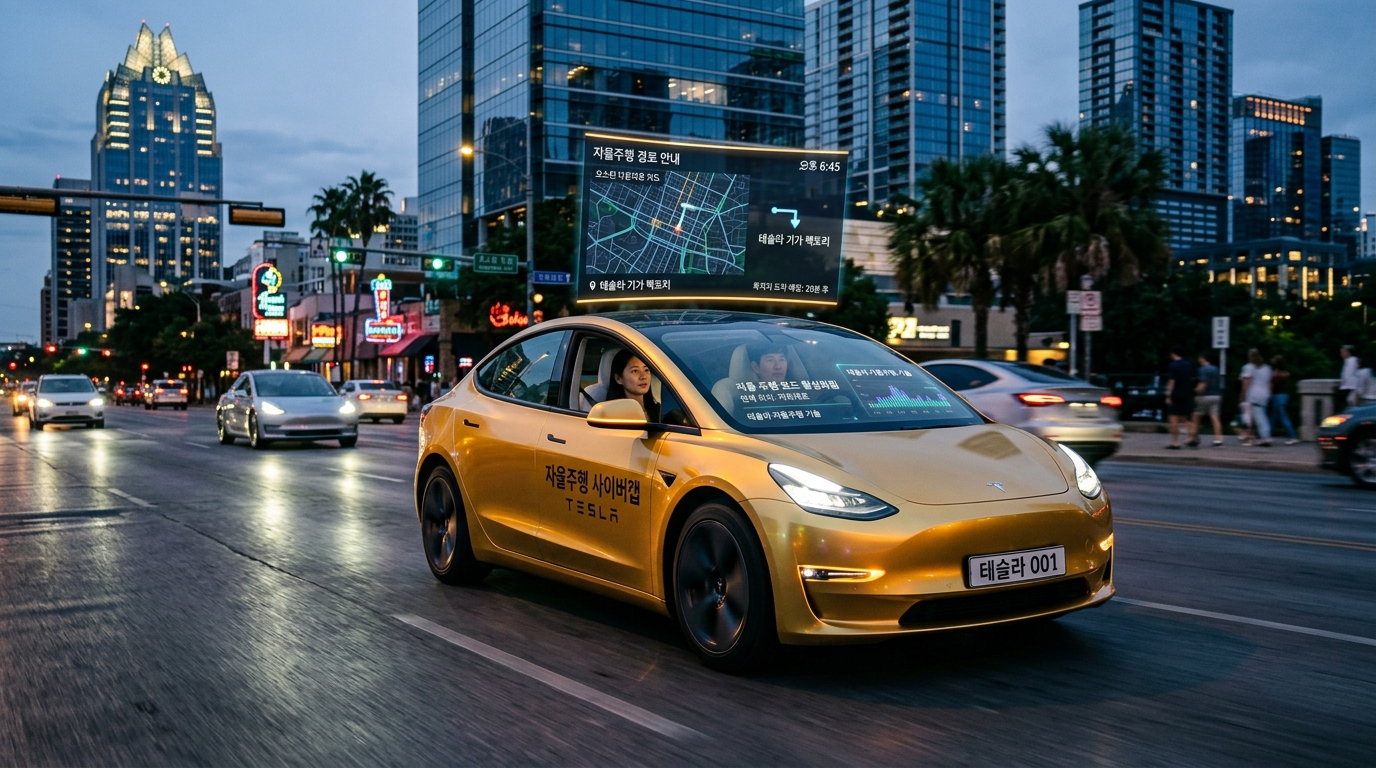
Tesla has signaled a paradigm shift in the mobility ecosystem by launching paid commercial ride-hailing services for its dedicated autonomous vehicle, the "Cybercab"—which lacks a steering wheel and pedals—in Austin, Texas. With cumulative driverless miles driven on Full Self-Driving (FSD) software surpassing 1 million miles, market attention is rapidly pivoting from pure vehicle delivery volumes toward the monetization potential of physical AI networks.
As of September 7, 2026, the global macroeconomic environment is characterized by distinct fundamental decoupling across three primary economic blocs—the US, Europe, and Asia—widening divergences in monetary policies and relative index performance. While the Nasdaq Composite traded at 26,506.99 (intraday, tentative) to sustain its AI infrastructure premium, the domestic KOSPI stood at 6,687.21 (intraday, tentative), with the KRW/USD exchange rate fluctuating around 1,349.50 won (intraday, tentative).
According to Daily Stock's proprietary Fear & Greed Index, the Nasdaq is currently in Neutral territory at 41.9, reflecting a slight rise in caution compared to the previous week (52.3). In contrast, the KOSPI Fear & Greed Index registered in Fear territory at 32.3, falling from Neutral (48.5) the prior week as conservative sentiment spreads across the robotaxi value chain and battery materials sectors.
Current Situation Overview
Tesla has officially integrated Cybercab vehicles into its ride-hailing app network within downtown Austin, initiating fully driverless commercial passenger service without safety drivers. The operational deployment of a pure-vision camera and end-to-end neural network FSD architecture—eliminating reliance on LiDAR—in a commercial ride-hailing setting marks a critical milestone in technological leadership.
Amid this tripartite global decoupling, the US equity market continues to demonstrate tech-led resilience, supported by ongoing capital deployment into autonomous driving systems and data centers. Conversely, European markets remain constrained by contracting manufacturing PMIs and recessionary concerns, closely watching the European Central Bank's (ECB) potential series of rate cuts, while legacy European automakers like Volkswagen face mounting EV transition costs.
In Asia, market dynamics are shaped by the People's Bank of China's (PBOC) liquidity injections aimed at economic stabilization, coupled with aggressive price competition led by domestic EV makers such as BYD. Simultaneously, the Bank of Japan's (BOJ) consideration of further incremental rate hikes is driving Yen volatility, exerting margin pressure on Asian export-oriented manufacturers.
In commodities, industrial copper demand tied to robotaxi charging infrastructure buildouts and AI data center expansions continues to provide firm downside support. Meanwhile, international crude oil prices face crosscurrents from Middle Eastern geopolitical tensions and OPEC+ output curbs, creating varied inflationary normalization speeds across key regions.
[이미지: /stdaily/uploads/202609/gen_6a9db86c956243.36226662.png]
Financial Analysis
Tesla's latest quarterly earnings reflect compounded headwinds: automotive gross margin compression alongside an aggressive ramp-up in capital expenditure (Capex). Total quarterly revenue reached approximately $28.24 billion, maintaining top-line resilience, but operating margin temporarily compressed to around 1.4% following widespread global price cuts.
Annual Capex surpassed the $20B–$25B+ range due to production line retooling at Giga Texas and substantial compute capacity expansion for AI, resulting in temporarily negative quarterly Free Cash Flow (FCF). However, the Energy Storage Systems (ESS) division, driven by Megapack deployments, delivered high double-digit operating margins, serving as a critical financial cushion against automotive margin compression.
| Metric Category | Latest Metric (H1 2026) | YoY / Benchmark Comparison | Key Observations & Macro Context |
|---|---|---|---|
| Nasdaq Index | 26,506.99 | Intraday (Tentative) | Neutral sentiment sustained by Big Tech Capex |
| KOSPI Index | 6,687.21 | Intraday (Tentative) | Fear (32.3) across secondary batteries & component supply chain |
| USD/KRW Exchange Rate | 1,349.50 KRW | Intraday (Tentative) | Macro liquidity divergence and persistent dollar strength |
| Tesla Operating Margin | Approx. 1.4% | Compressed YoY | Reflects EV price cuts and accelerated R&D investments |
| Tesla Annual Capex | $20B–$25B+ | Substantially higher YoY | Investments in Cybercab manufacturing & AI compute infrastructure |
| Price-to-Earnings (TTM P/E) | Approx. 320x–348x range | Above 5-year median (107x) | Pre-pricing software and robotaxi platform growth expectations |
Valuation Scenarios
With shares hovering between $348 and $376 based on recent reference levels (same-day market price unverified), Tesla trades at a trailing 12-month P/E (TTM P/E) exceeding 320x. This represents a substantial valuation multiple premium over legacy automakers such as GM (P/E ~5x) and Toyota (P/E ~8x), as well as Chinese EV peers.
This elevated multiple stems from capital markets pricing Tesla not merely as an automotive hardware OEM, but as a software and autonomous mobility platform monetizing subscriptions and network fees. However, should commercial scaling encounter operational bottlenecks or regulatory constraints, this high multiple faces significant risks of multiple compression (de-rating).
The valuation gap across European and Asian automotive peers highlights fundamental structural differences. US tech platforms with software-driven moats benefit from aggressive discounting of future cash flows, whereas European and Asian hardware and supply chain players are evaluated strictly on conservative traditional manufacturing metrics.
Institutional and Analyst Perspectives
Wall Street investment banks remain divided on the long-term monetization timeline of Tesla's robotaxi fleet. Dan Ives of Wedbush views the commercialization of Cybercab within an autonomous network as the primary catalyst capable of propelling Tesla's market capitalization past $3 trillion over the long term.
Conversely, more conservative institutions including Morgan Stanley and Barclays emphasize the limited initial fleet sizes approved for operation. Analysts note that competing against Alphabet's Waymo—which possesses tens of millions of commercial driverless miles and multi-redundant sensor suites—presents regulatory hurdles before nationwide operational licenses can be achieved.
From a macroeconomic asset allocation perspective, divergent central bank trajectories—ECB easing, potential BOJ tightening, and PBOC liquidity support—complicate global fund flows. Institutional analysts caution that currency volatility around the 1,349.50 won level could continue to constrain foreign net inflows into Korean and Asian supply chain equities.
Risk Factors
Near-term risks center on regulatory approvals and safety inquiries conducted by the National Highway Traffic Safety Administration (NHTSA). Vehicles completely lacking steering wheels and pedals must secure Federal Motor Vehicle Safety Standards (FMVSS) exemptions and individual state permits, suggesting that a nationwide deployment could take longer than anticipated.
Geopolitical tensions and supply chain regionalization present additional hurdles. Flare-ups in the Taiwan Strait or tightened export controls on rare earth elements and critical minerals could directly impact the supply of high-performance automotive semiconductors and drive motors essential for autonomous fleets.
From a macro perspective, softening US labor market indicators coupled with weak manufacturing activity globally could dampen consumer demand for big-ticket durable goods. If autonomous commercialization timelines face delays, elevated R&D and Capex burdens could negatively affect corporate cash liquidity.
Investment Outlook
Tesla's Cybercab launch represents a pivotal test of its transition from an automotive manufacturer to an AI software platform. Near-term equity volatility is expected to correlate closely with regulatory licensing milestones and initial passenger safety data from commercial operations.
Given the tripartite fundamental divergence across the US, Europe, and Asia, investors must track regional monetary policies and capital flows. With the Nasdaq Sentiment Index settling at Neutral (41.9) and the KOSPI lingering in Fear (32.3), maintaining balanced portfolio allocation remains preferable to aggressive leverage.
While autonomous driving carries long-term structural productivity benefits, early commercialization phases typically involve Capex burdens and margin volatility. Investors should look beyond short-term event-driven trading and adopt phased allocation strategies anchored in objective safety data, FSD performance metrics, and corporate cash flow generation.
Daily Stock Q&A
Q1. What is the fundamental difference between the Cybercab and the existing Model Y Robotaxi?
A1. The Cybercab is a dedicated two-passenger autonomous vehicle engineered entirely without manual driver controls—omitting steering wheels, acceleration/brake pedals, and side mirrors. Unlike Level 2 systems that require driver supervision, it is built exclusively for fully autonomous driverless operations.
Q2. Can full autonomy be achieved using pure vision without LiDAR?
A2. Tesla relies exclusively on vision cameras processed through end-to-end neural networks to mimic human visual processing. While this approach dramatically lowers hardware manufacturing costs, industry debate continues regarding safety redundancies under severe weather and edge-case operational conditions.
Q3. What drives the decoupling between the US, European, and Asian equity markets?
A3. US indices are supported by large-scale AI infrastructure investments and robust cash generation from mega-cap tech. In contrast, Europe faces manufacturing slowdowns and elevated structural energy costs, prompting ECB policy easing. Asia presents diverging dynamics, marked by Chinese stimulus measures alongside policy normalization discussions in Japan.
Q4. Can Tesla's 300x+ P/E valuation multiple be justified?
A4. Under traditional automotive manufacturing frameworks, current multiples reflect significant premiums. The valuation hinges on future high-margin cash flows generated via autonomous platform network fees and FSD software subscriptions. Delays in fleet scaling carry risks of valuation normalization.
Q5. What does the KOSPI Fear index (32.3) versus Nasdaq Neutral index (41.9) indicate?
A5. While the Nasdaq reflects profit-taking caution after key product events, tech sector sentiment remains relatively stable. The KOSPI's Fear reading highlights elevated sensitivity to global macroeconomic uncertainties, semiconductor cyclicality, and margin pressures across the secondary battery and components supply chain.