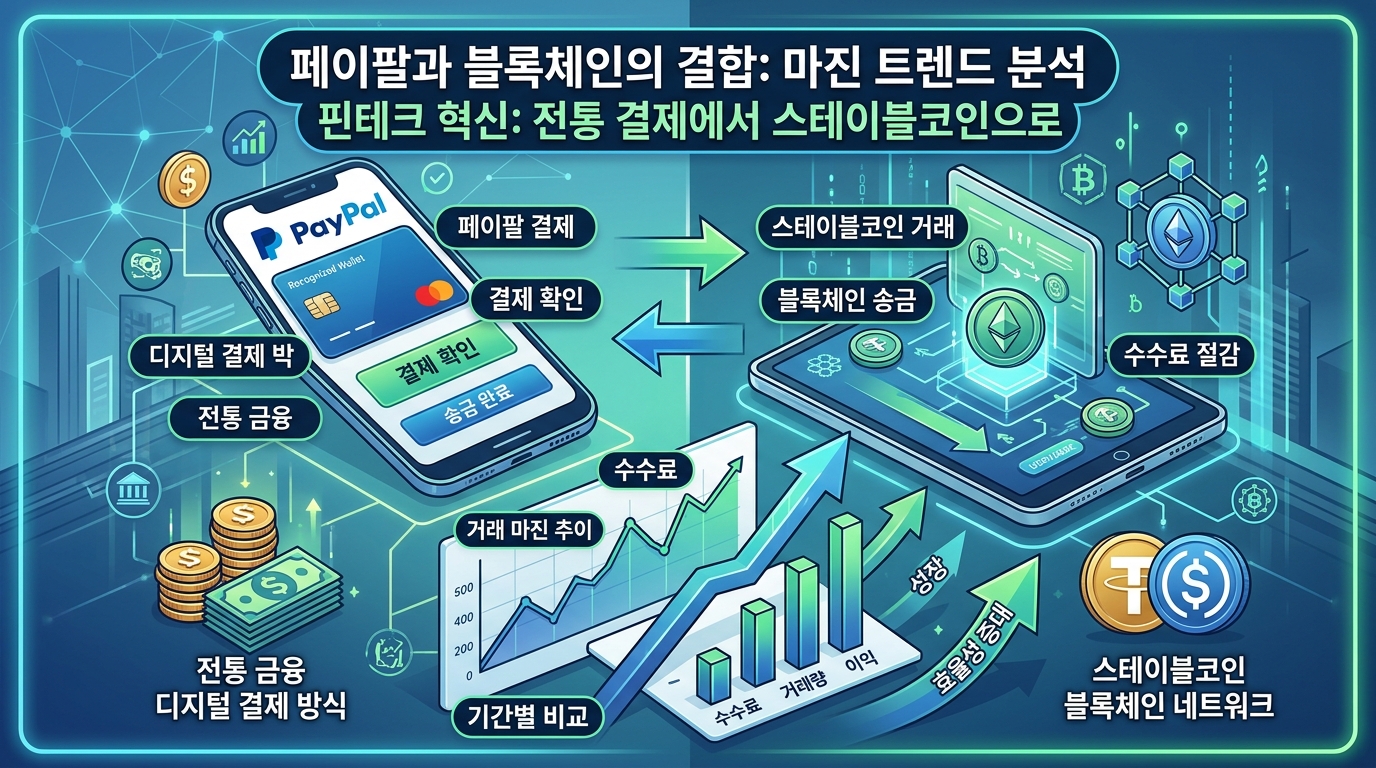
PayPal, an iconic symbol of global digital payment infrastructure, stands at a structural crossroads between blockchain-based settlement networks and margin defense.
[이미지: /stdaily/uploads/202609/gen_6a9cad39a4d408.52761501.png]
Key Takeaways
PayPal's (PYPL) push to expand its stablecoin ecosystem is viewed as a strategic maneuver to overcome relentless fee-compression pressures and reduce transaction costs.
While its issuance volume undergoes a consolidation phase, the company's ability to defend actual Transaction Margin Dollars relative to pure payment processing volume has emerged as a crucial turning point for its corporate valuation.
In a Nasdaq environment where liquidity remains concentrated in mega-cap Big Tech and AI value chains, any re-rating of traditional fintech platforms will hinge on protecting take rates and proving the concrete margin contribution of commercialized stablecoin settlements.
Current Market Context
As of September 6, 2026, global financial markets are displaying mixed movements amid prevailing macroeconomic uncertainties.
Domestic South Korean benchmarks closed with the KOSPI at 6,687.21 and the KOSDAQ at 813.50, while the USD/KRW exchange rate hovered at 1,349.50 KRW.
Meanwhile, the tech-heavy U.S. Nasdaq Composite Index fluctuated around the 26,506.99 level.
Reflecting market sentiment, the DailyStock Fear & Greed Index indicated "Fear" (32.3) for the KOSPI.
This follows Neutral (48.5) one week ago, Extreme Fear (18.4) one month ago, and Fear (32.2) three months ago.
The Nasdaq Fear & Greed Index registered "Neutral" (41.9), moderating from Neutral (52.3) a week ago, Neutral (60) a month ago, and Greed (61.2) three months ago, illustrating a more composed investor mindset.
Amid this backdrop, PayPal has established a dedicated 'Payment Services & Crypto' unit to integrate its proprietary stablecoin (PYUSD) into merchant checkout networks, aiming to trim per-transaction costs.
After circulating supply peaked above $4 billion earlier in the year before stabilizing in the high-$2 billion range, driving real-world transaction volume has become a critical operational metric.
[이미지: /stdaily/uploads/202609/gen_6a9cad44e077a2.80952264.png]
Financial Analysis
A close look at PayPal's financial trajectory shows solid top-line Total Payment Volume (TPV) expansion; however, the rebound in its core profitability metric—Transaction Margin Dollars—remains modest.
With the rising proportion of unbranded, large-merchant processing led by Braintree, the company faces ongoing structural pressure as its fee margin against total payment volume has trended lower than historical norms.
| Key Metric (Based on actuals and guidance) | FY 2025 Actuals | 1H 2026 Quarterly Trend (Q2 base) | FY 2026 Guidance Outlook |
|---|---|---|---|
| **Net Revenue** | $33.17 billion | $8.68 billion (+5% YoY) | Mid-single-digit annual growth expected |
| **Total Payment Volume (TPV)** | ~$1.68 trillion | $486.4 billion (+10% YoY) | Projected above $1.80 trillion |
| **Transaction Margin Dollars (TM$)** | $15.47 billion | $3.90 billion (+1% YoY) | Upward revision target to ~$15.6 billion |
| **Non-GAAP Diluted EPS** | $5.31 | $1.38 | Expected around $5.38 |
| **Stablecoin (PYUSD) Circulation** | ~$3.8 billion | $2.7 billion – $2.8 billion range | Multi-network expansion underway |
Transaction Margin Dollars are projected to expand modestly from $15.47 billion in 2025 to around $15.6 billion in 2026.
A meaningful structural rebound in margins will require stablecoin settlements to gain genuine commercial traction, thereby curbing interchange fees paid to traditional card networks.
Valuation
While the Nasdaq 100 commands relatively elevated multiples propelled by robust earnings growth and extensive AI capital expenditure (CapEx) cycles, fintech valuations remain pinned in a conservative band.
Elevated U.S. 10-year Treasury yields (US10Y) and a resilient U.S. Dollar Index (DXY) continue to constrain unbridled valuation multiple expansion for growth equities.
PayPal’s forward price-to-earnings (P/E) ratio trades in the low-to-mid teens, remaining below both its historical averages and the broader S&P 500 benchmark.
Having lagged the broader rally dominated by Big Tech and semiconductors (SOX), this discount reflects ongoing take-rate headwinds within the competitive payment processing space.
Consequently, tangible cost reductions via stablecoins and renewed traction in high-margin branded checkout could open the door for an eventual valuation re-rating.
Expert & Institutional Insights
Wall Street institutional perspectives on PayPal’s turnaround initiatives remain divided between "cautious optimism" and "structural limitation concerns."
Constructive institutions emphasize PayPal's resilient free cash flow (FCF), disciplined share repurchase program, and the operational efficiencies unlocked by leveraging stablecoins for cross-border remittances and settlement routing.
Analysts note that expanding to high-throughput, low-cost blockchains such as Solana and Polygon could meaningfully amplify settlement cost reductions.
Conversely, skeptical analysts caution that liquidity in the stablecoin landscape remains firmly dominated by Tether (USDT) and Circle (USDC).
They highlight that merely expanding token supply without cementing broad merchant payment adoption will leave any bottom-line margin contribution muted.
Risk Factors
The most immediate risk stems from evolving regulatory frameworks governing stablecoins across major global jurisdictions.
Tightening anti-money laundering (AML) compliance and stricter reserve backing mandates in the United States and Europe could elevate compliance overhead and operational expenditures.
Furthermore, intense market share competition against tech giants like Apple Pay and Google Pay, alongside independent payment service providers (PSPs), threatens to exert further downward pressure on take rates.
On the macroeconomic front, fluctuations in the 10-year Treasury yield, a persistently strong dollar, and signs of softening consumer discretionary spending could curb overall TPV momentum.
Investment Perspective
PayPal stands at a strategic pivot point: moving beyond purely chasing gross volume to focusing on the quality and profitability of each transaction processed.
Key milestones to watch include sustained quarter-over-quarter expansion in Transaction Margin Dollars and clear tracking toward the full-year target of approximately $15.6 billion.
In addition, demonstrating that PYUSD provides measurable merchant fee relief will be the ultimate catalyst for multiple recovery.
Within a tech market heavily indexed to AI momentum, investors may consider separating PayPal’s profile as a cash-generative, discounted value asset from the operational milestones required for a genuine margin-led turnaround.
DailyStock Q&A
Q1. What is the primary rationale behind PayPal’s aggressive stablecoin push?
The core objective is to reduce interchange fees charged by major card networks like Visa and Mastercard, establishing a proprietary settlement rail to defend its net transaction margins.
Q2. What drove the recent decline in circulating PYUSD supply?
After an initial surge fueled by launch incentives, the circulating supply has entered a normalization phase, transitioning toward balances supported by actual settlement and commerce demand.
Q3. Why are Transaction Margin Dollars such a pivotal earnings metric?
Even if overall TPV rises, a heavier mix of lower-margin or higher-cost processing dilutes profitability. Transaction Margin Dollars measure the absolute profit dollars retained by PayPal after direct variable costs.
Q4. Which macroeconomic indicators are most influential for PayPal's valuation?
The U.S. 10-year Treasury yield (US10Y), the Dollar Index (DXY), and Personal Consumption Expenditures (PCE) trends. Sustained higher yields restrict multiple expansion, while consumer spending deceleration curbs payment volume growth.
Q5. How is PayPal's current valuation perceived?
Trading at a forward P/E in the low-to-mid teens—well below large-cap tech peers—downside valuation risks appear cushioned; however, a decisive re-rating will require verifiable proof of a rebound in core transaction margins.