Hello, this is Daily Stock, your reliable partner in the global financial markets.
[Image: /stdaily/uploads/202609/gen_6a9b16041dec70.05519143.png]
Key Summary
- US non-farm payrolls for August surged by a surprising 162,000, significantly beating market forecasts and renewing concerns over a potential Federal Reserve rate hike in September.
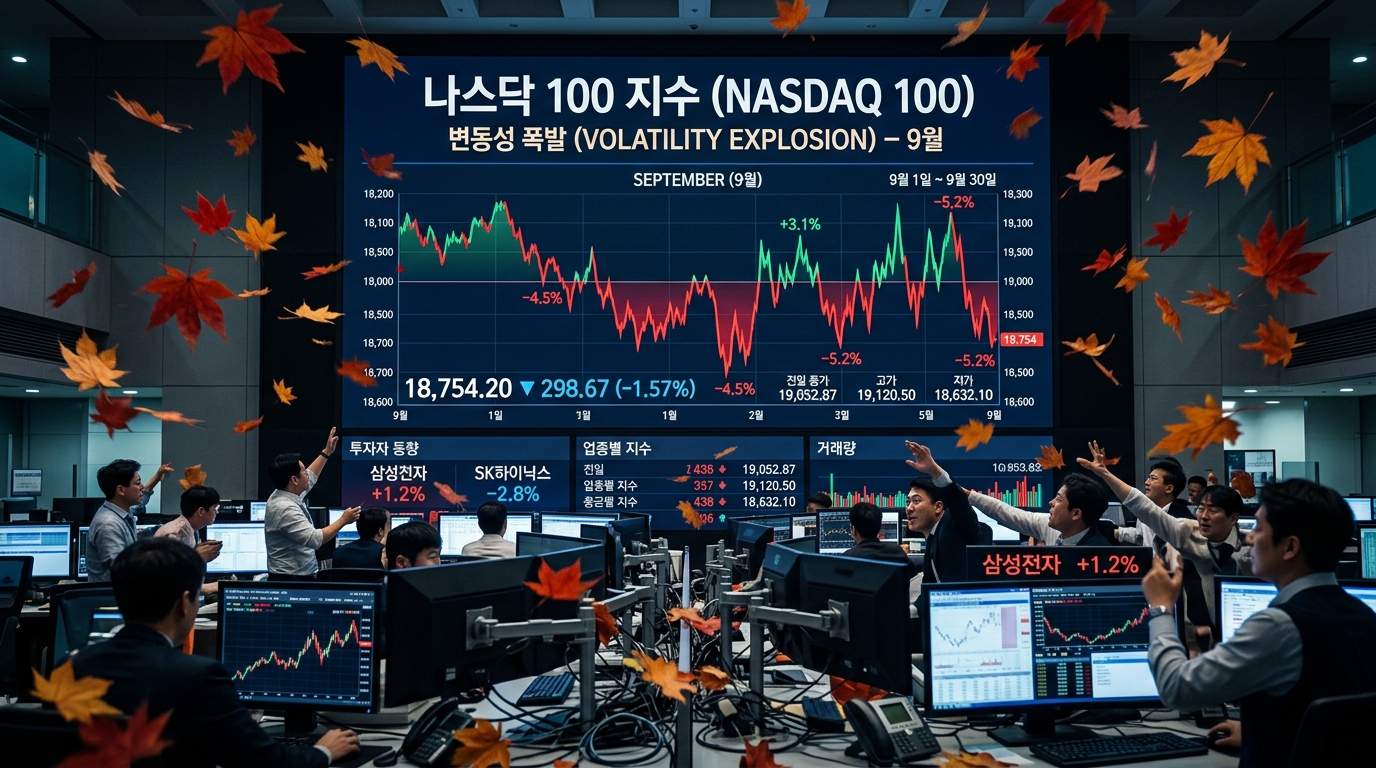
- The 'September Effect'—the historical seasonal weakness of the stock market—is colliding with geopolitical oil price surges in the Strait of Hormuz, widening volatility for the tech-heavy Nasdaq 100 index.
- Tri-polar decoupling among a robust US job market, a recovering European manufacturing sector, and an Asian market entering a rate hike cycle highlights the growing necessity of portfolio diversification.
Market Overview
US non-farm payrolls for August rose by 162,000, recording an earnings-level surprise that significantly beat the initial estimate of 55,000.
Furthermore, July's job decline figures were revised substantially upward, reinforcing the view that the US labor market remains close to full employment.
Consequently, the probability of a rate hike in September—which had temporarily eased following dovish comments from Fed presidents the previous day—rose back up to approximately 63%.
At the same time, the Nasdaq index closed at 26592.54 on Friday, reflecting strong market caution regarding prolonged monetary tightening.
Continuous geopolitical clashes between the US and Iran in the Strait of Hormuz have pushed Brent crude oil prices up to the $95–$97 per barrel range, intensifying supply-side inflationary pressures.
Global stock markets are absorbing these macro shocks, displaying divergent regional trends.
Financial Analysis
Megacap tech companies, which form the core of the Nasdaq 100, continue to demonstrate strong cash-generating capabilities driven by solid market dominance and high profit margins.
However, if high oil prices and elevated interest rates persist, growth stocks—whose valuations rely heavily on future earnings—will inevitably face increased discount rate pressures.
In particular, small and mid-sized growth companies are seeing a noticeable rise in interest expense burdens, widening the financial polarization between them and large-cap stocks.
Since European and Asian companies operate under different profit momentums and exchange rate conditions, comparing the relative strength of global portfolios has become more critical than ever.
| Classification | United States (Nasdaq 100) | Europe (CAC 40) | Asia (KOSPI / Nikkei) |
|---|---|---|---|
| **Core Drivers** | Job market surprise & Megacap AI momentum | Manufacturing PMI recovery & ECB monetary easing | Potential BOJ rate hike & carry trade unwinding |
| **Interest Rate Outlook** | Sept. hike probability rises to 63% | Gradual rate cut path maintained | Hawkish BOJ stance & Yen carry trade unwind risks |
| **Commodity Sensitivity** | Prolonged high oil prices increase discount rate pressure | Oil spikes increase energy import costs | Rising import prices spark trade balance concerns |
Valuation
According to Daily Stock's proprietary Fear & Greed Index, the Nasdaq stands at 44.8, indicating a 'Neutral' sentiment, down from 52.3 a week ago and 60 a month ago.
The KOSPI remains in 'Fear' territory at 32.3, strongly reflecting geopolitical and Yen volatility risks looming over Asian markets.
In terms of valuation, excluding the top 7 megacap tech stocks, the remaining constituents of the Nasdaq 100 are trading within reasonable price ranges.
Therefore, the current index overvaluation debate is concentrated on a small number of ultra-large caps, and their ability to prove AI monetization will be key to sustaining multiples moving forward.
[Image: /stdaily/uploads/202609/gen_6a9b160fc61999.55650859.png]
Expert & Institutional Analysis
Global asset managers advise preparing for downside risks associated with the 'September Effect' based on historical statistics.
Typically, September is a month when fund managers rebalance portfolios and retail investors sell shares for tax purposes, often leading to temporary market corrections.
Moreover, the strong job market has pushed the US 10-year Treasury yield back above 4.77%, placing additional pressure on growth stock valuations.
Analysts at BCA Research remarked, "Until inflation uncertainties and Middle East risks are resolved, a defensive approach may be more advantageous than aggressively overweighting tech stocks."
Risk Factors
The most critical potential risk is supply chain disruptions for essential commodities, such as crude oil and diesel, due to prolonged conflict in the Strait of Hormuz.
If surging oil prices trigger supply-side inflation, the Fed's room for monetary easing will be completely blocked.
Additionally, persistent pressure from the Yen carry trade unwind could dry up global liquidity starting from Asia and spill over to the New York stock exchange.
Amidst regional decoupling, rising trade barriers and protectionism also present medium-to-long-term headwinds for Nasdaq companies reliant on global supply chains.
Investment Perspective
[Image: /stdaily/uploads/202609/gen_6a9b161ab290f1.36939725.png]
At this juncture, maintaining a wait-and-see approach appears prudent until next week's CPI and PPI data—which could influence the Fed's September policy decision—are released.
Investors should establish portfolio directions only after assessing whether labor market strength translates back into reigniting inflation.
Given the distinct tri-polar decoupling among Asia, Europe, and the US, concentrating assets in a single region or sector should be avoided.
Within the growth-oriented Nasdaq 100, investors should focus on high-quality companies with robust cash flows and low debt ratios.
Investment Checklist
Q1. Why does the sharp improvement in US payrolls negatively impact the Nasdaq?
A1. A robust labor market gives the Fed a strong justification to maintain high interest rates longer or even raise them further without immediate concerns about an economic recession.
Q2. What causes the 'September Effect'?
A2. It is driven by seasonal factors, such as institutional portfolio rebalancing after summer vacations, individual capital withdrawals, and stock sales to cover tax obligations, all concentrated in September.
Q3. How do tensions in the Strait of Hormuz impact the Nasdaq 100?
A3. Tensions spike oil prices, which increases transportation and production costs. This drives inflation, potentially delaying Fed rate cuts and raising the discount rate for high-valuation tech stocks.
Q4. What does the Nasdaq's current Fear & Greed Index of 'Neutral (44.8)' signify?
A4. It indicates a state free of extreme fear or optimism, meaning market participants are adopting a wait-and-see attitude without a clear direction ahead of upcoming employment and inflation data releases.
Q5. What is the safest alternative for individual investors in a tri-polar decoupling market?
A5. Rather than solely relying on US megacap tech outperformance, a balanced diversification approach—incorporating European assets on a rate-cut path and undervalued Asian dividend growth stocks—is recommended.