Hello, this is Daily Stock, providing deep investment insights by analyzing key trends in global financial markets.
[Image: /stdaily/uploads/202609/gen_6a99c40147cc13.58085454.png]
Key Summary
According to the U.S. Energy Information Administration (EIA)'s recent report, commercial crude oil inventories in the United States recorded a sharp decline of 4.45 million barrels, significantly beating market expectations and heightening supply anxieties.
Furthermore, the Strategic Petroleum Reserve (SPR)—the ultimate buffer for national security—has shrunk to 286.6 million barrels, its lowest level since the early 1980s, triggering concerns that the market's safety net has crumbled.
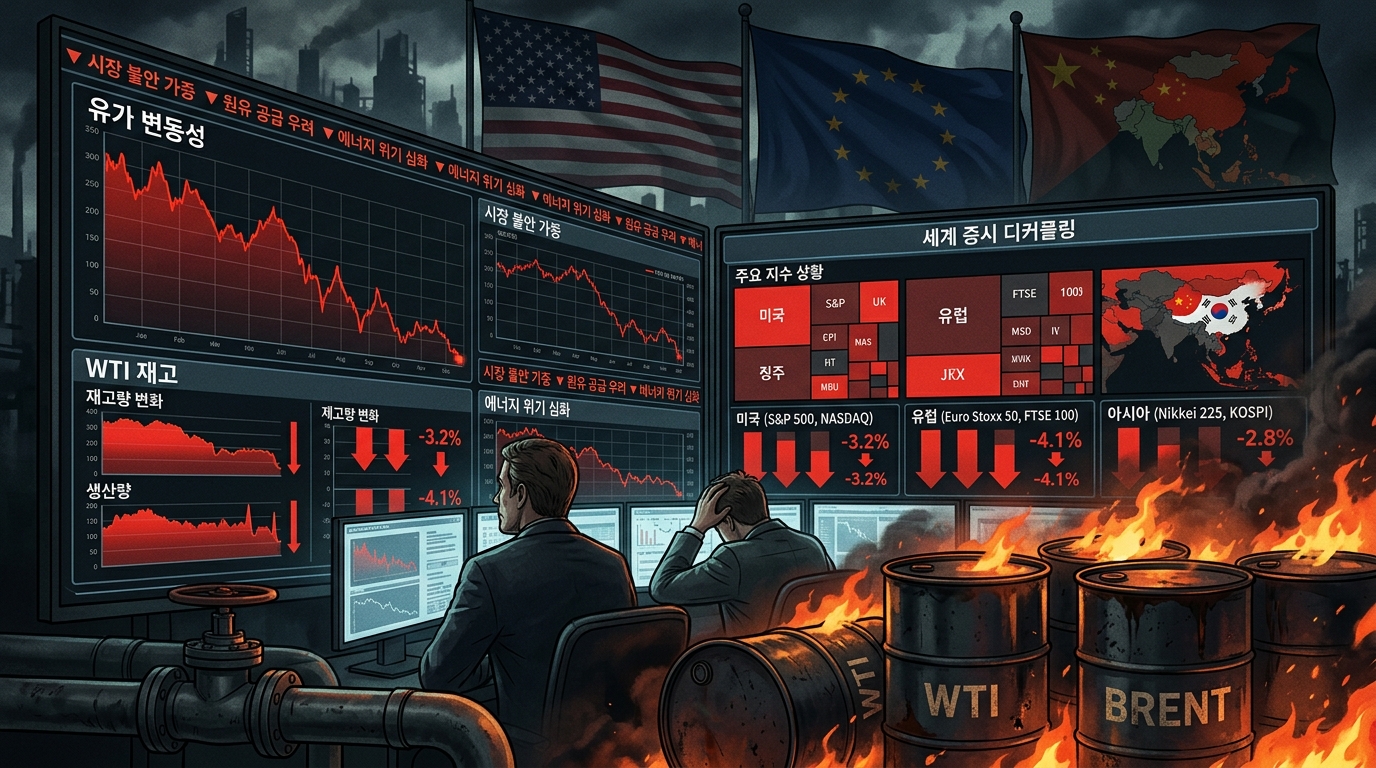
This high oil price pressure is absorbing global liquidity and emerging as a major factor accelerating the fundamental decoupling among three main regions: the US, Europe, and Asia.
As manufacturing PMIs contract globally and concerns arise over prolonged raw material supply chain disruptions, downward valuation adjustment pressures on major global stock indices are intensifying.
Market Overview
As of intraday trading on September 4, 2026 (provisional), West Texas Intermediate (WTI) crude oil prices are showing strong downward rigidity in the mid-$90s per barrel range.
The biggest driver supporting prices is the escalation of military tensions between the US and Iran, which has caused the number of tankers transiting the Strait of Hormuz to plunge by about 70% compared to average years.
Concurrently, US commercial crude inventories fell far beyond the market's expected draw of 400,000 barrels, tightening physical supply and demand.
This supply crunch is dealing a direct inflationary blow to Asian and European economies, which are highly reliant on energy imports.
As of the same intraday session (provisional), domestic indices stand at KOSPI 6579.48 and KOSDAQ 790.21, while the Nasdaq in New York is fluctuating around the 26581.22 level.
The USD/KRW exchange rate continues its climb near 1356.30 won, further compounding the burden of import prices.
[Image: /stdaily/uploads/202609/gen_6a99c40b89c6f0.13147271.png]
Financial Analysis
The supply drought in the US energy market is clearly visible in the recently released weekly petroleum supply and demand indicators.
A key feature is that refined products and crude oil inventories are declining simultaneously despite high refinery utilization rates.
| Classification | Recent Figures | Weekly Change | vs. 5-Year Average |
|---|---|---|---|
| Commercial Crude Inventory (ex-SPR) | 424.50 million barrels | -4.45 million barrels | Around +1% |
| Strategic Petroleum Reserve (SPR) | 286.60 million barrels | -3.10 million barrels | Extremely Low (approx. 40% level) |
| Total Gasoline Inventory | 205.70 million barrels | -1.20 million barrels | Around -6% |
| Refinery Utilization Rate | 97.2% | +0.4%p | Very High |
Despite US refiners maximizing utilization to 97.2%, the sharp decline in commercial crude inventories reflects robust exports and tight import channels.
The most concerning aspect is that the SPR, which the US government has used as a tool to control oil prices, is running dry, leaving no cushion in the event of additional supply shocks.
Valuation
Surging energy costs are directly fracturing global stock market valuations and investor sentiment.
According to Daily Stock's proprietary Fear & Greed Index, the KOSPI Fear & Greed Index currently sits in the "Fear" (26.1) territory.
This indicates a rapid cooling of sentiment from the "Neutral" (47) territory seen just a week ago, reflecting preemptive worries over trade balance deterioration caused by high oil prices.
The tech-heavy Nasdaq Fear & Greed Index is also charting a downward path, currently standing in the "Fear" (33) zone.
While it held neutral ground a week ago (55.4) and a month ago (50.7), worries of high oil prices driving bond yields up and prolonging tightening are compressing valuation multiples.
Amid these trends, the decoupling between the US, Europe, and Asia is deepening further due to divergent monetary policies.
The US is holding up relatively well backed by robust domestic energy production, while the European Central Bank (ECB) cannot easily ease policy due to high inflation controls.
In Asia, capital flows are sharply diverging between the People's Bank of China (PBOC) sticking to easing and the Bank of Japan (BOJ) weighing rate hikes.
[Image: /stdaily/uploads/202609/gen_6a99c4162ad568.99695194.png]
Expert & Institutional Analysis
Global investment banks (IBs) and energy analytics firms note that a substantial "geopolitical risk premium" is baked into current oil prices.
Some experts project that if physical blockades in the Strait of Hormuz ease and transit normalizes, oil prices could immediately retract to the $70 range.
However, in the short term, despite US crude production reaching an all-time high of 13.86 million barrels per day, high export volumes make it difficult to build up domestic inventories.
The International Energy Agency (IEA) warns that the high cost of oil imports for Asian countries could squeeze manufacturing margins, eventually dragging down global economic growth over the long run.
Risk Factors
The most critical risk factor is a scenario where localized conflicts in the Middle East escalate into a prolonged full-scale war, completely paralyzing maritime trade routes.
Already, transit restrictions in Hormuz have pushed up charter rates and logistics costs, driving up the prices of other major commodities like copper and aluminum.
If energy-driven commodity inflation prolongs, global Purchasing Managers' Indices (PMI) could slip back into contraction territory.
This could foster stagflation concerns and act as a risk that delays monetary policy pivots by major central banks, including the Federal Reserve.
Investment Perspective
The sharp decline in US crude inventories and near-empty SPR are expected to serve as a solid floor for oil prices for the time being.
Therefore, investors should consider defensive portfolios built around energy-self-sufficient sectors or shipping industries that benefit from rising freight rates.
Conversely, a conservative approach is recommended for manufacturing sectors such as IT hardware and petrochemicals, where margin pressures worsen under high oil prices.
It is advisable to closely monitor relative strength changes among US, European, and Asian indices and maintain a thoroughly diversified asset allocation strategy.
Investor Checklist Q&A
Q1. Why was the decline in US crude inventories so much larger than expected?
A1. Despite US refiners raising utilization rates to 97.2%, robust crude exports to Asia and Europe significantly drained commercial inventories.
Q2. Why is a low Strategic Petroleum Reserve (SPR) bad news for global stock markets?
A2. The SPR is the government's primary card to stabilize markets during price spikes. If this card is depleted, there is no shield to prevent oil price surges when further geopolitical shocks occur, magnifying market anxiety.
Q3. How will oil prices change if tensions in the Strait of Hormuz ease?
A3. If shipping normalizes, the war risk premium of $15 to $20 per barrel that has been supporting prices could quickly evaporate, potentially causing oil prices to fall sharply.
Q4. What is the impact of high oil prices on the local KOSPI market?
A4. Since South Korea relies almost 100% on crude imports, high oil prices lead to trade deficits and squeezed corporate margins. The KOSPI Fear & Greed Index entering the "Fear (26.1)" stage reflects these worries over slowing earnings.
Q5. Which indicators should investors watch most closely moving forward?
A5. Along with the weekly EIA Petroleum Status Report released every Wednesday, investors should check whether global PMIs, which show manufacturing trends, are falling in tandem.