Hello, this is Daily Stock, analyzing the latest trends in the financial market with depth.
Key Summary
- In August, Invesco QQQ Trust (QQQ), the representative Nasdaq 100 ETF in the US, saw a historic record net inflow of $10.9 billion.
- Conversely, massive capital outflows were observed in semiconductor (SMH) and software (IGV) ETFs, highlighting a distinct sector rotation toward mega-cap tech stocks.
- Amid prolonged high-interest rate concerns and Treasury yield volatility, the market appears to be choosing "big tech safe havens" with solid cash flows over individual tech themes.
Current Situation Summary
Recently, a rapid capital relocation within tech stocks has been captured in the global asset market.
In August, net inflows into the Invesco QQQ Trust (QQQ) reached $10.9 billion, more than doubling from July ($4.9 billion) and breaking the record for the largest monthly inflow in history.
At the same time, about $2.8 billion fled from SMH, a leading semiconductor ETF, and approximately $610 million flowed out of IGV, a software ETF.
This phenomenon shows that capital, which had been excessively concentrated in specific themes like semiconductors or AI-dedicated hardware, is now diversifying into the broader Nasdaq 100 mega-caps that have proven earnings and superior cash-generating power.
As of intraday September 2, 2026 (tentative), domestic and foreign stock markets are showing mixed results.
The domestic KOSPI index stands at 6633.52, the KOSDAQ index at 801.53, and the USD/KRW exchange rate is at 1373.00 KRW, maintaining upward pressure on the dollar.
As of intraday September 1 local time (tentative), the US Nasdaq index recorded 26,099.77.
According to Daily Stock's own Fear and Greed Index, which represents investment sentiment, KOSPI is currently in Neutral (45) and Nasdaq is also in Neutral (44.6).
This indicates that the market is in a breathing phase, prioritizing risk management over extreme optimism.
Financial Analysis
The financial fundamentals of the companies constituting the Nasdaq 100 index, which QQQ tracks, remain robust.
Second-quarter earnings of tech sector companies within the S&P 500 and Nasdaq 100 neared historic highs, with most mega-cap growth stocks demonstrating stable earnings stamina.
In particular, the average R&D-to-revenue ratio of companies in QQQ reaches 11.8%, significantly outperforming the S&P 500 average of 9.4%.
| Classification | Key Metrics of Invesco QQQ Trust (QQQ) |
|---|---|
| **Assets Under Management (AUM)** | Approx. $488.9 billion (As of intraday 2026-09-01, tentative) |
| **Past 1-Month (Aug) Inflow** | Approx. $10.9 billion (Historic Record) |
| **SMH (Semiconductor) Aug Outflow** | Approx. $2.8 billion |
| **IGV (Software) Aug Outflow** | Approx. $610 million |
| **R&D-to-Revenue Ratio** | Approx. 11.8% (Outperforming S&P 500 average of 9.4%) |
Such active R&D investments serve as the source of maintaining monopolistic positions in high-growth industries like AI and cloud computing.
Rather than locking up capital in a single industry group such as semiconductor equipment or specific software, the stability of a 'mega-cap' portfolio capable of sustainable investment through its own cash flow has stood out.
Valuation
As of intraday September 1, 2026 (tentative), QQQ's share price fluctuates around $717.12.
The 52-week price range spans from a low of $555.60 to a high of $748.65, currently sitting slightly below its previous peak amid recent tech adjustments.
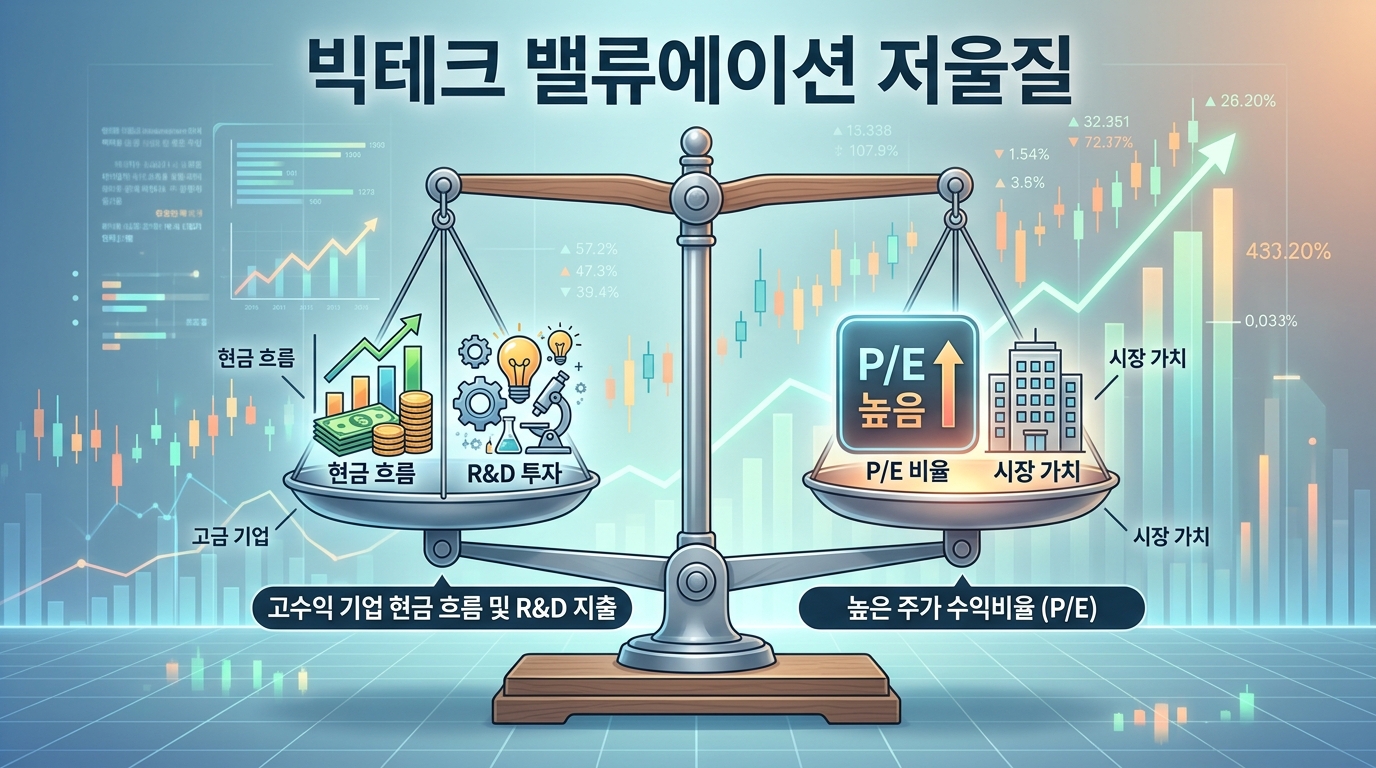
At present, the Price-to-Earnings (P/E) ratio of QQQ is estimated at approximately 34.58x, maintaining the premium typical of growth stocks.
[Image: /stdaily/uploads/202609/gen_6a9767e5092274.48103618.png]
However, unlike the dot-com bubble era where stock prices rose purely on expectations, the cash-generating capacity and operating margins shown by actual mega-cap tech stocks support the multiples to a certain extent.
Nevertheless, strong volatility in the US 10-Year Treasury yield (US10Y) acts as a limiting factor on the valuation ceiling by increasing the discount rate on the future cash flows of growth stocks.
Expert and Institutional Analysis
Wall Street and global investment banks (IBs) are defining the recent capital inflow as a "return to quality in portfolios."
This is a classic "flight to quality growth stocks" phenomenon, where capital previously dispersed across specific themes or high-risk small-to-mid-cap software stocks concentrates into mega-tech firms with verified cash cows.
Major research institutions analyze that "as concerns arose that the actual monetization speed of artificial intelligence (AI) would not keep pace with hardware supply speeds, the market moved first to large platform enterprises."
Indeed, the rapid sell-off in semiconductors (SMH) and the historic flow of capital into QQQ are interpreted as the result of investors building defensive strength ahead of autumn volatility.
Experts point out that while this concentration in mega-caps strengthens the overall market downside support, it could amplify "event risk," shaking the entire market whenever a handful of mega-caps announce earnings.
Risk Factors
The biggest risk factor that investors should pay attention to under current circumstances is the correlation between macroeconomic indicators and tightening monetary policies.
If the US 10-Year Treasury yield rises again or if the pace of inflation cooling falls short of expectations, QQQ, which is heavily populated with high-valuation growth stocks, will face immediate downward pressure on its multiples.
Secondly, there is the controversy over delayed AI monetization and overinvestment in capital expenditures (CapEx).
Although big tech companies are pouring astronomical amounts of money into AI infrastructure, if actual revenue contributions stagnate, investors may become disappointed by the pressure on big tech's margins.
Additionally, antitrust regulatory movements by the US Department of Justice and escalating geopolitical risks could rapidly dampen technology stock sentiment at any time.
Investment Perspective Summary
Market fund flows do not lie, and the $10.9 billion inflow into QQQ recorded in August can be viewed as an attempt by investors to secure both "growth" and "stability" in an uncertain market environment.
The fact that money pulled out of semiconductors and software has dispersed into a wider pool of tech stocks is a positive signal that cools valuation overheating in individual sectors while strengthening the downside support of the Nasdaq.
However, since macroeconomic uncertainties and strict standards regarding AI profitability are expected to persist, approaching from a split-purchase perspective rather than aggressive chasing is considered effective.
Investors should closely monitor changes in individual company guidance and the trend of the 10-Year Treasury yield while practicing risk management.
Investment Checklist
- **Check Monthly Fund Flows**: Track whether the record-breaking inflows into QQQ continue into September or if theme-based rotation begins again.
- **Monitor Treasury Yields**: Check daily trends, considering the impact of the US 10-Year Treasury yield on growth stock multiples.
- **Analyze AI R&D and Profit Margins**: Figure out the CapEx execution level relative to cash assets of the top mega-cap companies with high weights in the index.
- **Utilize the Fear & Greed Index**: Refer to Daily Stock's Nasdaq Fear & Greed Index (currently 44.6, Neutral) to gauge overbought and oversold zones.
- **Prepare for Portfolio Volatility**: Given QQQ's concentration in 100 stocks, build scenarios in advance for expanded volatility during mega-cap earnings season.