[Image: /stdaily/uploads/202609/gen_6a95cf7dc3f136.30563269.png]
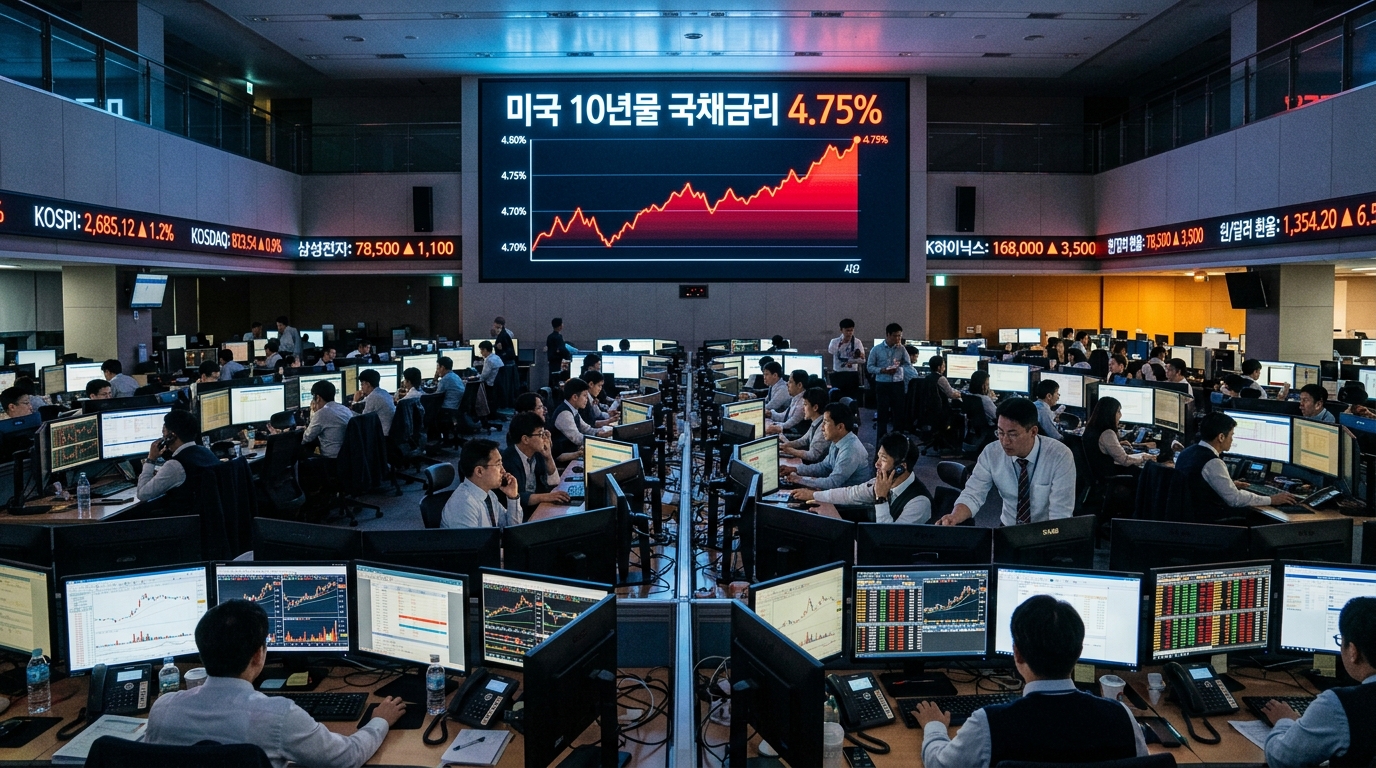
As volatility in global financial markets expands, the US 10-year Treasury yield is once again capturing market attention.
Key Summary
- **Surge in Treasury Yields:** The US 10-year Treasury yield broke above the 4.75% mark during intraday trading, reaching its highest level in about 1 year and 8 months since January 2025.
- **Hawkish Fed Remarks:** At the late August Jackson Hole Symposium, Federal Reserve Chair Kevin Warsh made remarks strongly favoring monetary tightening, triggering the rise in yields.
- **Geopolitical Risks Added:** A military clash between the US and Iran pushed West Texas Intermediate (WTI) crude oil past $90 per barrel, reigniting global inflation concerns.
- **Deepening Tri-Polar Decoupling:** Persistent high interest rates have further clarified the divergence in fundamentals and monetary policies among the US, Europe (with Germany's 10-year yield hitting a 15-year high), and Asia (with Japan's 2-year yield reaching a 31-year high).
Current Situation Summary
The US 10-year Treasury yield reached 4.75% during intraday trading, unleashing very strong upward momentum.
The fuse for this yield surge was the hawkish message delivered by Fed Chair Kevin Warsh at the Jackson Hole Economic Symposium held on August 28.
Warsh strongly hinted at the possibility of additional rate hikes, stating, "We need strong confidence that core inflation is moving down sustainably toward our 2% target, and if not, the Fed still has work to do."
Consequently, the market's implied probability of a 25 basis point rate hike at the September FOMC meeting rose sharply from 35% to over 57%.
Adding to this, a localized military conflict in which the US Navy struck Iranian rocket launchers near the Strait of Hormuz caused international crude oil (WTI) to soar to $91.14 per barrel, amplifying uncertainty over the path of inflation.
In the aftermath, global bond yields are fluctuating wildly, with Germany's 10-year Bund yield surging to 3.29%, marking its highest level in 15 years.
Financial Analysis
Breaking down the components of the US Treasury yield, it consists of real interest rate expectations (TIPS), break-even inflation (BEI), and the term premium.
The current surge in the 10-year yield is driven primarily by oil-induced inflation expectations and a reassessment of the term premium due to the Fed's hawkish stance.
In particular, with the US government's accumulated debt nearing $40 trillion, a persistent 10-year Treasury yield in the mid-4.7% range is highly likely to act as an "interest bomb," significantly increasing the interest burden to cover fiscal deficits.
Although the US Treasury Department is attempting to supply liquidity and stabilize long-term yields by expanding the scale of its long-term Treasury buyback program, the downward pressure on yields appears limited due to concerns over increasing supply of new debt and slowing private demand.
| Key Macroeconomic & Bond Indicators | Intraday Preliminary (2026-09-01) | Recent Trend & Characteristics |
|---|---|---|
| **US 10-Year Treasury Yield** | 4.75% | Highest level since January 2025 |
| **US 2-Year Treasury Yield** | 4.32% ~ 4.34% | Reflecting hawkish Fed stance; increased volatility |
| **Germany 10-Year Yield** | 3.29% | 15-year high following crude oil surge |
| **WTI Crude Oil** | $91.14 per barrel | Surged 3.5% after US-Iran military clash |
| **USD/KRW Exchange Rate** | 1,368.90 KRW (Intraday) | Weakening Won due to strong Dollar pressure |
Valuation
Treasury yields serve as the benchmark for the "Risk-Free Rate" when calculating stock market valuations.
If the US 10-year Treasury yield settles above the 4.75% line, the discount rate on future cash flows increases, putting downward pressure on the fair value of high-multiple tech and growth stocks.
The Nasdaq Index is currently at 26,267.59 points, and Daily Stock's own Nasdaq Fear & Greed Index is registered as 'Neutral (54.4)', showing that investor vigilance remains high.
The KOSPI Index stands at 6,820.02 points and the KOSDAQ at 834.29 points, with the KOSPI Fear & Greed Index positioned at 'Neutral (46.9)', indicating a wait-and-see attitude toward interest rate volatility.
European markets are suffering a double whammy of energy cost surprises and surging bond yields, while Asian markets face intense pressure on foreign exchange markets due to widening interest rate spreads with the US, deepening the regional tri-polar decoupling.
[Image: /stdaily/uploads/202609/gen_6a95cf8776b788.43514180.png]
Expert & Institutional Analysis
Market experts point out that hopes for an "early rate cut pivot" have completely dissolved following the Jackson Hole meeting, and the scenario of "higher for longer with additional hikes" is materializing.
An Jae-kyun, a researcher at Korea Investment & Securities, analyzed that while the US Treasury's long-term buyback program provides some defense, short- to medium-term bonds are highly likely to underperform for the time being due to upward pressure on short-term rates from the Fed's hawkish guidance.
Kim Myung-sil, a researcher at iM Securities, evaluated Warsh's remarks as the most distinct tightening move since taking office. Regardless of whether rates are frozen in September, the card for an additional hike in autumn or winter (October or December) remains active, meaning the bond market will find it difficult to escape downward pressure.
From a technical perspective, global investment expert Michael Kramer raised concerns that because the 10-year Treasury yield broke past 4.74%, a crucial resistance line, a technical path has opened for it to rise further toward the 5.0% level.
On the other hand, US Treasury Secretary Scott Bessent emphasized in a CNBC interview, "The rise in oil prices will not be prolonged, and the US bond market is the safest and most resilient in the world, making it unlikely to transition into an excessive credit crunch or systemic risk."
Risk Factors
- **Rate Hike Confirmation at September FOMC:** With the probability of a rate hike surging on FedWatch, a rate increase in September could deliver a secondary shock to financial markets.
- **Sticky Inflation from Prolonged Oil Prices:** If military standoffs in the Middle East persist and oil prices threaten the $100-per-barrel mark, stagflation concerns stemming from supply chain shocks could arise.
- **Plunge in Emerging Market Currencies:** High-flying US Treasury yields lead to strong Dollar pressure, causing capital outflow risks and depreciating Asian currencies, including the USD/KRW rate (1,368.90 KRW intraday).
- **US Fiscal Interest Burden Threshold:** If high interest rates around 4.7% persist on the $40 trillion federal debt, it could cause structural cracks in national credit ratings and global funding mechanisms.
Investment Perspective Summary
With the US 10-year Treasury yield at 4.75%, a conservative approach is required rather than aggressive stock purchases or reckless bottom-fishing of long-term bonds.
Until the commodity surge and the direction of the Fed's monetary policy become clear, it may be prudent to maintain a certain level of cash in portfolios while waiting for interest rate upward pressures to ease.
Particularly in a decoupling market where fundamental differentiation between the US, Europe, and Asian stock markets is maximized, allocating assets evenly to defensive value stocks and high-dividend sectors with strong earnings power, rather than high-valuation growth stocks, is advantageous for risk management.
Since both domestic and international Fear & Greed indexes are hovering in neutral territory, investors should guard against emotional trading, observe oil prices and Fed comments step-by-step, and construct scenario-based, split-trading strategies.
Investor Checklist Q&A
Q1. What caused the US 10-year Treasury yield to suddenly break past 4.75%?
A1. It was driven by Fed Chair Kevin Warsh's hawkish remarks at the late August Jackson Hole meeting emphasizing the inflation target, combined with a local military conflict in the Strait of Hormuz that pushed oil prices up, reigniting inflation fears.
Q2. How does rising interest rates negatively affect stock market valuations?
A2. Because the 10-year Treasury yield is used as the risk-free rate, rising yields increase the discount rate used to convert future earnings and dividends into present value, thereby lowering valuations.
Q3. Are bond yields in other major economies like Germany and Japan also rising?
A3. Yes. Geopolitical oil pressures have sparked Eurozone inflation concerns, driving Germany's 10-year yield to a 15-year high of 3.29%, while Japan's 2-year yield has also risen to its highest level in 31 years amid tightening stances.
Q4. Has the US Treasury's bond buyback program failed to stabilize interest rates?
A4. Although the Treasury's buybacks help prevent long-term yields from overshooting, the effect has been short-lived as it is offset by the $40 trillion accumulated national debt issue and concerns over additional year-end Fed hikes.
Q5. How should individual investors allocate assets at this juncture?
A5. Until a yield peak is confirmed, it is better to manage capital in short-term bonds or cash-like assets and approach long-term bonds through split-purchasing. For equities, it is recommended to prepare for volatility by slightly increasing the weight of defensive stocks and dividend-focused assets with solid fundamentals rather than high-valuation big tech growth stocks.