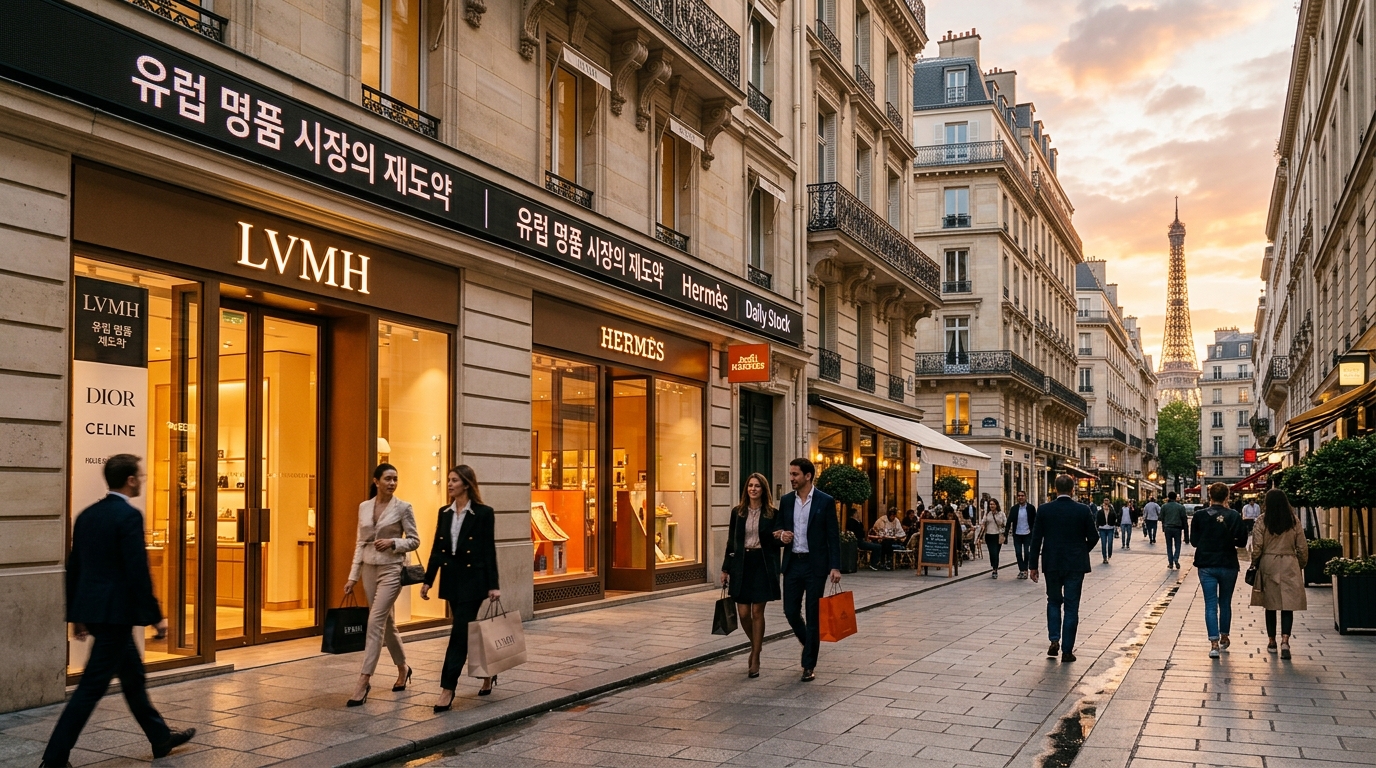
Hello, this is Daily Stock, delivering key trends in the global financial markets.
Key Summary
- **Strong Rebound of the CAC 40 Index**: On August 28, France's CAC 40 index closed at 8,416.00 points, up 1.15% from the previous trading day, driven by a recovery in consumer confidence across Europe and earnings improvements from major luxury companies.
- **Gradual Stabilization of the Luxury Market**: Following the H1 2026 earnings announcements, France's top three luxury conglomerates—LVMH (+2%), Hermès (+6.1%), and Kering (+1%)—are showing gradual sales recovery, seeking an end to the prolonged downturn.
- **Deepening Tri-Polar Global Decoupling**: Unlike the US market, which is racing ahead backed by resilient high-income households, a clear 'fundamental decoupling' is underway, with the Chinese market cooling rapidly due to offshore asset tax audits and the Middle East market stagnant due to geopolitical conflicts.
Current Status Summary
European stock markets are staging a relief rally supported by better-than-expected economic indicators.
On August 28, France's CAC 40 index successfully climbed back, rising 1.15% from the previous trading day to settle at 8,416.00 points.
The Eurozone Consumer Confidence Index came in at -15.5, reaching its highest level since February, and the Services Confidence Index also hit a 7-month high at 5.8, signaling a revival in consumer sentiment.
Additionally, France's Q2 GDP growth rate reached 0.7% year-on-year, matching market expectations and acting as a positive factor for the stock market.
Across global asset markets, the tri-polar decoupling among the US, Europe, and Asia is becoming more pronounced.
While the US maintains robust growth supported by expectations of a Federal Reserve monetary policy pivot and a strong Services PMI (August Services PMI at 56.8), Europe faces potential further rate hike scenarios due to energy price volatility driven by Middle East conflicts and persistent inflationary pressures (France's August CPI at 2.4%).
[Image: /stdaily/uploads/202608/gen_6a9334d66d40f9.11390756.png]
Financial Analysis
As the H1 2026 earnings season wrapped up, the diverging fortunes and resilience of France's leading luxury companies were proven by the numbers.
Despite the prolonged downturn across the broader market, the financial performances of the top three luxury companies showing differentiated fundamentals are as follows:
| Company Name | H1 2026 Revenue | Organic Growth (YoY) | Recurring Operating Margin | Key Earnings Drivers and Characteristics |
|---|---|---|---|---|
| **LVMH** | €38.6 Billion (approx. ₩57.1 Trillion) | +2% | 22.5% | Acceleration in Q2 growth (+3%), recovery in leather goods segment including Dior and Louis Vuitton |
| **Hermès** | €8.2 Billion (approx. ₩12.1 Trillion) | +6.1% | 41.0% | Maintaining exclusivity targeting Ultra High Net Worth (UHNW) individuals, benefiting from strong growth in the US market |
| **Kering** | €7.22 Billion (approx. ₩10.7 Trillion) | +1% (comparable) | 12.8% | First quarterly growth in 3 years (Q2 +2%), signs of gradual performance normalization for Gucci |
Excluding the impact of the Middle East conflict, LVMH accelerated its pace of recovery, with its Q2 revenue growth rate nearing 4%.
Gucci, the core brand of Kering, narrowed its H1 revenue decline to just 2%, showing significant improvement compared to 2025 (-19%) and Q1 2026 (-8%).
Hermès demonstrated the unwavering power of the ultra-high-end segment by maintaining an operating margin of 41% in H1.
This contrasts sharply with mass-market oriented brands that have aggressively expanded volume targeting mid-to-low tier consumers.
Valuation
After undergoing an intense correction over the past two years, the European luxury sector is considered to be entering a range where undervalued appeal is gradually emerging.
Since the end of 2022, when the post-pandemic revenge shopping boom ended, the combined market capitalization of LVMH and Kering had evaporated by more than €100 billion from its peak.
As a result, downside rigidity in valuation is strengthening in the phase of earnings normalization.
Technically, the fact that France's CAC 40 index has formed a strong support line around the €8,400 to €8,500 level is also positive.
On the other hand, compared to US big tech or Asian growth stocks in India, the relative strength of the Eurozone luxury sector remains near its historical average lows.
However, as the separation of winners and losers based on value-for-money has concluded, the potential for multiple re-rating of top-tier brands holding monopoly power is opening up.
[Image: /stdaily/uploads/202608/gen_6a9334e1eecd24.48908657.png]
Expert and Institutional Analysis
Global financial institutions analyze that the European luxury market is moving past the "contraction" phase and attempting to improve its structure into a phase of "caution and stabilization."
At its 2026 European Luxury Conference, Morgan Stanley projected that the global luxury market growth rate would remain at a conservative annual rate of 2.5%, but structural margin deterioration would halt.
BNP Paribas forecast that despite currency headwinds and tariff barriers, the overall luxury market could recover to an annual organic growth rate of around 6% in 2026.
Experts emphasize that consumer trends are shifting away from pure price hike strategies toward "post-materialism," which focuses on durability and collectible value.
In fact, while the luxury repair and maintenance market is growing rapidly at an annual average of 17.9%, brands that rely on indiscriminate discounting or volume dumping are losing their footing.
At the same time, technology-integrated luxury products are emerging as new alternatives, as seen in EssilorLuxottica—which evolved from a traditional eyewear maker into a smart-glass innovator—jumping 3.1% following its share buyback announcement.
Risk Factors
- **Tax Authority Backlash in China and Domestic Slowdown**: As the Chinese government strengthens tax audits on overseas assets and offshore investment income of the wealthy, capital inflows have slowed sharply. In July, sales of 25 major luxury brands in China fell by more than 10%, weighing on the "U-shaped recovery."
- **Ongoing Geopolitical Crisis in the Middle East**: The conflicts in the Middle East, triggered by Israel-Iran proxy actions, have caused local brick-and-mortar store sales to plunge by 30% to as much as 70% and serve as a primary reason for the drop in European tourist inflows.
- **Raw Materials and Supply Chain Risks**: Industrial raw material prices are soaring, with LME copper surpassing $14,000 per ton, and persistent high oil prices (Brent crude at around $89/barrel, WTI around $82/barrel) are adding pressure by raising logistics and production costs.
[Image: /stdaily/uploads/202608/gen_6a9334ed069778.51960936.png]
Investment Outlook Summary
In conclusion, current European luxury consumption trends serve as a miniature version of the global tri-polar decoupling.
A complex scenario is unfolding where the US drives strong consumption growth and Europe supports it with economic stabilization, while China's tax risks and Middle East conflicts exert downward pressure.
At this point, rather than premature optimism, a conservative approach focused on top-tier players with excellent brand credibility and margin defense capabilities appears more favorable.
Overall market sentiment remains heavily in wait-and-see mode.
Indeed, according to the Fear and Greed Index compiled by Daily Stock, the current KOSPI Fear and Greed Index stands at 46.6 (compared to 49.6 a week ago), staying in neutral territory.
Furthermore, the NASDAQ Fear and Greed Index also points to a thoroughly neutral flow at 54.4 (compared to 54.5 a week ago), indicating that global investors are cautiously monitoring macroeconomic events.
Investor Checklist Q&A
Q1. Why is Hermès' performance overwhelmingly stronger than other luxury companies?
A1. This is because Hermès has avoided mid-to-low mass expansion strategies and strictly maintained a limited volume and exclusive distribution structure targeting UHNW individuals.
It was less affected by the middle-class consumption slowdown and showed solid demand, with its growth rate in the US market reaching 17%.
Q2. What is the specific impact of China's tightened taxation on offshore assets on luxury firms?
A2. As the Chinese government tightens regulations on offshore assets and capital outflows of the wealthy, top-tier consumers are cutting back significantly on spending.
Consequently, sales of 25 major brands in China plunged by an average of more than 10% in July, blurring the visibility of recovery.
Q3. Will the improved Eurozone consumer confidence be a permanent positive for luxury stocks?
A3. While it is an indicator supporting the short-term economic bottoming, a complete recovery of the luxury market requires tourist inflows and easing currency headwinds.
It is safer to interpret this as a transitional phenomenon shifting from a liquidity-driven market to a fundamental-driven market.
Q4. When is the turnaround for Kering Group and Gucci expected?
A4. Gucci managed its H1 revenue decline to -2%, suggesting it is passing through the worst of the tunnel.
The key lies in whether new products from the new management and creative director successfully settle into stores during the second half of the year and beyond.
Q5. How does the European interest rate environment (ECB policy) affect luxury companies' financing?
A5. Currently, the ECB benchmark rate stands at 2.25%, but due to inflation pressures from the Middle East, there is a 98% probability of an increase to 2.50% at the September 9 meeting.
If high interest rates persist, it could not only increase borrowing costs but also slow down the purchasing power of general luxury consumers who rely on installment purchases.
---