Hello, this is the Daily Stock blog.
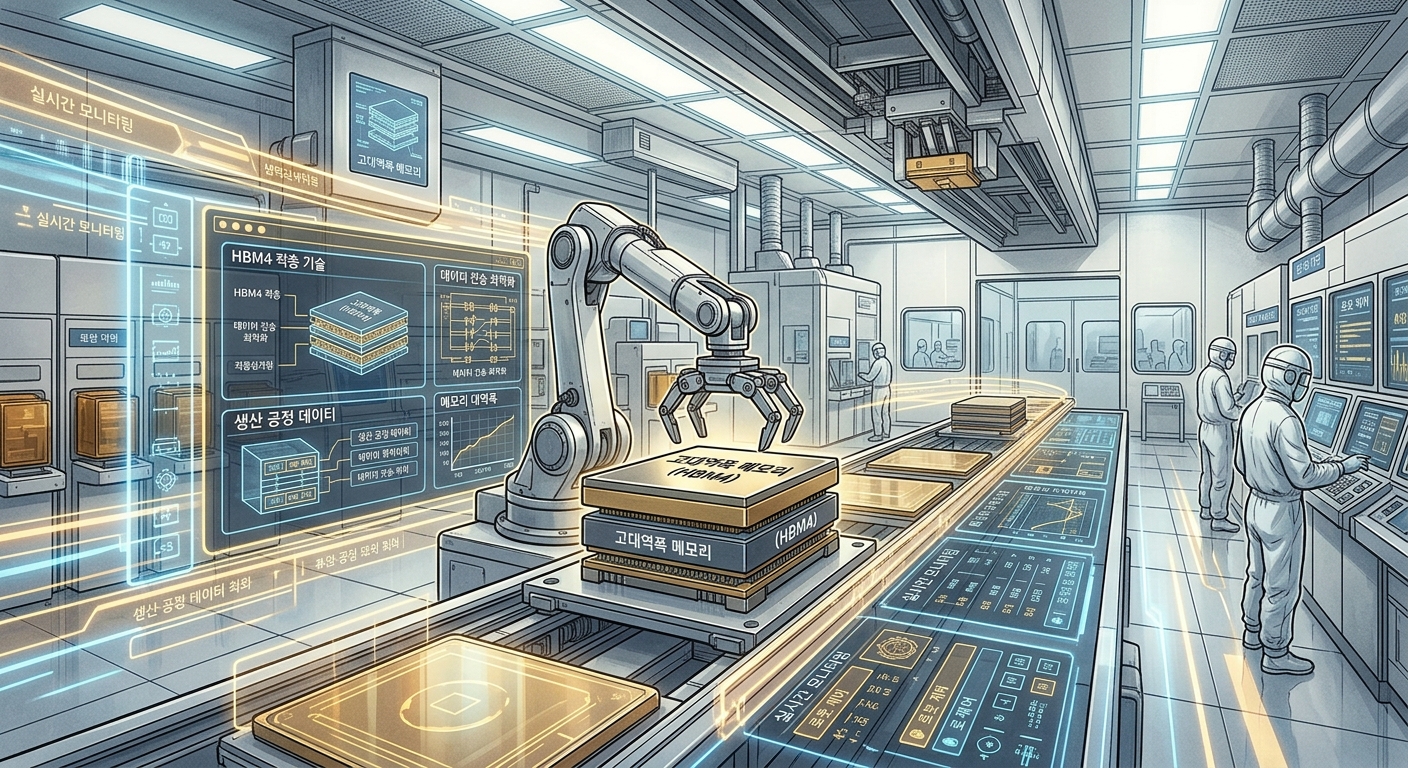
With the global artificial intelligence (AI) semiconductor market heating up, today we take a close look at SK Hynix's High Bandwidth Memory (HBM) shipment status and its next-generation production base strategy.
[Image: /stdaily/uploads/202608/gen_6a93d559c1b9a9.35191606.png]
Executive Summary
- **Groundbreaking of Indiana Fab in the U.S.**: SK Hynix has invested approximately $4 billion to break ground on its Indiana fab, the first HBM production base in the U.S., targeting mass production in the second half of 2029.
- **HBM4 Supply Chain Optimization Scenario**: In response to changes in Nvidia's supply-demand strategy, the company is flexibly expanding the proportion of 8-layer product supply alongside 12-layer products in its 6th-generation HBM4 shipments in the second half.
- **Record-High Financial Results**: The company proved its unrivaled cash-generating ability by recording sales of 79.3 trillion KRW and an operating profit of 60.5 trillion KRW in the second quarter of 2026.
- **Advancing Technological Leadership**: At Hot Chips 2026, the company shared the progress of its 16-layer qualification process, raising the possibility of maintaining a super-gap by developing hybrid bonding technology that supports 20 layers or more.
- **Intensifying Competition**: Risks remain, including Samsung Electronics' pursuit of market share in next-generation HBM4 and macro tariff concerns arising from U.S.-China trade tensions.
Current Status Summary
On August 27, 2026 (local time), SK Hynix successfully held a groundbreaking ceremony for its advanced HBM advanced packaging production base in West Lafayette, Indiana, USA.
The Indiana fab plans to complete the construction of its post-processing cleanroom by October 2028 and start mass-producing cutting-edge, next-generation HBM products in the second half of 2029.
Looking at the internal flow of the supply chain, the shipment portion of the 6th-generation HBM4 product family is being adjusted in accordance with recent changes in the supply-demand strategy of its major customer, Nvidia.
To align with Nvidia's goal of securing thermal and system stability, the supply plan is being flexibly revised to gradually increase the share of 8-layer shipments over the existing 12-layer-focused supply.
Financial Analysis
Driven by the surging demand for AI memory chips in the first half of 2026, SK Hynix is breaking its cumulative earnings record, achieving its highest performance since inception.
In the second-quarter results announced at the end of July, the company set an astonishing record, exceeding a quarterly operating profit of 60 trillion KRW for the first time in history.
| Assessment Item | Q2 2026 Results | Q1 2026 Results | 2026 Annual Outlook (Consensus) |
|---|---|---|---|
| **Revenue** | 79.3187 trillion KRW | 52.5763 trillion KRW | 230.2000 trillion KRW |
| **Operating Profit** | 60.5426 trillion KRW | 37.6103 trillion KRW | 170.0770 trillion KRW |
| **Net Income** | 93.9226 trillion KRW | 40.3459 trillion KRW | 134.3500 trillion KRW |
| **Operating Margin** | 76.3% | 71.5% | 73.9% |
Additionally, backed by the massive facility funds secured through its listing of Nasdaq American Depositary Receipts (ADRs) completed in July, the company has secured the financial strength to expand global infrastructure without financial strain.
Valuation
Despite strong fundamental improvements, SK Hynix is currently undergoing a stock price correction due to short-term macroeconomic uncertainties.
As of August 30, 2026 (Sunday), the daily closing price is unconfirmed (latest business day confirmed value applied), but based on the current stock price, the 12-month forward Price-to-Book (P/B) ratio is approximately 2.1x, and the Price-to-Earnings (P/E) ratio is around 4.1x, highlighting its valuation appeal.
Management established a defense line for shareholder value by announcing a proactive return policy to use more than 50% of cumulative free cash flow (FCF) for shareholder returns.
This scenario is supported by the fact that long-term agreement (LTA) contracts make up more than half of its memory supply agreements, dramatically improving earnings defense compared to past cycles.
[Image: /stdaily/uploads/202608/gen_6a93d563ee6a15.79763584.png]
Expert & Institutional Analysis
Semiconductor expert groups continue to give favorable reviews to SK Hynix's unrivaled stacking design and packaging integration technology.
According to disclosures at the Hot Chips 2026 symposium, the company is currently fast-tracking the customer qualification process for its 16-layer HBM products.
Furthermore, the company actively adopted 'hybrid bonding' technology, which is essential for mass-producing ultra-high stack memory of 20 layers or more, improving thermal resistance by 35% compared to before.
Domestic and foreign research institutions, including Mirae Asset Securities, forecast that SK Hynix will continue to benefit by securing a dominant share in the memory supply chain for Nvidia's next-generation 'Vera-Rubin' accelerators.
Risk Factors
The most immediate risk is the rapid pace of second-place competitor Samsung Electronics in chasing next-generation HBM4 standards and the potential scenario of market share erosion.
Global investment bank UBS warned of intensifying competition, suggesting that Samsung Electronics could capture up to around 41% of the HBM4 market in the future based on its capacity expansion speed.
Geopolitical risks are also rising; the Trump administration's pressure to induce domestic production and policies reviewing additional tariffs on imported semiconductors and components remain key uncertainties.
In addition, there are market anxieties that the cycle itself could peak out if the actual return on investment (ROI) for tech giants' massive AI infrastructure spending slows down.
Investment Outlook Summary
Regardless of short-term market concerns, SK Hynix is visibly demonstrating its differentiated packaging technology and record-high cash-generating capabilities.
By breaking ground on its packaging fab in Indiana, USA, the company has bypassed geopolitical hurdles and achieved further diversification of its global supply chain hubs.
However, it is a time for paced investing while closely monitoring the supply-demand dynamics resulting from competitors' (including Samsung Electronics) entry into the HBM4 market and potential changes in Nvidia's order allocation scenarios.
Investor Checkpoint Q&A
Q1. What is the primary purpose of establishing the packaging plant in Indiana, USA?
- A1. The purpose is to perform final back-end packaging processes for next-generation HBM products locally in North America, close to major customers like Nvidia, to shorten physical distance and minimize trade tariff risks by participating in the U.S. government's domestic-centric supply chain restructuring.
Q2. Why is HBM4 shipment moving toward a higher proportion of 8-layer products, contrary to original expectations?
- A2. This aligns with Nvidia's flexibility strategy to manufacture complete AI chips in diverse lineups, while also addressing thermal accumulation issues that are more likely to occur as stack levels become extremely high.
Q3. There are reports that Samsung Electronics will overtake the next-generation market. What is the reality?
- A3. Samsung Electronics has publicly declared a market share rebound by integrating its 1c nano-process shrinkage and its comprehensive in-house device manufacturer (IDM) capabilities. The future market positions of both companies will be determined by the timing of mass production qualification with customers and their volume absorption capacity.
Q4. Why is stock price volatility expanding despite generating record-high operating profits?
- A4. This is the result of selling pressure driven by short-term 'peak-out' concerns that accelerator investments have hit a peak, alongside anxieties that general-purpose DRAM prices may enter a cooling period.
Q5. What is the current market situation based on the Daily Stock Fear & Greed Index?
- A5. As of August 30, 2026, the KOSPI Fear & Greed Index stands at 46.6 (Neutral), and the Nasdaq Fear & Greed Index stands at 54.4 (Neutral). Rather than overheated greed or panic selling, market participants are taking a wait-and-see stance, cautiously observing economic and corporate supply-demand indicators.