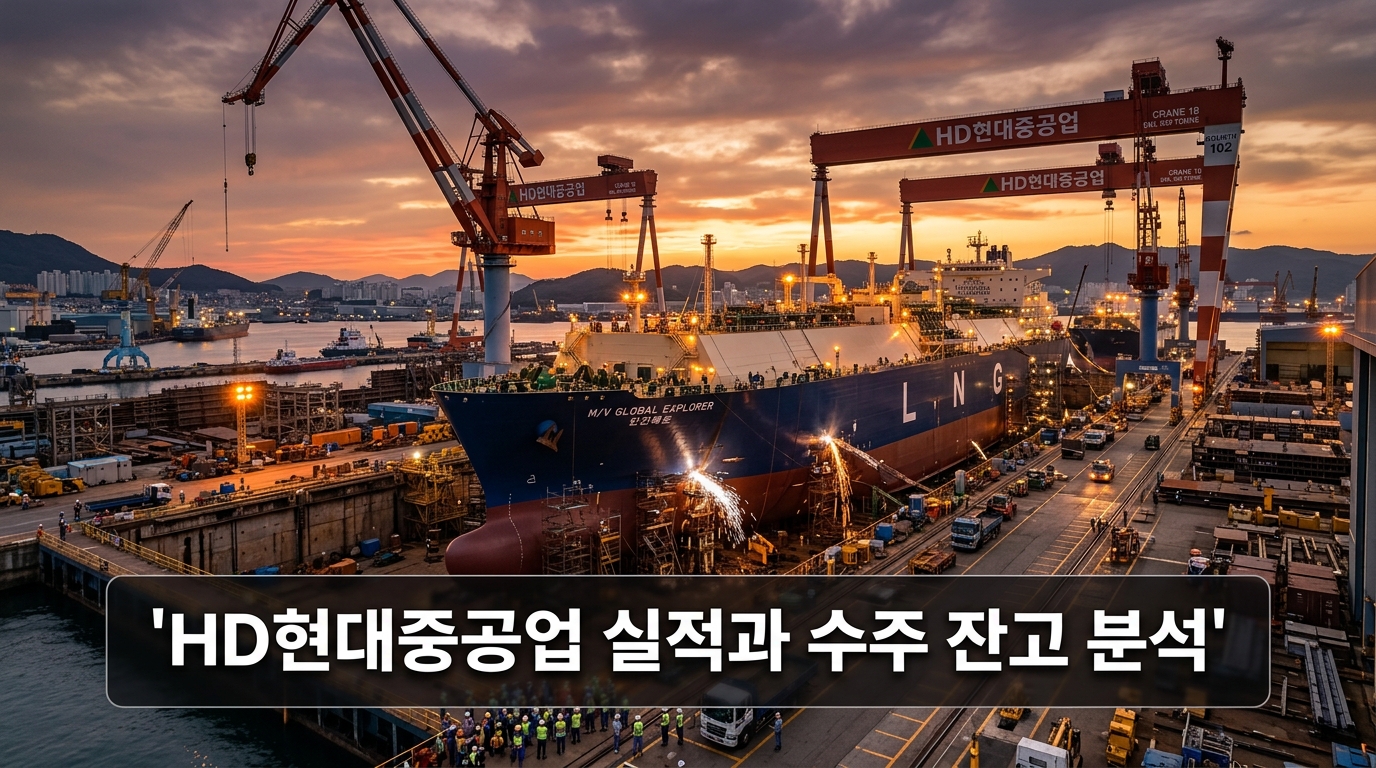
Hello. This is Daily Stock.
Today, we provide an in-depth analysis of the order backlog and second-half earnings outlook for HD Hyundai Heavy Industries (329180), which has proven its earnings resilience by achieving a quarterly operating profit of 1 trillion won for the first time in its history amid the global shipbuilding supercycle.
[Image: /stdaily/uploads/202608/gen_6a8d3dc643b6b2.51186411.png]
Executive Summary
Driven by the expansion of gas carrier construction—primarily gas ships—and the strong performance of its high-margin engine business division, HD Hyundai Heavy Industries achieved a historic quarterly operating profit milestone of 1 trillion won in Q2 2026.
The company has secured an overwhelming order backlog worth USD 60.9 billion on a delivery basis, securing approximately 3.5 years of stable work.
Beyond simple shipbuilding, the company is diversifying its portfolio by expanding the supply of medium-speed engines for AI data center emergency power generation, enhancing mid-to-long-term earnings visibility.
Market Overview
On August 25, 2026, the KOSPI closed at 6,742.74 points and the USD/KRW exchange rate recorded 1,386.10 won, reflecting ongoing macroeconomic volatility.
According to Daily Stock's proprietary Fear & Greed Index, the KOSPI Fear & Greed Index is in the Neutral territory (51.5), and the Nasdaq Fear & Greed Index also remains in the Neutral zone (55).
On this day, HD Hyundai Heavy Industries' share price closed at 453,500 won, down 2,000 won (-0.44%) from the previous day, undergoing a period of correction following a long-term surge.
At the group level, the total order backlog as of the end of June reached 111.4414 trillion won, surpassing 110 trillion won for the first time in history, proving robust standby demand.
[Image: /stdaily/uploads/202608/gen_6a8d3dd1c39128.01409993.png]
Financial Analysis
Consolidated revenue for Q2 2026 reached 6.3322 trillion won (+52.7% YoY), and operating profit recorded 1.0399 trillion won (+120.6% YoY).
As past low-price orders cleared out and high-value gas carriers such as LNG carriers and LPG/VLACs accounted for over 70% of revenue, the shipbuilding division's operating margin surged to 17.1%.
| Category | Q2 2026 Performance | Year-on-Year (YoY) | Key Features & Notes |
|---|---|---|---|
| **Consolidated Revenue** | 6.3322 trillion KRW | +52.7% | Increase in working days and integration synergy reflection |
| **Consolidated Operating Profit** | 1.0399 trillion KRW | +120.6% | Earnings surprise, surpassing 1 trillion KRW quarterly for the first time |
| **Shipbuilding Operating Profit** | 851.2 billion KRW | - | Achieved merchant vessel operating profit margin (OPM) of 17.8% |
| **Engine & Machinery Operating Profit** | 236.4 billion KRW | - | Recorded OPM of 24.8%, land-based generator exports surged |
| **Order Backlog** | USD 60.9 billion (Delivery) | - | Secured USD 45.2 billion on a revenue basis |
In particular, the Engine & Machinery division posted a remarkable operating profit margin of 24.8%, buoyed by the increased installation of eco-friendly dual-fuel (D/F) engines and the export of power generation equipment to land-based US data centers (securing a 627.1 billion won contract with AEG).
Valuation
The current stock price has corrected by approximately 41% from its 52-week high of 765,000 won, easing concerns over excessive valuation overvaluation.
Based on 2026 full-year estimates, the Price-to-Earnings (P/E) ratio stands at approximately 13.8x and the Price-to-Book (P/B) ratio is at 3.9x, maintaining a high technical premium compared to its competitors.
With the company's net cash reportedly reaching approximately 5 trillion won, the activation of structural cash flow leading to the controlling shareholder, HD Korea Shipbuilding & Offshore Engineering, and future expansions in shareholder returns could serve as factors supporting the valuation floor.
Expert & Institutional Analysis
Securities analysts generally maintain a 'Buy' rating and top pick status on the company, with the average target price forming around 822,409 won.
Many experts note, "This is a stable structure where rising ship prices are reflected over the long term up to 2028 deliveries," pointing to the high possibility of a long-term boom in the industry.
They also analyze that if scenarios such as the advancement of cooperation models with the US defense industry in the second half, visibility in overseas naval vessel orders, and additional expansion of land-based HiMSEN engines materialize, it will serve as a powerful catalyst for a multiple re-rating.
Risk Factors
Labor-Management Conflict: From August 25 to 27, 2026, the Hyundai Heavy Industries labor union initiated a strike vote targeting over 8,000 members, raising concerns about short-term production disruptions.
Potential Slowdown in H2 Order Momentum: Since the company early-achieved over 72.3% of its annual order target in the first half, it plans to maintain a selective order-taking stance in the second half. This could lead to a decrease in nominal order announcements, potentially dampening investor sentiment.
Exchange Rate Volatility: If the current favorable high exchange rate environment of around 1,380 won per USD rapidly normalizes, there is a scenario where profit margins could be partially eroded during the conversion of foreign currency shipbuilding payments.
Investment Perspective
Thanks to the secured 3.5 years of high-priced vessel orders, HD Hyundai Heavy Industries is highly likely to draw an upward earnings trajectory not only in the second half but also for the next several years.
In the short term, the outcome of the collective bargaining agreement between labor and management and the strike vote results may cause volatility, but this could serve as a price correction opportunity rather than damage to fundamentals.
Investors need to respond with a long-term perspective, monitoring the widening eco-friendly vessel technology gap and the expansion of the new growth engine of land-based power engines.
Investor Checklist Q&A
Q1. What is the current order backlog of HD Hyundai Heavy Industries?
A1. It has secured more than 500 vessels, worth approximately USD 60.9 billion on a delivery basis and USD 45.2 billion on a revenue basis, representing about 3.5 years of construction work.
Q2. What was the core driver of the record-high performance in Q2?
A2. The revenue proportion of high-priced gas carriers, such as LNG and LPG ships, exceeded 70%, combined with a 7-8% improvement in production efficiency and favorable currency effects from the high USD/KRW exchange rate.
Q3. How is the company connected to the AI data center theme?
A3. The company's Engine & Machinery division produces medium-speed power generation engines (HiMSEN engines) which are highly sought after as emergency power sources, establishing a new growth engine by signing supply contracts with US big tech infrastructure.
Q4. What caused the recent stock price correction, and what is the current valuation level?
A4. The excessive multiple burden compared to the peak of 765,000 won was resolved, correcting down to the 450,000 won range. At approximately 13.8x estimated 2026 P/E, it presents an attractive entry point after the correction.
Q5. What are the key risk factors investors must monitor in the second half?
A5. The results of the union's strike vote scheduled for three days from August 25 to 27, any sharp drop in the USD/KRW exchange rate, and a slowdown in order momentum due to the transition to selective order-taking.