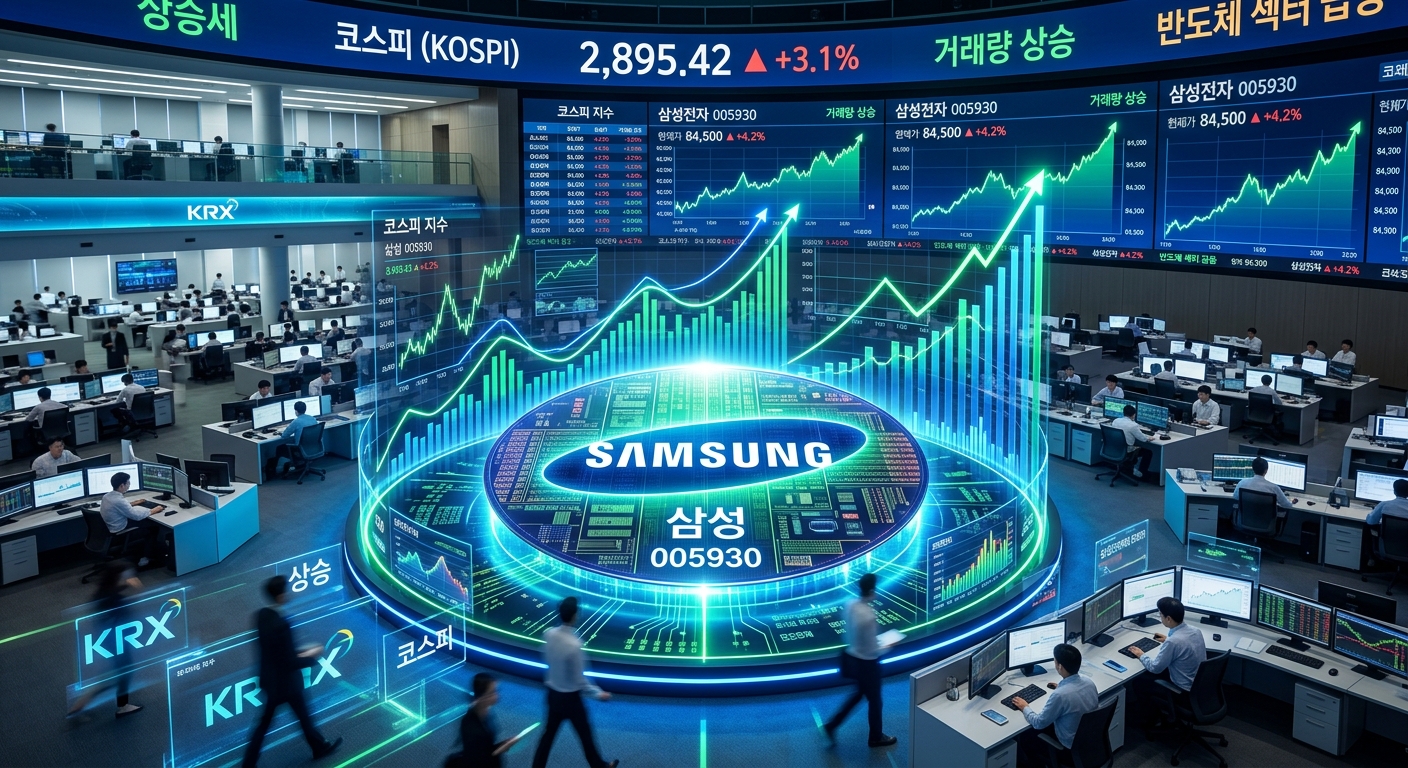
Hello. This is Daily Stock. Today, on August 21, 2026, we take a deep dive into Samsung Electronics' massive shareholder return initiative that has shaken the domestic stock market, as well as the game-changing scenarios in the future memory semiconductor market.
Key Summary
- **Stock Price Trend**: Closed strong on August 21, 2026, at 278,750 KRW (+2.86%)
- **Shareholder Return**: Reports of an imminent announcement of a historic shareholder return package worth at least 100 trillion KRW, including special dividends based on cumulative free cash flow (FCF), raising expectations for a dividend yield in the 7% range.
- **Earnings Performance**: Achieved historic record high Q2 2026 consolidated revenue of 171.5 trillion KRW and operating profit of 89.5 trillion KRW (the DS semiconductor division led 99% of the profits with 89.2 trillion KRW, while the DX finished product division marked its first-ever deficit).
- **Tech Battle**: Accelerating mass production of 6th-generation HBM4 and finalizing a high-priced (mid-$500 range) supply contract with Nvidia; pre-release of the 7th-generation HBM4E.
Current Status Summary
At the market close on August 21, 2026, Samsung Electronics closed at 278,750 KRW, up 7,750 KRW (+2.86%) from the previous trading day.
Foreign buying surged on reports from domestic and foreign media outlets, including Japan's Nikkei, that "Samsung Electronics' board of directors will resolve and announce a 100 trillion KRW shareholder return program—the largest in South Korean corporate history—after the market close on the 21st."
This coupled with SK hynix's announcement of a 40 trillion KRW treasury stock acquisition and retirement on the previous day, serving as the core engine driving the KOSPI index higher through the two semiconductor giants.
The KOSPI Fear and Greed Index is currently at a neutral level (52.1), gradually climbing out of the extreme fear (17.3) phase seen a month ago and finding supply-demand stability.
[Image: /stdaily/uploads/202608/gen_6a87f7bf91ee03.37087588.png]
Financial Analysis
Driven by the unprecedented AI memory boom, Samsung Electronics is on track for historic quarterly performances.
| Classification | Q2 2026 Results | Notes & Detailed Analysis |
|---|---|---|
| **Consolidated Revenue** | 171.5 trillion KRW | Surged 129% YoY, marking an all-time high |
| **Consolidated Operating Profit** | 89.5 trillion KRW | Increased 1,810% YoY, ranking #1 in global tech |
| **DS (Semiconductor) Division** | 89.2 trillion KRW (Op. Profit) | Led 99% of total profits due to record sales of DRAM and NAND |
| **DX (Finished Goods) Division** | -800 billion KRW (Op. Loss) | First-ever deficit in history due to rising component unit costs for home appliances and smartphones |
Although the semiconductor division heavily carried the company in Q2 2026, the transition of the finished goods division into a deficit remains a painful point.
However, as the average selling price (ASP) outlook for legacy DRAM and NAND is revised upward, securities firms are projecting unprecedented annual operating profits of 381 trillion KRW for 2026 and 575 trillion KRW for 2027.
Valuation
As of the close on August 21, 2026, Samsung Electronics' price-to-earnings ratio (PER) stands at approximately 12.49x, remaining undervalued compared to the industry average of 17.60x.
Most importantly, when applying the existing principle of returning 50% of the cumulative free cash flow (FCF) from 2024 to 2026, the surge in FCF this year has secured room for over 100 trillion KRW in residual cash to be returned through dividends.
If a massive cash payout in the form of a special dividend is realized, the dividend yield could exceed 7%, holding strong potential to be revalued as a premier portfolio asset combining both value and growth characteristics.
[Image: /stdaily/uploads/202608/gen_6a87f7c9a62d97.48047694.png]
Analyst & Institutional Perspectives
KB Securities projected that Samsung Electronics could comfortably settle in the 300,000 KRW range in the short term, boosted by prolonged memory supply shortages and highly attractive shareholder return prospects.
In particular, the fact that major US tech firms (hyperscalers) are actively pursuing 5-year long-term agreements (LTAs) to secure stable memory procurement sharply increases earnings visibility.
Major institutions, including Kiwoom Securities, commented, "Since HBM4 (6th gen) requires foundry processes for base die production, Samsung Electronics—as an Integrated Device Manufacturer (IDM) possessing both foundry and memory capabilities—has seized the opportunity to widen the gap with its competitors."
Risk Factors
- **Cost Pressures in Finished Goods (DX)**: Paradoxically, the soaring prices of memory semiconductors like DRAM have driven up component procurement costs for the consumer electronics and smartphone (DX) divisions, creating a 'chipflation' boomerang that eats into profitability.
- **Labor Disputes**: Large-scale rallies led by the DX labor union due to differences in performance incentive structures across divisions are cited as a potential risk for production disruptions.
- **Interest Rate Volatility and Macro Factors**: Concerns over global tech giants adjusting their pace of AI investments due to fluctuations in long-term US Treasury yields could trigger market volatility at any time.
Investment Outlook Summary
Samsung Electronics is pursuing a dual strategy of 'high growth' and 'high dividends' by committing to maximize shareholder value.
If the 100 trillion KRW special dividend scenario materializes and the HBM4 supply pricing negotiations with Nvidia are finalized, a scenario of strong upward pressure along with valuation normalization appears highly viable.
However, whether the DX division can turn a profit and internal labor relations can stabilize remain crucial checkpoints for long-term holding.
Investor Checklist Q&A
Q1. What was the main driver behind today's surge?
A1. Investor sentiment was heavily boosted by reports from foreign media, such as Japan's Nikkei, suggesting that Samsung Electronics' board would announce a '100 trillion KRW shareholder return plan'—the largest in domestic history—after the market close.
Q2. Why is the finished goods division in the red despite record-breaking Q2 earnings?
A2. The surge in semiconductor prices acted as an increase in procurement costs (chipflation) for the DX division, which manufactures finished goods, resulting in a structural contrast that led to an operating loss of 800 billion KRW.
Q3. What is Samsung Electronics' core competitive advantage in the HBM4 market?
A3. Starting from the 6th-generation HBM4, advanced foundry processes are required for base die design and manufacturing. Samsung Electronics is the only Integrated Device Manufacturer (IDM) capable of executing memory production, foundry, and packaging altogether, offering unmatched integrated design efficiency.
Q4. What impact will the special dividend have on the stock price?
A4. If more than 100 trillion KRW of residual FCF is returned to shareholders as dividends, the annual dividend yield could soar above 7%, which is expected to attract strong inflows from foreign and institutional investors.
Q5. What are the downside risks for stock price volatility going forward?
A5. Close monitoring is required for potential slowdowns in AI spending by global big tech firms due to fluctuations in long-term US Treasury yields, as well as temporary production risk concerns from domestic labor disputes.