Hello, this is Daily Stock, delivering deep insights into global macroeconomics and international stock markets.
Summary
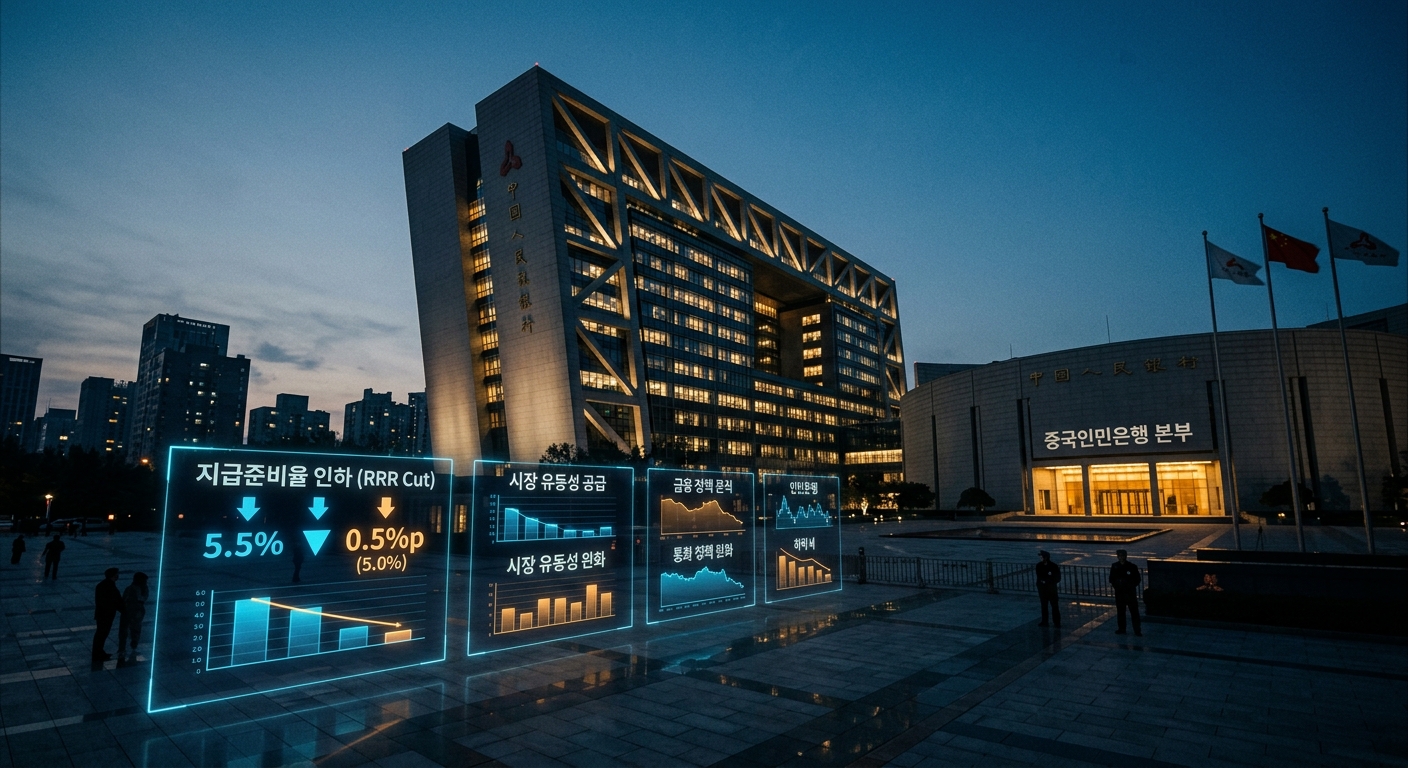
Recently, the market's calculations surrounding the People's Bank of China (PBOC) cutting its reserve requirement ratio (RRR) and launching economic stimulus measures have become increasingly complex.
With the second-quarter economic growth slowing to 4.3%, an RRR cut is drawing attention as a key tool to supply liquidity and support massive government bond issuances.
However, as explicit signals of a cut were omitted from the recently released Q2 Monetary Policy Implementation Report, global markets are closely watching the tri-polar decoupling phase driven by a moderated pace of easing.
[Image: /stdaily/uploads/202608/gen_6a80b78a003ea3.71680403.png]
Current Status Summary
The People's Bank of China (PBOC) has emphasized maintaining a "moderately loose" monetary policy stance in the second half of the year and supplying sufficient market liquidity.
However, in the Q2 Monetary Policy Implementation Report released in mid-August, the direct liquidity prescription phrase "RRR and interest rate cuts" that was previously included was omitted, raising caution in the market.
Although China's Q2 gross domestic product (GDP) growth rate stopped at 4.3%, flashing a red light on achieving its annual target of 4.5–5.0%, authorities are prioritizing structural improvements over indiscriminate money printing.
Under the current US-EU-Asia tri-polar decoupling system, the US Nasdaq remains in a greed phase, testing its policy path, while China is left to carve out its own liquidity supply path due to chronic sluggish domestic demand and a real estate slump.
Financial Analysis
China's key macroeconomic financial indicators and monetary policy standards can be summarized as shown in the table below.
For precise liquidity adjustment, a transition from existing quantitative targets to structural support tools is becoming clear.
| Indicator Category | Current Value (As of 2026-08-16) | Change QoQ | Key Characteristics & Evaluation |
|---|---|---|---|
| **Major Banks Reserve Requirement Ratio (RRR)** | 7.50% | Frozen | The average RRR is around 6.30%, leaving room for further cuts |
| **1-Year Loan Prime Rate (LPR)** | 3.00% | Frozen | The de facto benchmark interest rate maintained at historical lows for 14 consecutive months |
| **5-Year LPR (Mortgage Rate)** | 3.50% | Frozen | Maintained near historical lows to address the real estate market slump |
| **Q2 GDP Growth Rate** | 4.3% (yoy) | -0.7%p (vs 5% in Q1) | Slipped to the lowest level in three and a half years since the aftermath of COVID-19 |
| **July Consumer Price Index (CPI)** | 0.5% (yoy) | Slowdown continues | Deflationary pressures build due to weak domestic demand and falling food prices |
| **Foreign Exchange Reserves** | $3.4188 Trillion | Slight Increase | Influenced by dollar index fluctuations and asset diversification (continued gold purchases) |
Valuation
The delay in the RRR cut and the cautious monetary easing stance are acting as factors limiting the rebound of Chinese asset valuations.
While the bond market remains strong, with China's 10-year government bond yield falling below the 1.70% level for the first time in history, the stock market is showing a limited trend until clear signs of stimulus are confirmed.
On the other hand, the South Korean KOSPI Fear & Greed Index is currently at a neutral (55.6) level, gently recovering from extreme fear (17.5) one week ago and extreme fear (11.6) one month ago.
Compared to the US Nasdaq Fear & Greed Index maintaining a greed (65) state due to the US tech rally, Asian emerging market assets are linked to the effectiveness of China's monetary policy path shift and liquidity supply, showing a differentiation in valuation.
[Image: /stdaily/uploads/202608/gen_6a80b792d154f3.89136428.png]
Expert & Institutional Analysis
Global financial institutions believe that the PBOC is highly likely to implement a "targeted RRR cut" in the third quarter to absorb government bond supply rather than an explicit benchmark rate cut.
Song Yu, chief economist at UBS Securities, noted, "Chinese authorities will increase the intensity of macroeconomic policies in the second half to ensure a successful start to the 15th Five-Year Plan," expecting the RRR cut card to be used to coincide with concentrated periods of government bond issuance.
Conversely, analysts at Nomura Securities drew a line, stating, "As the PBOC prioritizes currency stability and preventing capital outflows, an immediate and sharp interest rate cut is not easy."
Indeed, analysis suggests that the renminbi exchange rate maintaining a stable trend of 6.74 to 6.78 yuan per dollar is due to the PBOC refraining from indiscriminate easing that could widen the interest rate gap.
Risk Factors
First, there is the risk of "credit transmission channel blockages" in the liquidity supply.
Even if the PBOC cuts the RRR to inject money into the market, there is a risk of a "liquidity trap" where liquidity only circulates within the banking system and fails to flow into the real economy due to stagnant household consumer sentiment and a deep slump in the real estate sector.
Second, foreign exchange market volatility driven by the US-China interest rate differential.
Despite uncertainties over the US Federal Reserve's policy path, if external conditions fluctuate, sudden further easing by China could weaken the yuan and revive pressure on capital outflows.
Investment Perspective Summary
At this juncture, the impact of China's RRR cut should be interpreted as a tool for "policy coordination" to support the expansion of government fiscal spending rather than just a short-term positive for the stock market.
Consequently, rather than broad index tracking, investors may find it more advantageous to take a selective approach centered on the five major priority areas of new quality productive forces (advanced technology, green energy, digital economy, etc.) that Chinese authorities are actively supporting.
Furthermore, under the tri-polar decoupling of the US, Europe, and Asia, Asian stock markets are in a complex environment where they must simultaneously consider the pace of China's monetary supply and global commodity price trends, such as oil prices.
Therefore, from a portfolio diversification perspective, it is necessary to closely track correlations between assets and maintain a balanced allocation to hedge volatility between the Korean stock market, which has climbed to neutral (55.6), and the Nasdaq, which is in greed (65).
FAQ
Q1. Why did the PBOC omit signals of an RRR cut from its recent report?
A1. It is because they are taking a cautious stance to defend against rapid capital outflow risks and stabilize the renminbi exchange rate, while focusing funds on specific priority sectors rather than providing indiscriminate liquidity.
Q2. If an RRR cut is implemented, how will it affect the Korean stock market?
A2. Industries with a high share of exports to China, such as chemicals and machinery, may benefit from expectations of a Chinese economic recovery, but this must be accompanied by a recovery in real demand to lead to actual stock price increases.
Q3. What does China's Q2 GDP growth rate of 4.3% imply?
A3. It is the lowest growth rate since COVID-19, proving that weak domestic consumption and a prolonged real estate market slump persist, which increases the necessity for strong additional fiscal and monetary stimulus in the second half.
Q4. What variables should investors focus on in the US-EU-Asia tri-polar decoupling situation?
A4. Investors should continuously check the interest rate cut pace gap among major central banks, global liquidity flows, and whether the PBOC intervenes in the market to coincide with massive Chinese government bond issuances.
Q5. How does the current Daily Stock Fear & Greed Index represent market conditions?
A5. The South Korean KOSPI has calmed down to neutral (55.6) from previous extreme fear, but the US Nasdaq maintains a greed (65) stage, showing a clear temperature difference in investor sentiment between the two markets.