Hello. This is Daily Stock, bringing you a core analysis of Nasdaq technology stocks.
Summary
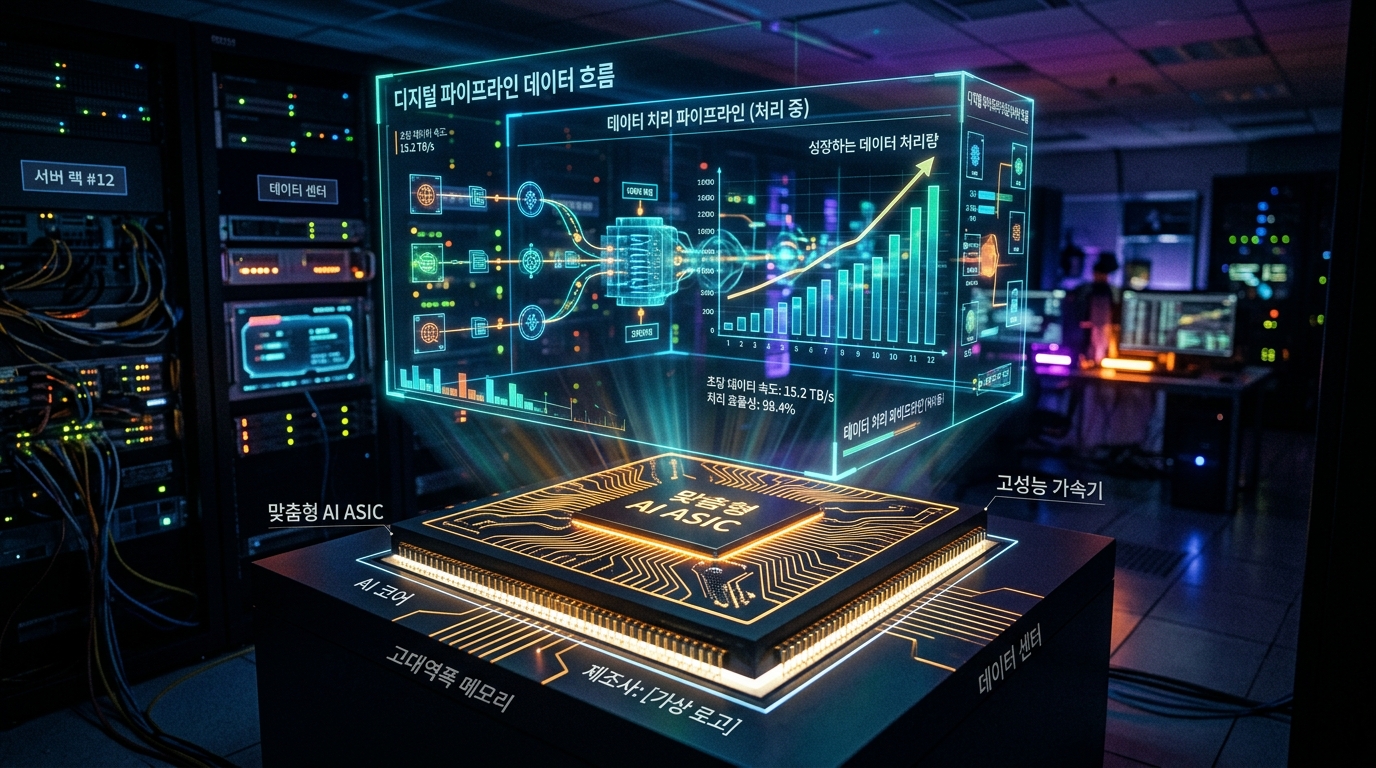
Broadcom (AVGO) is rapidly seizing dominance in the custom ASIC (Application-Specific Integrated Circuit) market, carving out a niche in the general-purpose AI semiconductor market currently monopolized by Nvidia.
While new AI orders reached $30.0 billion in the recent quarter, actual shipments stood at $10.8 billion, demonstrating an overwhelming backlog accumulation where demand exceeds supply by approximately threefold.
The company currently holds an AI-related backlog of $73.0 billion, which serves as a powerful shield securing earnings growth for years to come.
However, the stock has recently undergone a short-term correction due to highlighted contingent liability risks associated with the 'AI XPV Finance Platform' co-established with Apollo, Blackstone, and others.
[Image: /stdaily/uploads/202608/gen_6a7fac9a7b78e2.60505062.png]
Current Status Overview
Broadcom's standing is soaring as global Big Tech companies shift toward developing bespoke silicon to reduce astronomical AI GPU costs.
This is driven by its selection as a key partner for Google's 3nm-based TPU v7 development, Meta's MTIA, and custom inference engine projects for OpenAI and Anthropic.
Broadcom is currently estimated to monopolize about 60% to 70% of the global custom AI accelerator market.
However, despite explosive demand, a bottleneck is observed where order volumes are not immediately translated into actual revenue due to advanced packaging (CoWoS) production quota limits at TSMC.
Consequently, on the New York stock market on August 14, 2026, Broadcom's share price dipped below the $400 mark to around $390.69, exposed to short-term financial platform risks.
Investors have begun focusing not just on simple demand issues, but on supply chain velocity and the stability of financial guarantee structures.
Financial Analysis
Broadcom's fiscal Q2 2026 (quarter ended May) results clearly demonstrated its overwhelming earnings power.
Consolidated revenue for the quarter jumped 48% year-over-year to $22.19 billion, easily beating market consensus.
In particular, AI-related sales accounted for $10.8 billion of semiconductor segment revenue, showing an explosive annual growth rate of 143%.
Adjusted EBITDA reached $15.244 billion, representing a margin of 69% relative to revenue, while free cash flow (FCF) also totaled $10.262 billion (a margin of 46%).
The following table summarizes Broadcom's recent major financial performance and guidelines for the next quarter.
| Metrics | Fiscal Q2 2026 Results | Fiscal Q3 2026 Guidance | YoY Change |
|---|---|---|---|
| **Consolidated Revenue** | $22.19 billion | Approx. $29.4 billion | +48% (Q2) / +84% (Q3 Est.) |
| **AI Semiconductor Revenue** | $10.8 billion | Approx. $16.0 billion | +143% (Q2) / Over +200% (Q3 Est.) |
| **Adjusted EBITDA Margin** | 69% | Approx. 68% | Steady high-margin maintained |
| **Free Cash Flow (FCF)** | $10.262 billion (46% Margin) | - | Proves extreme cash generation power |
| **AI Backlog** | $73.0 billion | - | Scheduled to convert sequentially over 18 months |
[Image: /stdaily/uploads/202608/gen_6a7faca3c5c882.38369592.png]
Valuation
Due to the correction triggered by short-term headwinds, Broadcom's shares are currently trading at a forward price-to-earnings (Forward P/E) ratio of around 36x based on estimated fiscal 2026 earnings.
When applying fiscal 2027 earnings estimates—the year when the custom chip market expansion starts in earnest—the forward P/E drops sharply to under 22x.
This presents strong valuation appeal, considering high annual AI revenue growth of over 40% and stable fixed margins from software services (such as VMware).
In particular, as the stock has approached the lower bound of its historical average multiple range, conditions are set for mid-to-long-term investors to begin buying on dips.
However, a slight dilution in gross margin due to the increasing share of complete system equipment unit sales in the overall product mix is a factor capping the upper multiple.
Nonetheless, the growth rate of absolute operating profit and net profit offsetting this dilution is rapid, keeping the stock in an attractive growth phase.
Expert and Institutional Analysis
Major Wall Street investment banks give high marks to Broadcom's peerless custom chip design capabilities and vertical integration of high-speed networking technology.
JPMorgan analyzed that Broadcom's fiscal 2026 AI-related revenue would exceed initial estimates to reach around $50.0 billion, driven by expanding Google TPU volumes and Meta's adoption of its own accelerators.
Bank of America (BofA) also selected Broadcom as a top pick, stating that custom chips will be the key to significantly reducing the total cost of ownership (TCO) for cloud providers.
However, institutions advised caution regarding the recently raised contingent loss limit (up to $29.0 billion) of the 'XPV Finance Platform' used to support data center leasing dedicated to Anthropic.
Experts diagnose that while such financing structures are not direct liabilities on the balance sheet, they temporarily weigh on investor sentiment, meaning meaningful explanations must follow in future earnings calls.
[Image: /stdaily/uploads/202608/gen_6a7facb01b2247.45835812.png]
Risk Factors
The most immediate risk is indeed the CoWoS packaging supply chain bottleneck at TSMC, the world's leading foundry.
No matter how many orders are received, if they cannot be packaged and shipped on time, revenue recognition velocity can only increase linearly.
Additionally, long-term attempts by mega-cap customers like Google and Meta to diversify with Taiwanese IC design houses like MediaTek to reduce reliance on Broadcom's single supply chain present a potential threat.
In fact, Google is attempting joint development and dual-sourcing with MediaTek for its next-generation TPU v7 design, raising concerns over potential market share dilution.
Lastly is the risk associated with the joint AI financing special purpose vehicle (SPV) with Apollo and Blackstone, which has recently caused controversy.
If an extreme default scenario occurs where Anthropic fails to pay data center lease fees in full, Broadcom—as the ultimate guarantor—must bear up to $29.0 billion in residual value guarantees, which is dampening investor sentiment.
Investment Perspective Summary
With Broadcom facing dual short-term challenges of 'XPV finance noise' and 'supply bottlenecks,' it is difficult to rule out a scenario of heightened short-term stock price volatility.
However, the 3x discrepancy between bookings and shipments is, conversely, a strong indicator proving that a massive pipeline of work is continuously stacked up for years to come.
In the long term, CEO Hock Tan's guidance of achieving $100.0 billion in annual AI semiconductor revenue by 2027 is not an unrealistic figure but is backed by a solid backlog.
Therefore, if this correction is judged to be an excessive de-rating caused by macro and financial structure anxieties, it sits in a sufficiently attractive range to be approached as a mid-to-long-term buy-on-the-dip opportunity.
As the Nasdaq market remains at a greed level (Fear and Greed Index at 65) with warmth returning to tech stocks overall, now is the time to closely track whether Broadcom's fundamentals recover.
Investor Checkpoints Q&A
Q1. When will Broadcom's $73.0 billion AI backlog actually convert to revenue?
A1. The company stated that the current $73.0 billion AI-related backlog is expected to be recognized as revenue sequentially over the next 18 to 24 months.
Q2. Why is there such a large gap between recent quarterly orders ($30.0 billion) and shipments ($10.8 billion)?
A2. This is due to supply bottlenecks where production and delivery times are prolonged because TSMC's CoWoS packaging capacity is limited compared to the global explosion in advanced semiconductor demand.
Q3. What is the reality of the 'XPV Finance Platform' contingent liability risk, and is actual loss highly likely?
A3. It is an equipment lease guarantee for Anthropic's 1GW data center build-out. A guarantee obligation of up to $29.0 billion would trigger only under extreme circumstances where Anthropic goes completely bankrupt with zero recovery value, making the likelihood of actual loss extremely low.
Q4. If general-purpose GPUs like Nvidia's Blackwell chips succeed, will Broadcom's custom ASIC business shrink?
A4. To reduce power consumption and costs for specific fixed workloads, Big Tech companies must increase their share of dedicated ASICs. Therefore, the general-purpose GPU and custom ASIC markets are structured to grow together complementarily.
Q5. How attractive is Broadcom's valuation at the current stock price (based on $390.69)?
A5. Based on fiscal year 2027 estimated earnings per share (EPS), the forward P/E has dropped to around 22x, approaching the lower end of historical valuations, meaning it is evaluated as entering an undervalued zone relative to its long-term growth potential.