Hello, readers.
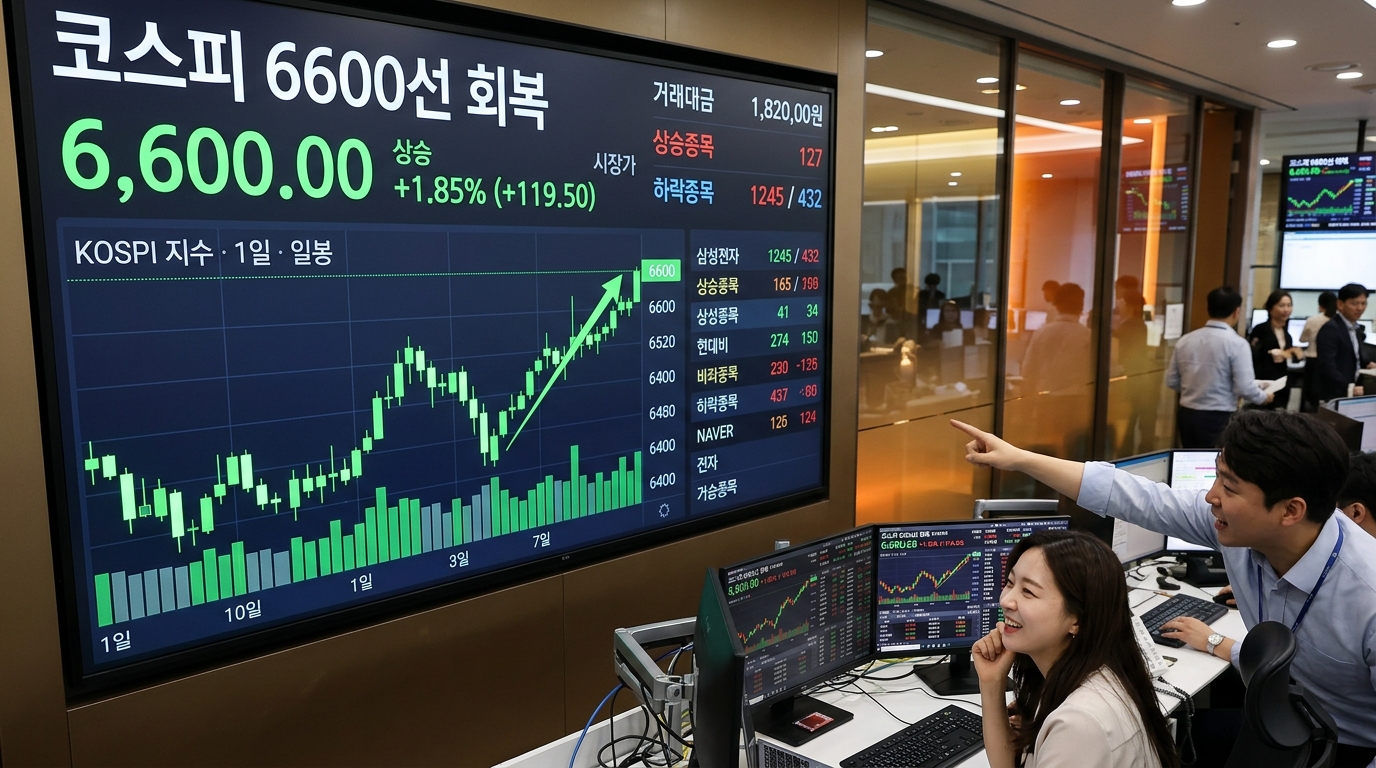
Today at Daily Stock, we take an in-depth look at the KOSPI's recovery toward the 6,600-point mark and examine the foreign capital flow scenarios surrounding the upcoming August options expiration next week.
Key Summary
On August 5, 2026, the KOSPI index closed at 6,598.26, surging 3.76% from the previous trading day, driven by a rally in U.S. semiconductor technology stocks and easing geopolitical tensions in the Middle East.
During intraday trading, the index temporarily surpassed the 6,600 level, triggering a buy-side "sidecar" that temporarily suspended the execution of program buy orders.
Foreign investors led the stock market rally, net purchasing KRW 1.4514 trillion worth of shares in the main board (KOSPI) market in a single day.
However, with the options expiration scheduled for August 13 just a week away, a close scenario analysis is required to determine whether foreign capital flow will settle into a trend-following buying pattern or transition to short-term profit-taking.
[Image: /stdaily/uploads/202608/gen_6a72dff78e3606.61183496.png]
Current Situation Summary
Today, the domestic stock market was strongly driven by favorable winds from the U.S.
Overnight on Wall Street, Palantir's strong earnings outlook sparked a surge in AI-related stocks, and the Philadelphia Semiconductor Index jumped 6.6%, translating into robust buying of large-cap domestic semiconductor stocks.
Additionally, optimistic prospects for negotiations between the U.S. and Iran regarding the opening of the Strait of Hormuz emerged, causing West Texas Intermediate (WTI) crude prices to fall to around $75 per barrel, easing external risk factors.
Consequently, the USD/KRW exchange rate closed at 1,424.60 won, down 8.0 won from the previous trading day, slightly relieving pressure on the weak won.
Semiconductor bellwethers Samsung Electronics and SK Hynix surged over 3% and 6%, respectively, driving up the KOSPI index's growth rate.
Despite the sharp rebound of the index, market participants' sentiment remains cautious.
According to Daily Stock's proprietary Fear & Greed Index, the short-term psychological indicators of the domestic and international stock markets are as follows:
[Table 1: Daily Stock Fear & Greed Index Trend]
| Category | Present (2026-08-05) | 1 Week Ago | 1 Month Ago | 3 Months Ago |
|---|---|---|---|---|
| **KOSPI Fear & Greed Index** | Fear (26.4) | Extreme Fear (12.6) | Extreme Fear (15.1) | Greed (66.3) |
| **NASDAQ Fear & Greed Index** | Neutral (58.2) | Fear (34.7) | Fear (32.5) | Neutral (55.0) |
The KOSPI moved out of the "Extreme Fear (12.6)" phase from a week ago to rise into the "Fear (26.4)" phase, but psychological resistance has not completely dissipated.
As this is a phase where a V-shaped recovery occurs following a sharp index decline, it is interpreted that a temporary supply vacuum and the digestion of short-term profit-taking are occurring concurrently.
Financial Analysis
The overall fundamental health of listed companies in the domestic market remains solid, supported by ongoing investment demand for AI infrastructure and a trade surplus trend.
In particular, export growth centered on the semiconductor sector continues, leading to upward revisions in the operating profit outlooks for large-cap listed companies.
Corporate earnings visibility, which previously weighed on the domestic stock market, has improved significantly due to growing order backlogs for conglomerates in the AI value chain and power infrastructure sectors.
Import and export trends also strongly back the domestic economy's fundamentals, with semiconductors and the trade balance establishing a substantial supply-dominant environment.
However, amid a prolonged high-exchange-rate environment, domestic-focused sectors with high raw material import ratios or heavy dollar-denominated debt still face concerns over compressed operating margins due to rising costs.
Additionally, the slow trickle-down effect from large export companies to small- and mid-caps remains an obstacle to achieving evenly distributed earnings growth among listed firms.
[Image: /stdaily/uploads/202608/gen_6a72e00228df37.69148586.png]
Valuation
The KOSPI's 12-month forward return on equity (ROE) recently rose to approximately 11.9%, showing a distinct structural improvement compared to historical levels.
This figure surpasses the ROE of major Eurozone markets like Germany (around 11.7%), serving as a positive evaluation factor for Korean companies' profitability in valuation assessments.
Currently, the KOSPI's price-to-book ratio (PBR) remains undervalued compared to its historical average, indicating attractive pricing.
The relatively low valuation level compared to major global indexes serves as a primary driver attracting bargain-hunting foreign capital.
Furthermore, the government's recently announced '2026 Tax Reform Bill,' which proposes applying an inheritance and gift tax surcharge on low-PBR listed companies, could prevent artificial stock price depression.
This tax reform move is highly likely to act as a catalyst for ultimate valuation reraising, leading to voluntary shareholder return policies and value-up initiatives by previously neglected undervalued large-cap stocks.
Expert & Institutional Analysis
The financial investment industry is closely watching how foreign investors will behave under different scenarios ahead of the August 13 options expiration.
In particular, the key focus is whether the recent foreign net buying of over KRW 1.4 trillion in the cash market will maintain continuity.
Experts point to the pace of the USD/KRW exchange rate decline and linked plays in the derivatives market as primary sources of volatility.
If the exchange rate continues to decline steadily and a stronger won trend takes hold, a favorable structure is formed where foreigners can simultaneously enjoy capital gains and currency translation gains, encouraging supportive supply.
Conversely, as the August options expiration approaches, a scenario remains open where large program selling for profit-taking emerges following the sharp short-term gains.
If foreigners turn to net sellers in the futures market and liquidate cash hedging positions, volatility in the index's direction is highly likely to occur.
[Table 2: Foreign Capital Flow Scenarios Around the August Options Expiry]
| Scenario | USD/KRW Trend | Major Trading Flows | Expected KOSPI Impact |
|---|---|---|---|
| **Scenario A (Bullish Consolidation)** | Settles below 1,420 won and declines further | Foreigners maintain cash net buying, futures long rollover | Consolidation above 6,600 and secured upside momentum |
| **Scenario B (Expiry Selling Outflow)** | Rebounds above 1,430 won with downward rigidity | Futures turn to net selling, program cash profit-taking | Increased short-term volatility and test of support at 6,400-6,500 |
Risk Factors
The most immediate risk is the uncertain direction and rapid volatility of the USD/KRW exchange rate.
Although the USD/KRW exchange rate has reached the 1,424.60 won level, any shift in global monetary policy or a resurgence in high oil prices could put upward pressure on the exchange rate again, prompting capital flight by foreign investors.
Concerns over a global economic slowdown also remain an underlying risk factor.
If consumer and manufacturing indicators in major countries, including the U.S., deteriorate, the earnings outlooks for major domestic export companies will inevitably face downward revisions, translating directly into valuation burdens on the stock market.
Finally, during the derivatives expiration week, index distortions frequently occur during the liquidation of outstanding futures and options open interest, which can be bloated relative to actual cash market trading volume.
Particularly in large-cap semiconductor and financial sectors where program trading is highly active, unexpected heavy selling could materialize, requiring caution regarding afternoon volatility on the day of expiration.
Investment Perspective Summary
At this juncture, while the KOSPI has laid the groundwork for a strong rebound by attempting to reclaim the 6,600 level, a cautious approach that simultaneously considers psychological resistance and upcoming expiration-day volatility seems prudent.
From a long-term perspective, the earnings improvement trend and valuation attractiveness of large domestic listed companies are expected to act as valid support levels.
However, it is necessary to first verify whether the USD/KRW exchange rate, which acts as the "faucet" for short-term capital flows, settles stably.
We recommend a conditional response strategy that adjusts portfolio volatility by daily monitoring shifts in foreign futures positions and program net buying strength around the options expiration date.
Investor Checklist Q&A
Q1. What is the "Buy Sidecar" that was triggered today?
A1. This is a market stabilization system triggered when the KOSPI 200 futures price rises by 5% or more compared to the base price, and that state lasts for one minute.
It temporarily suspends the execution of program buy orders for five minutes to cool down market overheating.
Q2. When exactly is the August options expiration day, and why is it important?
A2. The August 2026 options expiration day is Thursday, August 13.
It is important because large-scale program trading by foreigners and institutions seeking to settle derivatives positions is concentrated on this day, which can trigger sharp intraday volatility for the index.
Q3. What is the effect of a falling USD/KRW exchange rate on foreign capital flows?
A3. When the USD/KRW exchange rate falls (strengthened won), foreign investors can enjoy currency translation gains alongside stock price appreciation when converted back into dollars.
Therefore, a declining exchange rate trend strongly increases the likelihood of foreign net buying inflows.
Q4. How will the "anti-stock depression bill" in the 2026 Tax Reform Bill affect the stock market?
A4. It is a plan to apply up to a 30% surcharge on stock valuations for inheritance and gift taxes to prevent controlling shareholder families of extremely low-PBR companies from intentionally depressing stock prices.
This blocks incentives for corporate owners to suppress stock prices for corporate succession purposes and encourages voluntary efforts to exit low-PBR ranges (dividends, share buybacks and cancellations, etc.), contributing to overall valuation improvements.
Q5. Why does the Fear & Greed Index remain in the "Fear (26.4)" phase despite the index rebound?
A5. Because the Fear & Greed Index does not simply look at the day's index gain, but comprehensively analyzes short-term volatility, price disparities, and supply-demand momentum.
Until the selling pressure from the recent decline and unstable investor sentiment are completely resolved, investor sentiment on the indicator will recover only gradually despite technical rebounds.