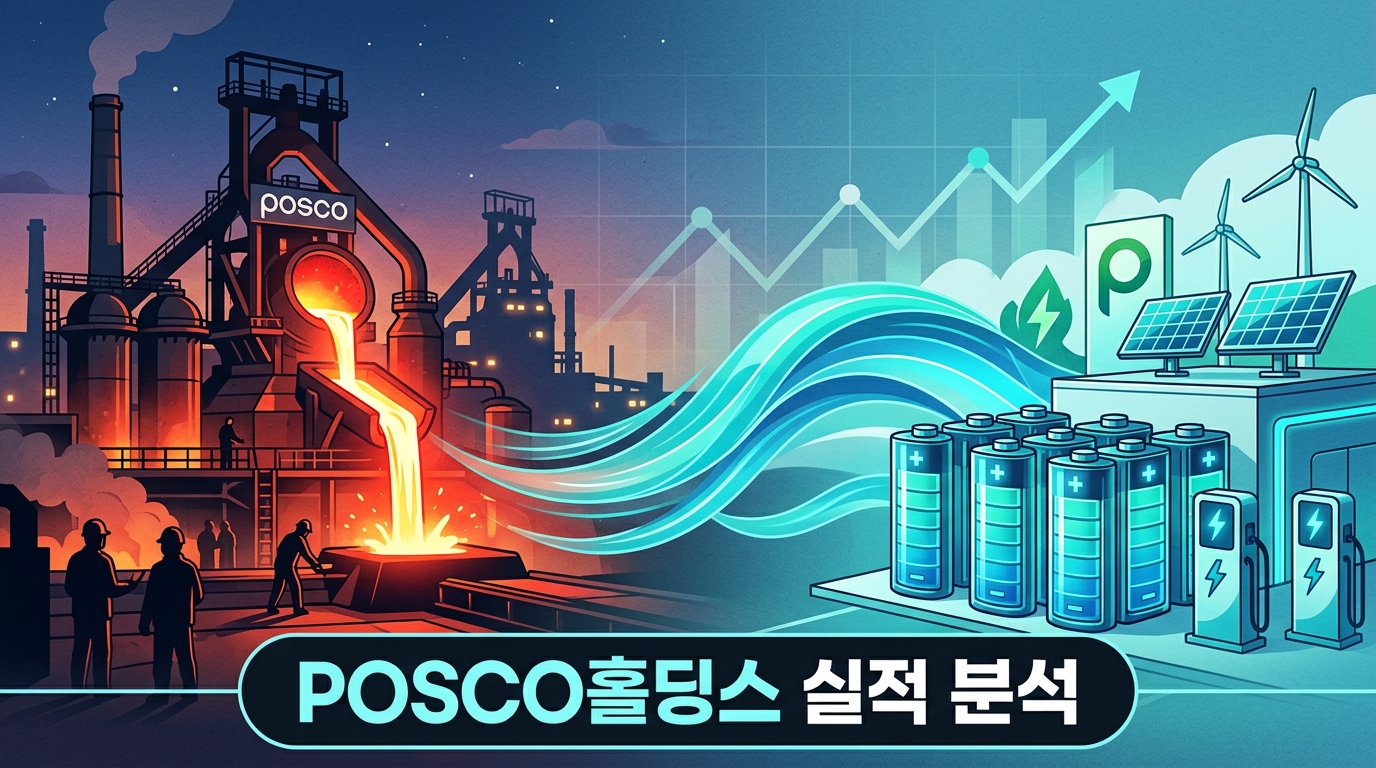
Hello, this is Daily Stock. We examine the latest news and market trends of POSCO Holdings, which is quietly building its path through a comprehensive new business strategy and structural improvements despite global economic recession concerns and a sluggish steel industry.
[Image: /stdaily/uploads/202608/gen_6a703cf9e61465.79896652.png]
Executive Summary
- **Earnings Surprise**: In Q2 2026, POSCO Holdings recorded consolidated revenue of KRW 19.259 trillion and operating profit of KRW 819 billion, comfortably beating market expectations (consensus).
- **New Business Segment Turns Profitable**: Posco Argentina's salt lake lithium plant 1 achieved its first quarterly profit during its operation stabilization phase, helping the entire secondary battery materials division secure a turnaround for the first time in 9 quarters.
- **Mid-to-Long-Term Value-Up Target Raised**: The company has made a voluntary disclosure targeting consolidated revenue of KRW 87.9 trillion and a PBR of 1.0x by 2028, alongside actively returning 35-40% of its adjusted controlling shareholder net income to shareholders.
Market Context
As of August 3, 2026, the KOSPI closed at 6,257.45. According to Daily Stock's proprietary Fear & Greed Index, the KOSPI is currently in the "Extreme Fear (17.8)" zone.
Meanwhile, the Nasdaq closed at 25,373.85, with the Nasdaq Fear & Greed Index hovering at a "Neutral (42.5)" level.
The USD/KRW exchange rate closed at 1,431.20 won, showing a prolonged high-exchange-rate trend. This has exerted pressure on large-cap Korean stocks through foreign capital outflows in cash and futures, as well as higher raw material import costs.
Amid these macroeconomic downward pressures, POSCO Holdings shares closed at KRW 300,000, down 4.00% (KRW 12,500) from the previous trading day.
During the trading session, institutional profit-taking and risk-averse selling pressure concentrated on the stock due to conservative economic forecasts for the steel business and preliminary earnings, strongly testing the KRW 300,000 support level.
Financial Analysis
POSCO Holdings demonstrated even structural improvement across all business divisions, defending against the limitations of traditional manufacturing through a diversified portfolio.
The financial data summarizing the Q2 2026 performance is as follows:
| Category | Q2 2026 Results (Consolidated) | QoQ | YoY | Market Consensus | Performance vs. Consensus |
|---|---|---|---|---|---|
| **Revenue** | KRW 19.259 trillion | Continued growth | +9.7% | KRW 18.0648 trillion | Beated by +6.6% |
| **Operating Profit** | KRW 819.0 billion | +15.9% | +34.9% | KRW 720.0 billion | Beated by +13.8% (Earnings Surprise) |
| **Net Income** | KRW 761.0 billion | +45.6% | +325.0% | - | Significantly exceeded expectations |
The parent steel division saw its carbon steel roll margin (the difference between selling price and raw material cost) expand slightly, delivering a quarterly operating profit of KRW 274 billion, an improvement of 28.5% compared to the previous quarter.
Overseas steel operations also succeeded in defending profit margins by concentrating on cost-innovation efforts to secure margins amid adverse factors such as high exchange rates and logistics volatility.
In particular, subsidiary POSCO International drove the consolidated performance by recording a record-high quarterly operating profit of KRW 429 billion, fueled by the expansion of gas fields in Myanmar and Australia, alongside a strong performance in the Indonesian palm oil business.
This was supported by the recovery of POSCO Future M's capacity utilization rate and the first-ever quarterly profit from Posco Argentina, marking the beginning of tangible bottom-line improvements across the secondary battery materials value chain.
[Image: /stdaily/uploads/202608/gen_6a703d024ac2d1.12457730.png]
Valuation
Based on the closing price of KRW 300,000, POSCO Holdings' market capitalization stands at approximately KRW 23.7725 trillion.
Its current Price-to-Book Ratio (PBR) has fallen to around 0.4x, which places it in an undervalued range near the absolute bottom of its historical valuation band.
The dividend yield exceeds 3.16% per annum, acting as a cushion to attract long-term value-oriented capital that prioritizes dividend appeal.
If the company's targets of KRW 87.9 trillion in consolidated revenue and a shareholder return rate of 35-40% by 2028 are met as promised in the corporate value-up voluntary disclosure, there is significant room for the multiple to normalize toward a PBR of 1.0x in the long run.
Professional & Institutional Analysis
Securities analysts evaluated the strong earnings positively, but also adjusted target prices more realistically to reflect the slowing global macro environment.
Shinhan Securities viewed the profitability of the lithium sector, including the Argentine project, as a significant signal of profit recovery. It maintained its "Buy" rating while lowering its target price to KRW 490,000.
iM Securities also recognized positive factors, such as the parent company's roll margin improvement, but cautiously lowered its target price to KRW 400,000, taking into account China's supply-demand conditions where steel price recovery remains prolonged.
Most analysts agree that the current business cycle is passing through a typical bottom, placing more emphasis on the visible turnaround performance that the lithium and secondary battery businesses will demonstrate in the future rather than downside risks.
Risk Factors
The heaviest constraint is the prolonged slowdown in China's downstream industries, which slows down the recovery of product price spreads and fuels oversupply concerns in the Asian steel market.
In the upcoming third quarter, consolidated operating profit is projected to take a brief breather, staying at around KRW 800 billion due to temporary costs at POSCO International and scheduled regular maintenance at Posco Argentina.
Furthermore, due to the sharp volatility affecting large-cap KOSPI stocks, some financing negotiations—such as the Price Return Swap (PRS) being pursued using affiliate shares—have faced minor delays or adjustments in speed, introducing a variable in financial liquidity management.
Investment Perspective Summary
POSCO Holdings is actively materializing its "Triple Core" new business strategy, which combines its traditional steel competitiveness with strategic resources like lithium and rare earths, alongside LNG energy.
While it is temporarily shaken by the deteriorating macro environment and profit-taking pressure from foreign and institutional investors, the fact that its new businesses have started turning a profit proves that they have moved beyond mere business concepts into the stage of generating real profits.
At a time dominated by supply-demand instability and "Extreme Fear (17.8)" in the KOSPI market, the historically low price range at a PBR of 0.4x, coupled with the mid-to-long-term Value-Up roadmap, could serve as a strong cushion from a long-term dollar-cost averaging perspective.
Daily Stock Q&A
Q1. What was the main driver behind the Q2 2026 earnings surprise?
A1. It was driven by the combination of improved carbon steel roll margins at the parent company, record-high operating profits from POSCO International, and the successful first-quarter turnaround of the Argentine lithium project.
Q2. Will the profitability of the lithium and secondary battery materials segment continue without disruption in Q3?
A2. While the long-term turnaround remains intact, subsidiary profitability may temporarily flatten in Q3 due to scheduled maintenance at the Argentine plant and fixed-cost effects during the early stages of operation.
Q3. What is the core of the mid-to-long-term Value-Up roadmap announced by POSCO Holdings?
A3. The company aims to achieve consolidated revenue of KRW 87.9 trillion and a PBR of 1.0x by 2028, with plans to consistently return 35-40% of adjusted controlling shareholder net income to shareholders.
Q4. There were reports that equity-based financing (such as PRS) is being delayed. Is this a financial risk factor?
A4. Rather than liquidating shares at a discount during periods of extreme stock price volatility, this is a rational adjustment of financial timing to proceed when the market stabilizes.
Q5. Is there a mechanism to provide downside support for the stock price amid economic slowdown risks?
A5. Downside support is highlighted by the fact that the PBR is near its historical low of around 0.4x, and a stable annual dividend yield in the 3% range is maintained, even amid the market's "Extreme Fear (17.8)" sentiment.